
The Scream of Edvard Munch: A Masterpiece of Expressionism
The Scream of Edvard Munch: A Masterpiece of Expressionism
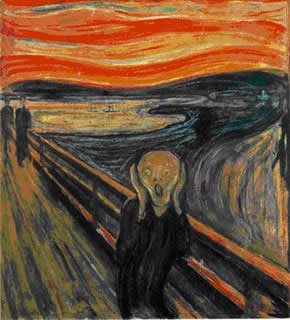
The Scream is one of the most famous and iconic paintings by Norwegian artist Edvard Munch. Created in 1893, this expressionist masterpiece depicts a androgynous figure screaming in despair against a backdrop of a red blood sky.
The painting is known for its intense emotional power and its ability to capture the anxiety and existential despair that Munch felt about modern life.
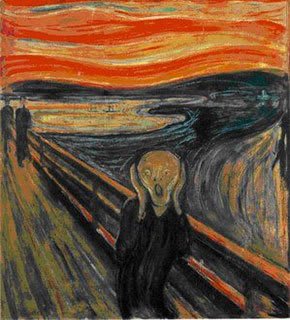
The Scream is a painting by Norwegian artist Edvard Munch, considered a masterpiece and his most famous work.
The painting is the initiator of the expressionist movement, which has Vincent van Gogh as its precursor.
Analysis of the Composition
Intriguing, the painting is intended to create much curiosity and tension about the theme that presents a brilliant composition.
The strong colors and the violent juxtaposition of curved and straight lines converge entirely on the central figure, which screams as if the very medium was expressing emotion through this distorted and disfigured figure.
The famous painting may have been inspired by the eruption of the Vulcão Krakatoa, in 1883, which was described by Munch as "a huge, infinite scream of nature."
The painting presents whirling brushstrokes that appear in the sky and the water, with the same repeated in the lines of the head of the screaming figure, creating a sense of anxiety.
The Hidden Inscription
In the upper left corner of the work, almost imperceptible to the naked eye, lies a phrase written in pencil by Munch himself: "Only a madman could have painted this".
More than a confession, the small annotation made years after the completion of the painting reflects the artist's anguish in the face of the criticisms that questioned his sanity.
Several facts indicate that Munch was aware of the danger that this type of art represents for a neurasthenic humanist like himself.
He soon abandoned the style and rarely or never submitted a figure in the foreground to such radical and systematic distortion.
In the painting, he built a defense, in the form of the perspective of the road and its fence, which preserves a rational world of three dimensions, keeping at a distance the undulation of the curves.
Safe in this rational world, the two men in the distance remain unequivocally masculine.
In the foreground, nature has come close to crossing the fence, close enough to distort the form and personality of the protagonist.
But the fence still protects him from total absorption in subjective madness.
Where the Scream Resounded
The scene that immortalized Munch's despair has a fixed address: the Ekeberg hill, in Oslo.
The wooden path where the figure is located was, at the time, a place of somber contrasts.
On one side, the viewpoint offered a breathtaking view of the fjord; on the other, the cries from a nearby slaughterhouse and a psychiatric hospital - where Munch's sister was interned - mixed with the wind, turning the walk into a sensory nightmare.
He wrote:
"It was night, when I walked along a road, the city on one side and the fjord below, I felt very tired and ill...
With the sunset, the clouds turned red like blood.
I felt a scream pass through nature; it seemed to me that I had heard the scream. I painted this painting, I painted the clouds as real blood. The color howled". - Edvard Munch
Technical Specifications and Versions
Edvard Munch was not satisfied with a single representation of this deep feeling, raising a common question among art historians.
Why four versions?
The Scream is not a unique work, but an obsession repeated.
Edvard Munch created four main versions between 1893 and 1910, using different materials such as tempera, oil, pastel, and even a lithograph for mass reproduction.
This repetition allowed the artist to explore the same emotion under different lights and textures, spreading his "soul painting" to different museums and private collections.
- TITLE - The Scream
- AUTHOR - Edvard Munch
- YEAR - 1893
- TECHNIQUE - Oil, tempera, and pastel on cardboard over canvas
- DIMENSION - 91 x 74cm
- LOCATION - National Gallery, Oslo (Norway)
About the Author: Edvard Munch
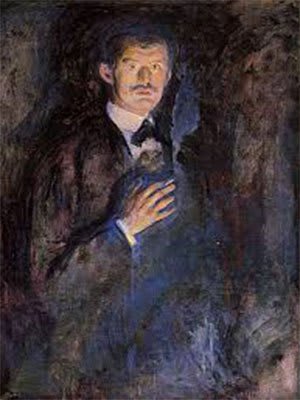
EDVARD MUNCH - Painter and engraver from Norway, born in the city of Ådalsbruk in 1863, is considered one of the most influential and electrifying protagonists of modern art.
Munch suffered from depression and mental illness, aware of his illness, he used it to produce extraordinary, delirious works.
His pessimistic view of life was transmitted in bold colors and strong lines, anticipating the expressionist movement.
In his own words, he approached existential themes such as life, death, and despair in an attempt to "dissect souls".
Edvard Munch began painting in Oslo, but it was during his stays in Paris that he came into contact with paintings of the Pós-Impressionismo and the Simbolismo, especially the paintings of Van Gogh and Paul Gauguin.
From there, he began to use whirling brushstrokes, simplified forms, and non-naturalistic colors.
In 1908, after a nervous breakdown inspired him to lead a more calm life, he did not slow down the pace of his productions.
He died in the city of Oslo, capital of Norway in 1944.


