
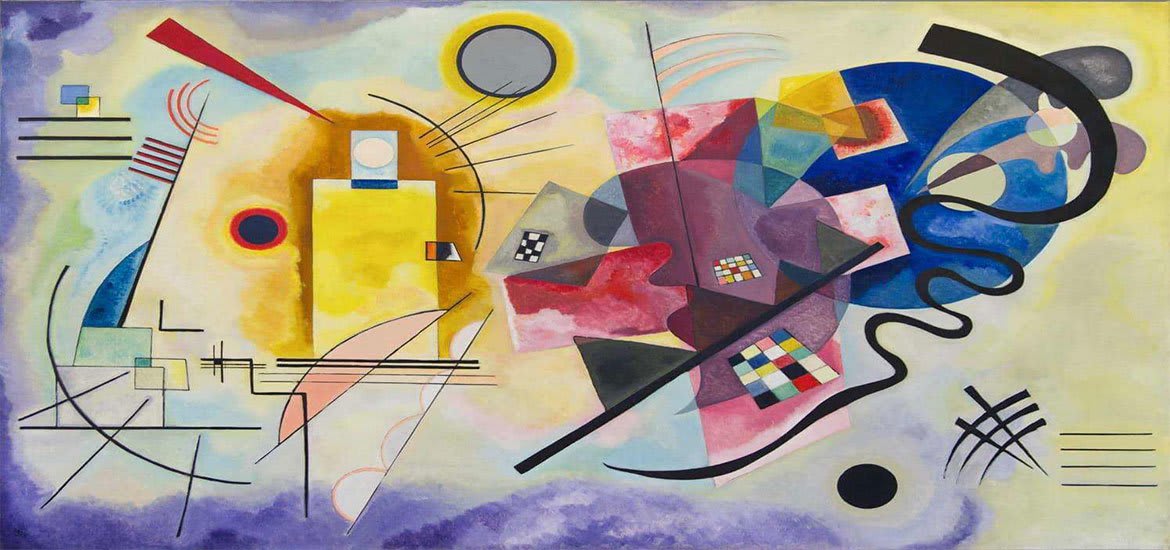
Yellow, Red, Blue - Wassily Kandinsky
A pioneering work in abstract art, Yellow, Red, Blue showcases Kandinsky's unique approach to color and form.
Article Index
Wassily Kandinsky is a name that resonates in the history of art, particularly when discussing abstract art.
Considered one of the pioneers of abstract art, Kandinsky was a Russian artist who sought to create a visual language that transcended the representation of the physical world.
The work 'Yellow, Red, Blue' is a striking example of Kandinsky's approach to art, where forms and colors are used to convey emotions and abstract concepts.
This painting, created in 1925, is an example of Kandinsky's belief that art could be a means of expressing the spiritual and the non-material.
With vibrant primary colors - yellow, red, and blue - in simple geometric shapes, 'Yellow, Red, Blue' creates a dynamic and visually stimulating composition.
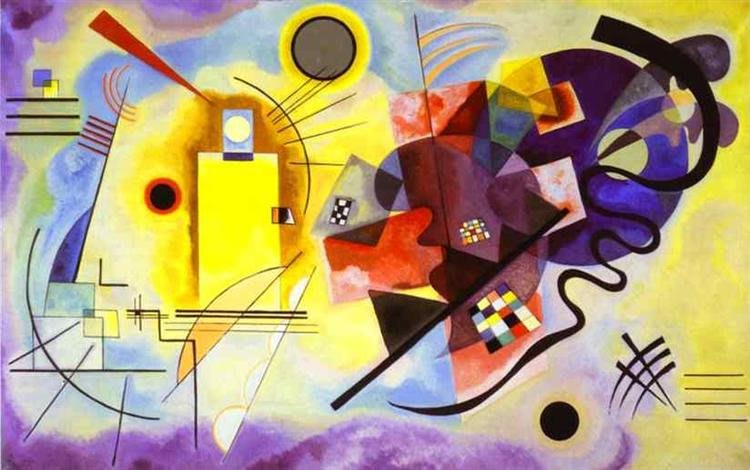
Yellow, Red, Blue is a painting by Wassily Kandinsky and belongs to the abstractionism, a movement initiated by him at the beginning of the 20th century.
Considered his masterpiece, Kandinsky combines primary colors of yellow, red, and blue in complex color clouds that overlap and intersect without a pattern.
In many ways, this freedom of movement was a synthesis of the many new artistic movements erupting in the 1920s.
Movements like Russian Suprematism and the German school Bauhaus were revolutionary, captivating the artistic world with their bold abstract compositions.
However, this does not mean that he only removed fragments of ideas from his contemporaries to create this beautiful work.
The artist was an innovator in his own right and, in fact, intended to do something absolutely unique.
In terms of dimensions and meaning, this painting approaches the most important compositions of Kandinsky, by which he expressed the entire set of his artistic efforts.
While the left half of the painting appears clear and light, with a graphic and straight composition, the right half reveals, above all, pictorial reflections, dark and heavy colors, as well as elementary colored shapes.
Thus, the blue color is reserved for the circle, the most perfect and harmonious of the elementary geometric figures.
The light yellow and luminous, framed on the left by a rectangle, contrasts with it.
The black line in the shape of a serpent, which launches itself through the painting, evokes the previous compositions of 'Der Blaue Reiter' (The Blue Rider).
Kandinsky was fascinated by the association between color and music, even going so far as to compose music for his paintings.
Through his apparently infinite flow of diffuse and opposing colors, the artist sought to represent musical sounds.
Just as a musician can provoke an emotional response from a spectator with just sounds, the artist hoped to create an art that alluded to emotions without the constraining influence of defined objects and physical limits.
Yellow-Red-Blue invites us to experience a symphony of artistic styles from the time.
This is a work in which Bauhaus techniques, Suprematist ideas, and artistic theology marry together.
In this marriage, the forms become celestial images, disappearing and reappearing as they flow across the canvas, changing color and fighting for dominance.
It is clear that one can experience Kandinsky's belief that forms and colors had the unique ability to explain the invisible and imperceptible.
As the artist himself once wrote: 'The creation of a painting is the creation of a world.'
Work Information
TITLE – Yellow, Red, Blue
AUTHOR – Wassily Kandinsky
YEAR – 1925
TECHNIQUE – Oil on Canvas
SIZE – 127x200 cm
LOCATION – National Museum of Modern Art, Georges Pompidou Center - Paris, France


