
The Japanese Woman - Claude Monet
The Japanese Woman is a painting by Claude Monet completed in 1876.
The Japanese Woman is a painting by Claude Monet completed in 1876.
In this work, Monet portrays Camille Doncieux, his wife, dressed in a Japanese kimono and an umbrella, in a lush garden filled with exotic vegetation.
The painting reflects the influence of Japanese art on Monet's work, which was part of an artistic trend known as 'Japonism' at the time.
The work is characterized by an impressionist representation of light and color, with loose brushstrokes and a vibrant color palette.
The Japanese Woman is an example of Monet's ability to capture the beauty and serenity of everyday life through his distinctive impressionist technique.
The Japanese Woman, is a painting in which Claude Monet portrays his first wife Camille Doncieux.
This work is also known as "Madame Monet in Japanese Attire"
In this sumptuous painting rich in details, the painter refers to japonism, a fashion that enthralled plastic artists from the 60s of the 19th century.
Indeed, men of letters such as the brothers Edmond and Jules de Goncourt were also influenced by the charm of the unknown and treated Japanese themes in their novels.
Since 1862, one could buy, in addition to Japanese prints and art objects, clothing and accessories at the store “Porte Chinoise”, Rue de Rivole located in Paris, France.
Just like many of his friends, Monet had a collection of kimonos, fans, and Japanese screens that can still be admired in his house in Giverny.
Contrary to Monet's usual preferences for everyday themes, the situation presented in this painting seems more artificial and prepared.
Camille's pose and her blonde wig have a quasi-theatrical air, while the fans seem to be floating on the wall.
The embroidery on the dress with wonderful colors was applied in relief.
This effect is further emphasized by the draping of the fabric.
Later, Monet critically analyzed this work because he considered it a concession to the taste of the public at the time.
However, a eloquent testimony to the fascination that exoticism exercised on Monet and his era.
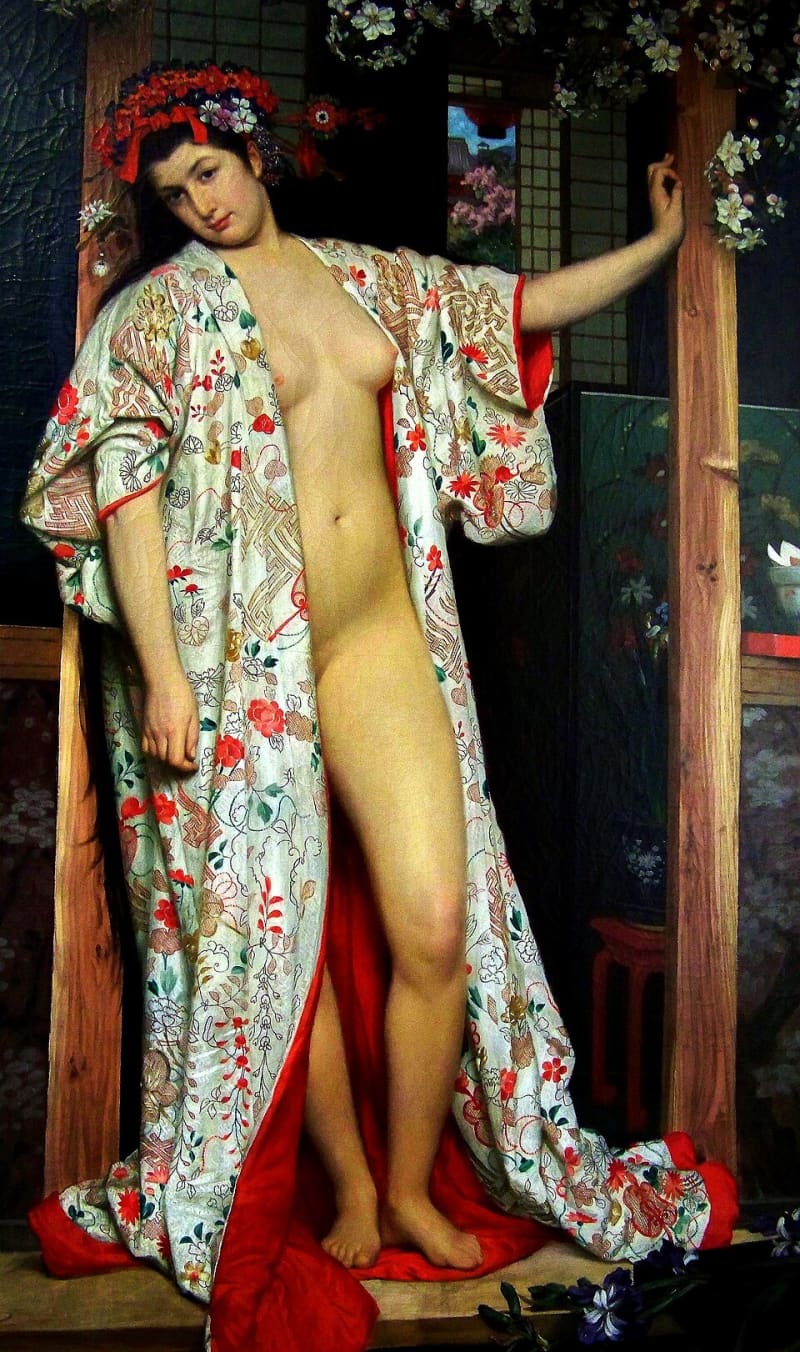
This pencil drawing is one of the rare drawings of the artist that we know.
In it, Monet represents Camille Doncieux, where we can observe the similarity of the face of the drawing with the painting in which he portrayed his wife.
WORK IN HIGHLIGHT: THE JAPANESE WOMAN
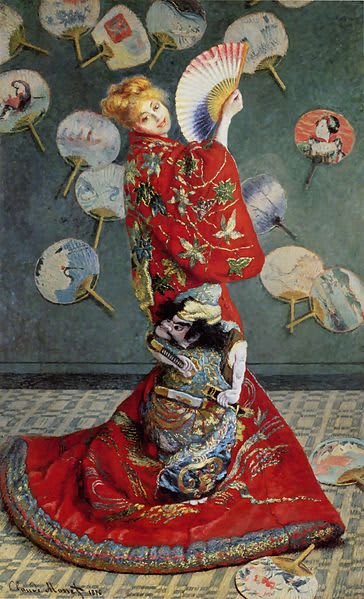
Year: 1875
Technique: Oil on Canvas
Dimensions: 231.8 x 142.3
Location: Museum of Fine Arts, Boston - USA


