Woman with Parasol (The Passeio) – Claude Monet
Woman with Parasol (The Passeio) – Claude Monet
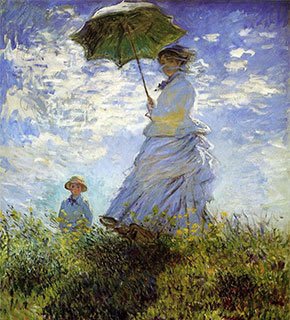
Woman with Parasol is an Impressionist painting by Claude Monet, also known as "The Passeio".
Completed in 1875, this work depicts Monet's first wife, Camille, and their son Jean, in a poplar field near their home in Argenteuil, France.
The painting is a classic example of the Impressionist style, characterized by loose brushstrokes, vibrant colors, and a fleeting representation of light and atmosphere.
"Woman with Parasol" captures the feeling of a fleeting moment, with Camille caught in a moment of movement as she and her son stroll through the field.
The painting is considered one of the most iconic works of Impressionism and a testament to Monet's talent in capturing the beauty of everyday life with delicacy and sensitivity.
Woman with Parasol or 'The Passeio'
1875 - Oil on Canvas (100 x 81cm) - Location: National Gallery of Art in Washington, United States
Woman with Parasol is a painting by Claude Monet, also known as ‘The Passeio’.
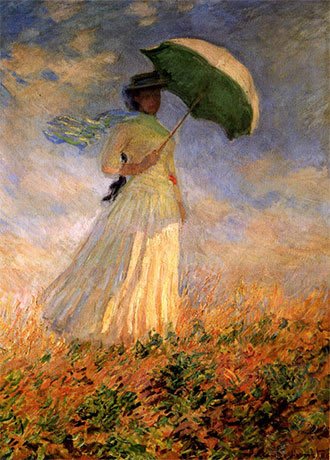
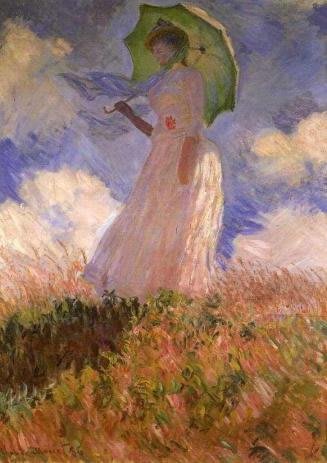
The painting belongs to the Impressionism and is part of the rare outdoor paintings of fully painted figures, which Monet will revisit in two more canvases in 1886.
Camille, his wife, is the woman seen from below, standing out against the sky full of clouds as she turns quickly.
The spontaneous, smooth, and sometimes only outlined brushstroke creates, in a convincing way, the movement in which the human figure and nature are merged.
You can feel the wind and the game of sunlight in an extraordinarily fresh and direct way.
However, this moment was not captured without reflection.
The pose is consciously prepared like a photograph taken in backlight, Camille's wife and her son Jean project long shadows on the lawn in the foreground, applied with contrasting colors where color, light, and movement are the main theme of this painting.
Claude Monet and the Representation of Light
Claude Monet sometimes imagined having been born blind, suddenly regaining his sight and setting out to paint what he found in front of him without knowing what it was.
This first look of the painter on his subject seemed to him the most honest, as it was the least subject to mixtures of projections and preconceived ideas.
This concern led him to study the atmospheric variations of an image.
The theme is not what it seems, but what the light transforms it into.
Thus, we have in Woman with Parasol, where the artist repeats the theme after having passed eleven years from the initial image.
In these paintings, Monet portrays his niece Suzanne Hoschedé, who poses instead of Camille.
These symmetrical paintings do not belong to a series and are the last two in which the painter will be interested in the representation of the human figure outdoors and in large format:
- Study Outdoors, Woman Looking to the Right, 1886
- Study Outdoors, Woman Looking to the Left, 1886