
Alberto Giacometti: Biography and Works: From the Swiss Alps to the Surrealist Revolution in Paris
Alberto Giacometti: Biography and Works: From the Swiss Alps to the Surrealist Revolution in Paris
Alberto Giacometti was one of the most important sculptors of the 20th century who distinguished himself in surrealist sculpture and expressionist painting. Philosophical questions about human condition, as well as existential and phenomenological debates, played a significant role in his work. His self-criticism led him to great doubts about his work and his ability to do justice to his own artistic ideas, but it worked as a great motivator.
Alberto Giacometti was born on October 10, 1901, in the small mountain village of Borgonovo di Stampa, Switzerland, just near the border with Italy. His father Giovanni Giacometti, was a talented painter who worked in the impressionist style. In addition, both his godfather and an uncle were artists as well - all three provided Giacometti with his first artistic instructions and directions.
In 1906, his family moved to the neighboring city of Stampa, during this period Giacometti already showed a strong interest in drawing. When he was in adolescence, he began to paint, sculpt, and make woodcuts, achieving great success.
To pursue a career in art, Alberto moved to Geneva in 1919, where he studied at the École des Beaux-Arts and the École des Arts et Métiers.
In 1920, he accompanied his father to the Bienal de Veneza and in 1921 visited Rome, Florence, and the surrounding areas. During this time, Giacometti became fascinated with Egyptian and African art.
In 1922, he moved to Paris where he began to study with the sculptor Antoine Bourdelle, one of the artists who worked with the famous Auguste Rodin. He spent the next four years studying sculpture at the Académie de la Grande-Chaumière.
In the City of Light, Alberto experimented with cubism and surrealism, soon becoming one of the leading surrealist sculptors. He met and worked with names like Joan Miró, Max Ernst, Pablo Picasso, Bror Hjorth, and Balthus.
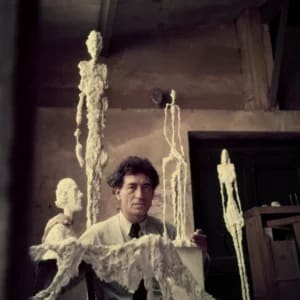
In the second half of the 1920s, Giacometti began to nurture his new love for primitive art and his representations of the human body were becoming increasingly abstract. When he graduated, Alberto abandoned any realism in his work and instead constantly sought to convey the psychological essence in his work. The most important and representative works of this period are the famous Spoon Woman and The Couple.
In the early 1930s, Giacometti's emerging style and his intransigent nature earned him some of the most important figures of the surrealist movement, such as André Breton, Man Ray, and Georges Bataille. The massive influence in his work can be seen in metaphorical pieces, as we can observe in the work Suspended Ball of 1931. However, his personal investigation into the nature of existence would lead him to distance himself from surrealism.
During the second half of the fourth decade of the 20th century, Giacometti concentrated his energies on a series of head sculptures that were intended to transmit his own physical relationship with his models in space. Unfortunately, when he was at the peak of his personal creative efforts, the outbreak of World War II and the advance of the German army in France forced him to flee Paris and return to Switzerland. During this time, his sculptures became finer and smaller in size, giving the figures an air of loneliness and suffering.
But history holds a bizarre detail:
To understand the rest of this journey, continue to our next article: Alberto Giacometti: Biography and Works: From Post-War Solitude to the Universal Sculptural Legacy.
Alberto Giacometti: BIOGRAPHY
But history holds a bizarre detail:


