
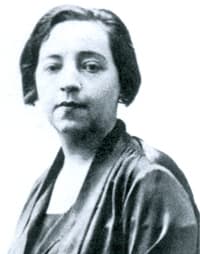
Anita Malfatti: A Life and the Early Works of a Brazilian Art Pioneer
Discover the life and early works of Anita Malfatti, a key figure in Brazilian modern art.
Article Index
I invite you to explore the life and work of Anita Malfatti, one of the most important figures in Brazilian modern art.
Born in São Paulo in 1889, Malfatti was a visionary artist who challenged the aesthetic conventions of her time.
In 1917, she staged an exhibition that sparked great controversy and divided the specialized press, being both praised and severely criticized.
This exhibition, known as Anita Malfatti's Exhibition, was a landmark in Brazilian modernist movement, introducing the Brazilian public to new artistic currents, such as expressionism.
Anita Malfatti was an important Brazilian artist, one of the most representative figures of Brazilian modernism, which influenced a whole generation of artists in the early 20th century, awakening from her work the need for a break with the academic art that had been prevailing in Brazil until then.
BIOGRAPHY of Anita Malfatti
Anita Catarina Malfatti was born in São Paulo on December 2, 1889. She was a painter, draftsman, engraver, illustrator, and teacher.
Anita was born with a small physical disability. When she was three years old, her parents took her to Italy to seek treatment, hoping to correct a congenital atrophy in her right arm and hand.
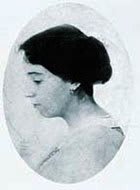
Upon realizing her daughter's talent, Anita's mother, Bety Malfatti, began her artistic education and, concerned about her daughter's future, hired an English governess to help develop her left hand for writing, drawing, and painting.
At 20, Anita traveled to Europe to further her studies. With the financial support of a successful uncle, George Krug, she moved to Germany and enrolled in the Imperial Academy of Fine Arts in Berlin.
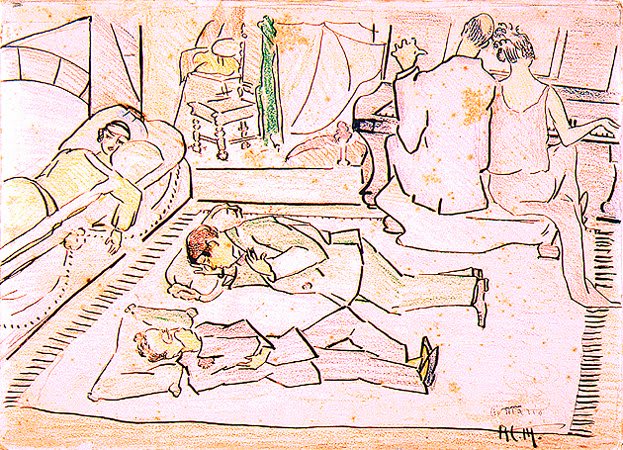
In one year living in Germany, despite being exposed to European avant-garde movements, her studies were still quite traditional. As an academy student, she had classes in drawing, perspective, and art history.
In 1912, Anita visited a major retrospective of modern art in the city of Sonderbund, by which time she was already familiar with modern production.
When she returned to Brazil in 1914, Anita exhibited her paintings in her first solo show in São Paulo.
After a year in Brazil, the artist traveled again for further studies, this time to the United States.
In the United States, she enrolled in the Independent School of Art and began taking classes with Homer Boss. Living with this American vanguardist professor, she developed the modern freedom she had cultivated in Germany.
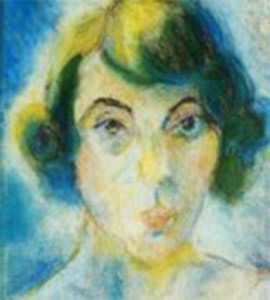
In 1917, the artist returned to Brazil and began associating this freedom of expression with forms and criticizing nationalistic models she now carried.
This reaction, for some, would shake the artist's confidence, causing a violent impact on her career; for others, Anita had already been oscillating between more realistic formal schemes and solutions closer to international modernism.
With the disappointment caused by the 1917 exhibition, Anita turned to traditional language and began taking classes with the painter and academic teacher Pedro Alexandrino.
In 1921, motivated by the group's idealizers to organize the Week of Modern Art (Menotti Del Picchia, Oswald de Andrade and Mário de Andrade), Anita became interested again in vanguard languages.
The year of 1922, finally arrived at the São Paulo Modern Art Week, Anita exhibited again the same paintings shown in 1917 and took advantage of the opportunity to also display some new works.
Anita Malfatti was part of the Group of Five that, besides the painter, included Mario de Andrade, Tarsila do Amaral, Oswald de Andrade, and Menotti Del Picchia.
In 1923, Anita Malfatti finally achieved what she had not achieved in 1914, the art scholarship of the Pensionato Artístico do Estado and traveled to Paris, staying there for five years.
She returned to Brazil in 1928 and began to focus on regionalist themes and primitivist painting, returning to traditional forms, such as Renaissance painting and naïf art.
From the 1940s onwards, the painter began to choose themes from everyday life and continued in this vein.
To understand the rest of this journey, continue to our next article: Anita Malfatti's Legacy: Analysis of Marked Works and Impact on Brazilian Modernism.


