
Anita Malfatti: The 1917 Controversy and Brazilian Modernism (Chapter 2)
Biography of Anita Malfatti: The 1917 Controversy and Brazilian Modernism (Chapter 2)
Article Index
In 1917, the artist returns to Brazil and begins to associate this freedom of expression and compose with forms to nationalistic criticism to imported models that she now carries.
These paintings are part of this period, Tropical and Caboclinha.
These works are reunited in her second individual, the famous: Exposição de Arte Moderna de 1917.
On December 20, this individual artistic exhibition with 53 works.
It was in this exhibition that she met the writer Mario de Andrade, and from then on, they became great friends.
Because it was innovative and revolutionary, this exhibition had a great impact: the writer Monteiro Lobato, who at the time was an art critic and wrote for the newspaper O Estado de São Paulo, criticized Anita's art with an article titled “Paranoia or mystification?”
The acceptance of her works, resonated in various ways, without knowing the importance of this exhibition for the future of art in Brazil, which made Anita the great precursor of our modernism.
This exhibition that seemed to be a failure for some, but for others, only contributed to the approximation of intellectuals and artists who questioned the academic art that was still thriving in the country.
The result of Monteiro Lobato's criticism, was the rejection of the Paulista elite to Anita's works.
The state trusted blindly in the opinions and personal tastes of the author of Urupês, and immediately caused: scandal, returned paintings, a attempt of aggression to the painter, the show is closed before time.
As time passed, the mere labels of modernism in Brazil influenced by “Lobatinho” were demystified, Anita Malfatti's exhibition functioned as a bomb of a movement that exploded in the 1922 Week of Modern Art, making a modernity in art more free, expressive, conceptual, and poetic happen.
This reaction, for some, will shake the artist's confidence, causing a violent impact on her career; for others, Anita had already been oscillating between more formal schemes and solutions closer to international modernism.
After being criticized by Monteiro Lobato, the painter fell into deep depression, remaining without any inspiration to paint for a long time.
With the disappointment caused by the 1917 exhibition, Anita approached the traditional language and decided to take classes with the academic painter and professor Pedro Alexandrino.
Her paintings became more realistic from then on.
She already knew Tarsila do Amaral, who at the time lived in Europe and the two painters exchanged many letters.
Anita kept her friend well informed about the events in Brazil.
By around 1921, motivated by the idealizers to carry out the Week of Modern Art (Menotti Del Picchia, Oswald de Andrade and Mário de Andrade), Anita became interested again in avant-garde languages.
The year of 1922, finally arrived at the Week of Modern Art in São Paulo, Anita exhibited again the same paintings shown in 1917 and took advantage of the opportunity to also show some new works.
The impact was great, considered by the art critic Sérgio Milliet, who was present, as the greatest artist of the exhibition.
Anita Malfatti was part of the Group of Five, which, in addition to the painter, included Mario de Andrade, Tarsila do Amaral, Oswald de Andrade, and Menotti Del Picchia.
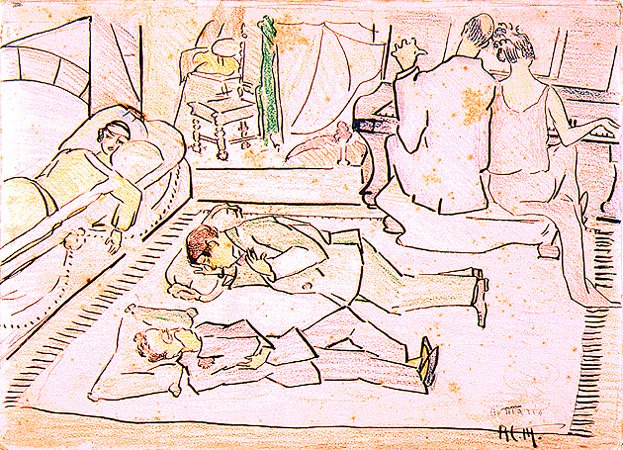
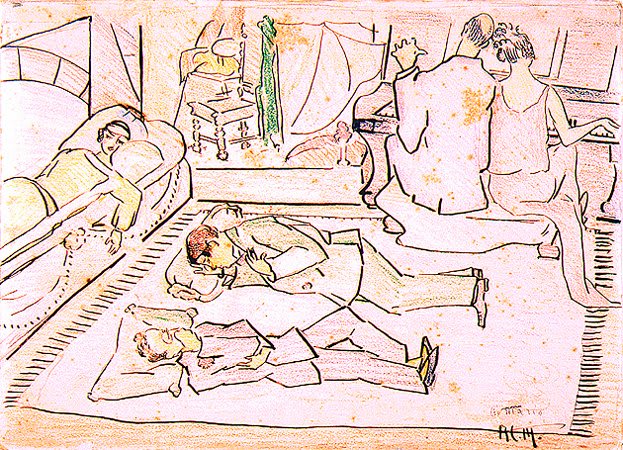
The drawing of Anita Malfatti below, represents the Group of Five, the friends who revolutionized the history of art in Brazil: Anita Malfatti is asleep on the sofa, the writers Oswald de Andrade and Menotti Del Picchia are also sleeping (on the floor), while Tarsila do Amaral and Mário de Andrade play a piano...
To understand the broader landscape of Brazilian Modernism, explore the foundational work of another pioneer: Biography of Candido Portinari: Childhood, Art, and the Roots of Brodowski
In 1923, Anita Malfatti manages to do what she couldn't do in 1914, the art school scholarship and travels to Paris, staying there for five years. Anita does not abandon modernism, but avoids what it has of rupture.
To truly appreciate the artistic movements influencing Anita's time in Europe, delve deeper into Fauvism
In Paris, she approaches the avant-garde, the fauvism mainly.
She returns to Brazil in 1928, and begins to be interested in regionalist themes and primitive painting, and returns to traditional forms, such as Renaissance painting and naive art.
From the 1940s onwards, the painter begins to choose themes from popular life and continues to do so.
For another perspective on Brazilian art rooted in popular culture and regional themes, explore the works of: Carybé: Biography and Work: A Detailed Look at His Main Creations

In 1963, she realizes a year before her death, a individual at the Casa do Artista Plástico and also receives the last tribute she receives in life, a retrospective of all her work.
In 1964, on November 6, in the city of São Paulo, Anita Malfatti dies, but leaves a precious legacy for Brazilian art, introducing a new style of painting that, despite the rejection it received when it was presented, gradually influenced an entire generation of artists.
- Anita Malfatti
MAIN WORKS
- THE FOOL
To understand the rest of this journey, continue to our next article: Biography of Anita Malfatti: Works and Artistic Legacy (Chapter 3).


