Anita Malfatti's Legacy: Analysis of Notable Works and Impact on Brazilian Modernism
Anita Malfatti's Legacy: Analysis of Notable Works and Impact on Brazilian Modernism
In 1963, she held an individual exhibition at the Casa do Artista Plástico a year before her death, and also received the last tribute she received in her lifetime, a retrospective of all her work.
On November 6, 1964, in São Paulo, Anita Malfatti died, but left a precious legacy for Brazilian art, introducing a new style of painting that, despite the rejection it received when it was presented, gradually influenced an entire generation of artists.
"I sought all techniques, but returned to simplicity directly; I am no longer modern or old, but I write and paint what I love." - Anita Malfatti
To delve deeper into the pioneers of Brazilian art, consider the impactful journey of another master. Biography of Candido Portinari: From Academia to Historic Mural Paintings
MAIN WORKS
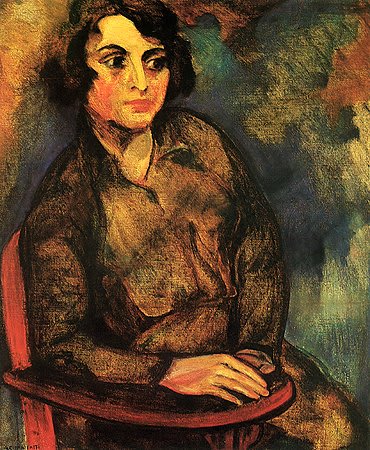
- THE FOOL
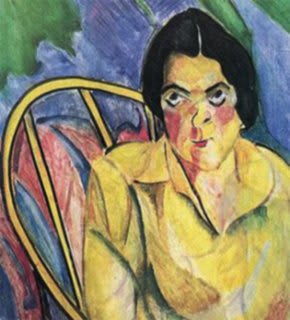
The canvas is constructed with the use of colors, in an orchestration of oranges, yellows, blues, and greens, highlighting in this way the chromatic zones outlined by the black lines, most of which are diagonal. In the foreground, an angular and asymmetrical figure receives the irregular application of color. Yellow, blue, and green, highlighting in this way the chromatic zones outlined by the black lines, most of which are diagonal.
In the physiognomy of the figure portrayed, the abnormal and vague expression of the young woman is highlighted by black lines, according to the expressionist aesthetic of the irrational and dissonant. The background is elaborated with quick brushstrokes, which serves as a counterpoint.
The character has a distant look, as if lost in a world that is only hers. Her dark eyes are outlined by black contours, with eyebrows in the shape of an acute accent. Her black hair is parted in the middle and covers her ears.
The background of the composition is painted in blue and green, contrasting with the figure's clothing and her chair.
- TROPICAL
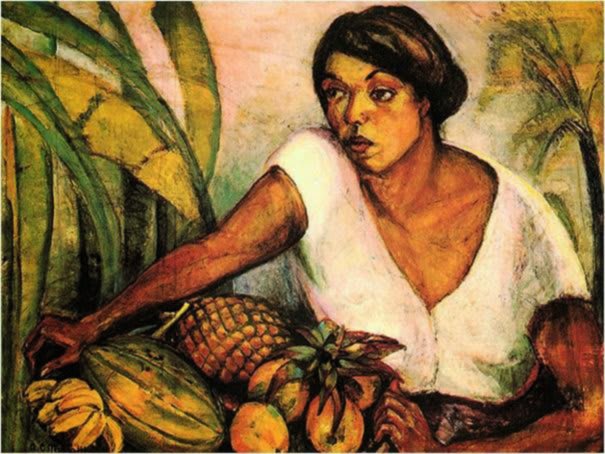
As she wanted to be accepted as an artist in her country, the painter leaves aside the expressionist inspiration and passes to give more realistic touches to her creations.
Her work ‘Tropical’ , was the first modern painting of a Brazilian theme. In it, the artist represents a woman of mixed skin color. The figure appears carrying a basket of tropical fruits, showing, in a way, the face of Brazil at that time.
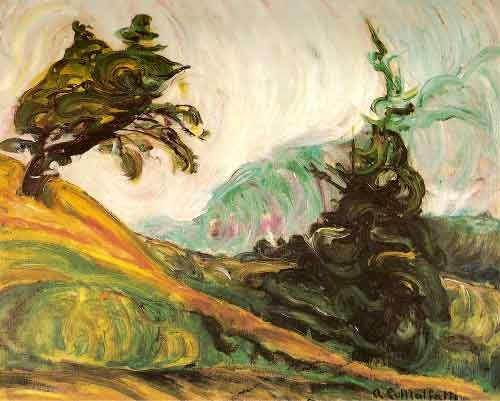
– The Lighthouse
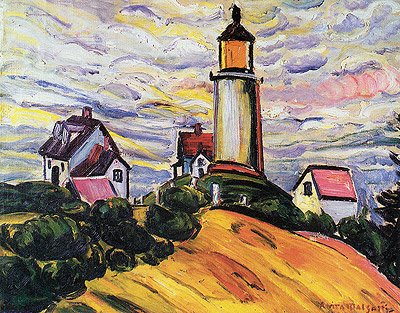
This is one of Anita Malfatti's most famous works. In this painting, the landscape is more harmonized with human presence, through the buildings that make up the scenery.
The artist painted this painting when she was still studying in the United States. Her teacher, Homer Boss, used to take his students to the Monhegan Island, in the north of the country, where there was this lighthouse, which had been portrayed by other painters.
"WE PAINTED IN THE WIND, IN THE SUN, IN THE RAIN, AND IN THE FOG. IT WAS TELLS AND TELLS. IT WAS THE STORM, IT WAS THE LIGHTHOUSE, IT WAS THE FISHERMEN'S HUTS SLIPPING DOWN THE HILLS, IT WAS THE CIRCULAR LANDSCAPES, THE SUN AND THE MOON AND THE SEA. THE BIGGEST PROGRESS I MADE IN MY LIFE WAS IN THAT ISLAND AND IN THAT TIME OF VERY SPECIAL ENVIRONMENTS. I LIVED ENCHANTED WITH PAINTING." Anita Malfatti
For another perspective on groundbreaking artistic movements that defined a new era, consider the revolutionary path of an influential artist. Max Ernst: Early Years and the Dadaist Revolution
In the first year, Anita comes into contact with all the modernist agitation, visiting the exhibitions with great curiosity, but her studies are still quite traditional. In the academy she has classes in drawing, perspective, and art history. The interest in new languages is amplified in the private lessons she has with the teacher Fritz Burger-Mühlfeld (1867 - 1927). This artist, linked to the post-impressionism of Germany, offers her artistic possibilities beyond traditional approaches. The presence of modernism in her formation is emphasized in the courses with Lovis Corinth (1858 - 1925) and Ernst Bischoff-Culm. In 1912, when visiting the great retrospective of modern art Sonderbund in Cologne, Anita had already familiarized herself with modern production. In the portraits painted by the artist during this period, the learning of new poetics is evident. The classical contour prevails, but the colors are used in an expressive way, demonstrating a greater and more contrasting movement than the drawing. Although they do not conflict with the forms, it is perceptible that the elements operate in distinct dynamics. Anita exhibits these paintings in her first individual, in 1914, after returning to São Paulo.
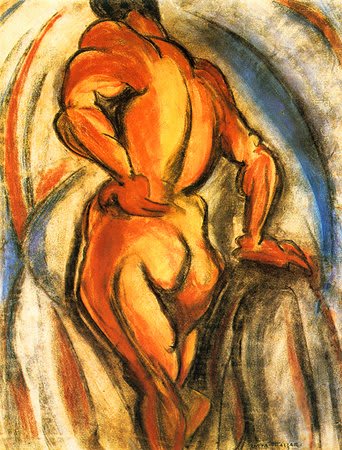
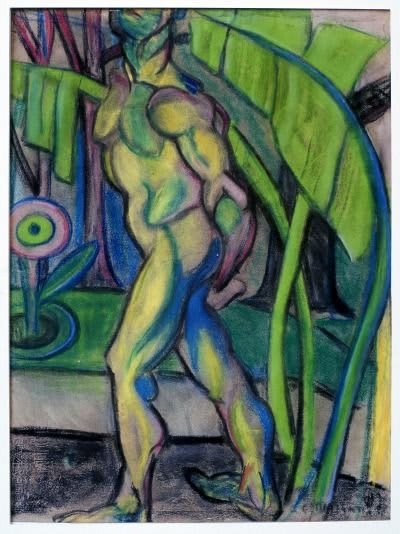
In 1915, the artist goes to the United States for another period of studies, where she has classes with Homer Boss (1982 - 1956) at the Independent School of Art. The coexistence with this American teacher and the avant-garde climate of the school will lead to the development of the modern freedom cultivated in Germany. It is there that she realizes her most famous works, such as The Lighthouse (1915), Torso/Rhythm (1915/1916) and The Yellow Man (1915/1916). In these paintings, the drawing loses its commitment to classical verisimilitude and gains a more interpretive sense. Sometimes, the thick and sinuous contour presents the figures as a heavy and voluminous mass. In other works, with the more closed line, the color is flattened and composes portraits and landscapes free, by the articulation of surfaces in contrasting colors.
In Brazil, in 1917, the artist associates this freedom of composition with forms to criticize the nationalistic criticism of imported representation models. Paintings such as Tropical (1917), originally titled Black Bahiana, and Caboclinha (1907) are part of this effort. All these paintings are reunited in her second individual: Exposição de Arte Moderna, in December 1917. The show has decisive repercussions for her work. The reactions are diverse. On the one hand, the exhibition animates an approach of the artists and intellectuals who, later, will realize in São Paulo the Week of Modern Art of 1922, on the other hand, it becomes the target of a violent reaction to the modern languages. The positions opposed to the vanguards of European origin, which have as their greatest exponent Monteiro Lobato (1882 - 1948), consider the exhibition a waste of Anita's talent, which was delivered to dazzling and mystifying foreignness.
This reaction, for some, will shake the artist's confidence, causing a violent impact on her career; for others, Anita had already been oscillating between more realistic formal schemes and solutions closer to international modernism. After the 1917 exhibition, she approaches traditional language and takes classes with the academic Pedro Alexandrino (1856 - 1942). Her works also become more realistic. Encouraged by the group that would realize the Week of Modern Art, such as Menotti Del Pichia (1892 - 1988), Oswald de Andrade (1890 - 1954) and Mário de Andrade (1893 - 1945), Anita, around 1921, becomes interested again in vanguard languages. In the Week of Modern Art in São Paulo, in 1922, the artist exhibits again the paintings shown in 1917, together with new modernist works, being considered by Sérgio Milliet (1898 - 1966) the greatest artist of the exhibition.
In 1923, Anita finally conquers the scholarship of the Artistic Pension of the State - which she had not been able to get with the 1914 exhibition - and goes to Paris, where she stays for five years. In her stay, she takes distance from the polemical positions of the vanguard. She paints interior scenes like Interior of Monaco and La Rentrée, and approaches fauvism and the simplicity of primitive painting. The artist does not deny modernism, but avoids what it has of rupture. Upon returning to Brazil, in 1928, she becomes interested in regionalist themes and returns to traditional forms, such as Renaissance painting and naive art.
The interest in a more fluid and uncommitted painting brings Anita closer to the group of painters of the Família Artística Paulista - FAP. She identifies with the search for a spontaneous and well-made painting, not tied to consensual models or lost in the desire for innovation. From the 1940s onwards, the artist begins to paint, more and more, scenes of everyday life. In the 1950s, the popular is not only a theme, but also begins to be incorporated into the forms, influenced by non-cultured art. In 1963, a year before her death, she holds an individual exhibition at the Casa do Artista Plástico and receives a retrospective of her work at the 7th Bienal Internacional de São Paulo. It is the last tribute she receives in her lifetime.
Interested in other iconic Brazilian artists who shaped modern art? Explore the unique trajectory of another remarkable figure. Tomie Ohtake - Biography and Art: A Journey from Immigration to Abstraction
GALLERY OF SOME WORKS