
Biography of Auguste Renoir and His Major Works: Maturity, Personal Life, and Challenges
Discover the life and works of Auguste Renoir, a renowned French painter known for his contributions to Impressionism.
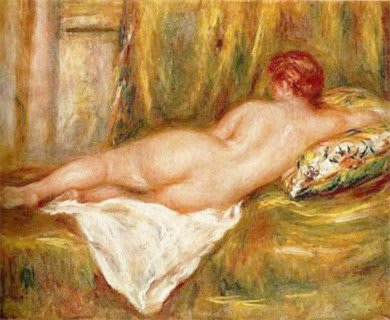
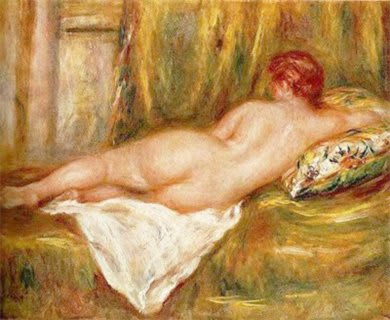
Renoir considered the nude the most indispensable form of art, saying: "it's impossible to imagine anything more beautiful."
This painting emphasizes the elegance of the silhouette, while at the same time softening the contours and the colors blend together to form a charming harmony.
In conversation with his friends, he commented Degas: "The nudes that had never appeared in public seem to be discovered secretly, seen with a furtive glance. It's possible. I've seen some images. They certainly don't have the naturalness and freshness of Renoir's nude women." (Edgar Degas)
In 1880, at a dairy shop where he used to have meals, Renoir met Aline Charigot. Friendship blossomed into love, and Aline became his model and wife for the rest of his life.
In 1879, at the headquarters of the magazine La Vie Miderne, Renoir held his first solo exhibition. He gradually distanced himself from the Impressionists. From 1881, the so-called "asperous" or "bitter" period began, known by some in his work. Renoir valued more the contours of the figures and the colors became more opaque. Despite being known as an Impressionist, he dedicated himself to this movement only a small part of his life. By the end of the 1870s, he declared that the Impressionist experience was partially exhausted, preferring to freely explore other styles.
Renoir’s shift away from Impressionism marks a significant turning point, though the movement’s origins can be traced back to earlier masters of light and atmosphere. William Turner, the Precursor of Impressionism: Notable Works and Style Analysis (Part 2)
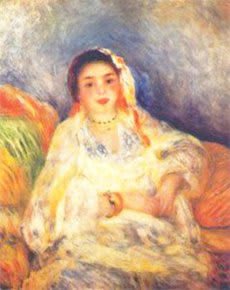
In 1881, he traveled to Algeria with his friend Corday to see the country that had been a source of inspiration for Delacroix. In Algeria, he painted several landscapes and portraits of Algerian women.
The influence of travel on a painter's perspective was a common theme among artists who looked toward historical and international roots to refine their craft. Biography of El Greco: The Greek Origins and Journey to European Renaissance
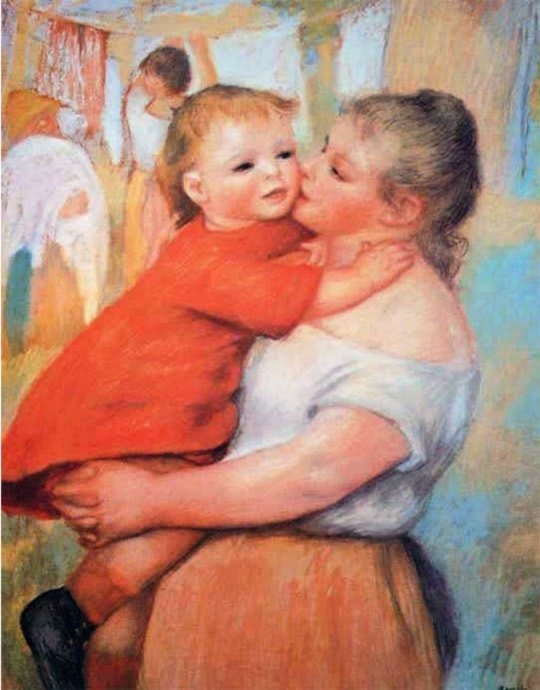
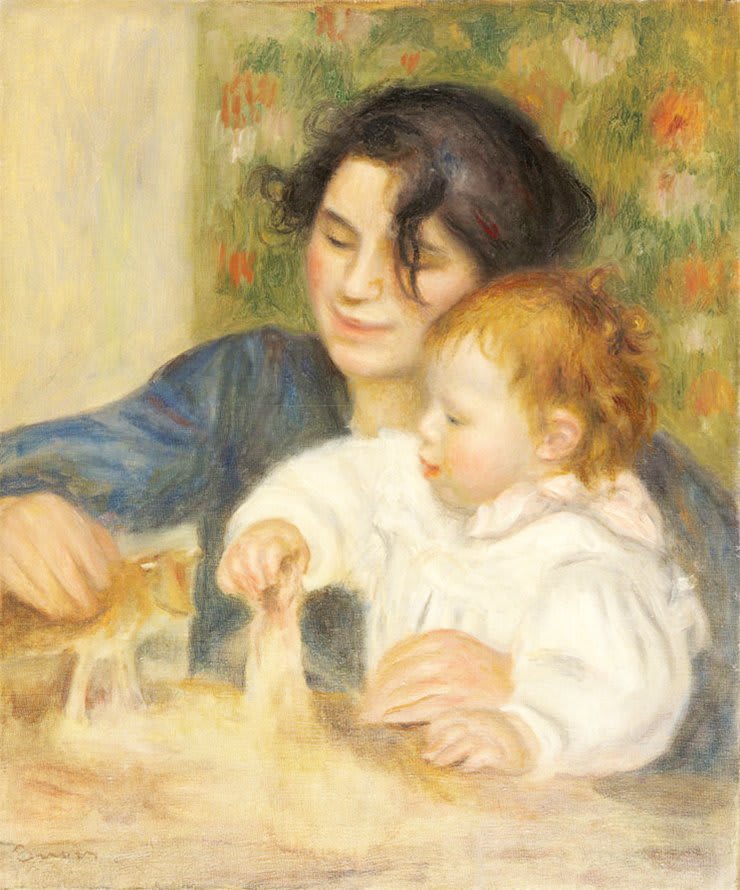
In 1884, when Aline was expecting a child, the artist decided to move to a new studio and another apartment where their first child, Pierre, was born. From then on, Renoir dedicated himself entirely to family life; his favorite models would be the woman and the children.
Between 1885 and 86, Renoir painted various versions of motherhood, all intense and full of charm. Mother and child were the theme of numerous paintings, pastels, blood drawings, crayon, and pen nib.
At the peak of his career, around 1890, Renoir began to suffer from rheumatism, a cruel disease that would not give him any respite. In the hope of finding relief
In 1903, after some time spent in Le Cannet, he rented a spacious apartment at the Maison de la poste, in Cagnes. From his window, he could see the city and its surroundings bathed in the warm sunlight of Provence, the colors standing out due to the proximity of the sea. Despite the natural wonders that surrounded him, Renoir's favorite themes continued to be his wife and children: Pierre, Jean (the future filmmaker born on September 15, 1894) and Claude, nicknamed "Coco," who was born on August 1, 1901, when the father was 60 years old.
From 1907 to 1910, Renoir painted several portraits of Gabrielle, a young peasant woman from Essoyes, hired to assist Aline after the birth of Jean. From then on, she became part of the family and also, for many years, Renoir's favorite model.
In June 1914, the assassination of the Austrian archduke Franz Ferdinand led to the outbreak of World War I. France called up its men in August: Pierre enlisted in the 4th Infantry Regiment, and Jean became a sergeant in the 1st Dragoon Regiment. With both sons at the front, Renoir only thought of them.
After weeks of anxiety, waiting in vain for news, the painter learned that both had suffered serious injuries. Pierre, who was fighting in Lorraine, was sent to the Carcassonne Hospital, and Jean was recovering in Gérardmer. Although relieved to know that the boys were alive, Renoir and Aline worried about them. Aline visited them but returned exhausted and disturbed by the horrors of war. Upon returning home, she fell ill and never recovered. She was hospitalized in Nice and died on June 28, 1915.
The endurance Renoir showed in his final years echoes the perseverance required by other great masters who faced their own share of professional and personal obstacles. Auguste Rodin: Birth, Struggle, and Early Notable Works (Chapter 1/3)
In 1917, Renoir received a visit from a young painter named Henri Matisse who, visibly interested in studying the work of the famous painter and transporting his ideas on color to a new era, began to frequent his home and, despite the almost 30-year age difference between them, became his friend.
I once read that Matisse observed, sadly, as Renoir, with his brushes tied to his hands, or holding a brush only with his fingertips, continued to paint, despite saying he felt stabbing pains in every movement. It is said that one day Matisse asked Renoir why he persisted in painting at such great cost and so much torture, he replied:
Renoir replied: "I don't know, but I know I need you to continue painting."
To understand the rest of this journey, continue to our next article: Biography of Auguste Renoir and His Major Works: Legacy, Glory, and the Final Gallery.


