
Biography of Camille Pissarro: From Childhood to Impressionist Years
Discover the life and work of Camille Pissarro, from his childhood in St. Thomas to becoming a key figure in Impressionism.
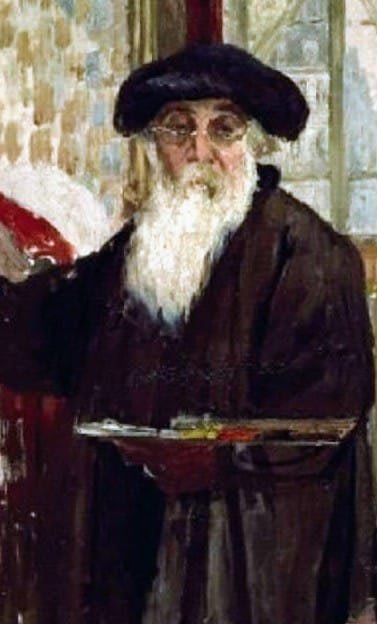
Camille Pissarro is considered one of the most renowned Impressionists. His breathtaking scenes of rural life and everyday life have become highly recognizable for their style and coloration.
The importance of Pissarro as an artist and teacher in the development of modern art in late 19th-century France cannot be overlooked. He taught several Post-Impressionist artists, including Georges Seurat - pioneer of the pontilhista technique - Vincent Van Gogh, and Paul Gauguin.
BIOGRAPHY
Jacob-Abraham-Camille Pissarro was born on July 10, 1830, to a family of merchants, in Charlotte-Amalie on the island of St. Thomas, then part of the Danish West Indies. At the age of 12, he was sent to a boarding school in Paris to receive a formal education. It was there that he was first introduced to French masters by visiting museums. After completing his studies, the young artist returned to St. Thomas and began working with his father, providing support for his business.
When Camille Pissarro was 21 years old, he met the Danish marine painter Fritz Sigfred Georg Melby, who inspired him to start painting, and soon became his friend and teacher. Camille decided to leave his job and family and live in Venezuela, where he and Fritz spent two years working as artists. Camille drew everything he could, including scenes of villages, landscapes, and many sketches that could fill several sketchbooks.
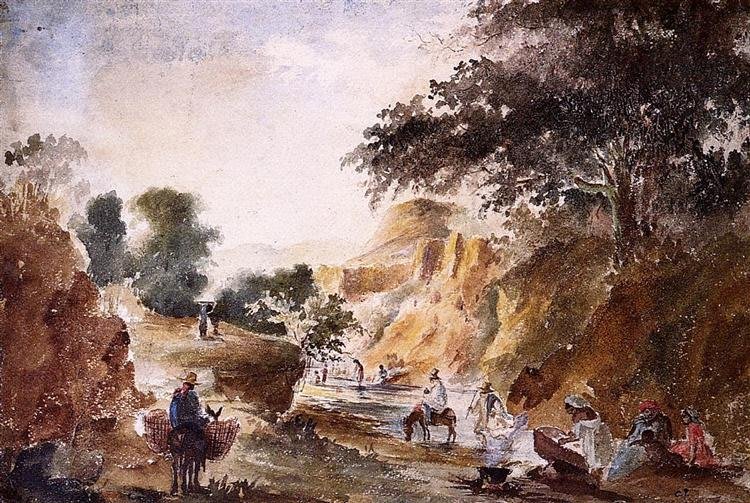
Upon returning to Paris, Pissarro relied on his family's support to begin his artistic development. Upon arrival, he participated in the World's Fair and there had contact with the work of Jean-Baptiste-Camille Corot, which greatly influenced him and he studied directly with him, as well as with Gustave Courbet and Charles-François Daubigny.
During this period, he began to understand the importance of expressing the beauty of nature. He started to leave the city and paint scenes of the countryside to capture the reality of everyday village life, finding the French countryside picturesque and worthy of being painted. Unlike Corot, Pissaro preferred to finish his paintings outdoors, all at once, giving his canvases a more realistic feel.
Pissarro also attended the Académie Suisse, an art school founded by Charles Suisse, where there were models for students to study. It was during this time that he met some of his contemporaries, such as Claude Monet, Armand Guillaumin, and Paul Cézanne. The group was brought together by their shared artistic visions.
In 1871, Pissarro married Julie Valley, they had eight children, one of whom became a renowned painter and engraver, Lucien Pissarro. They were living in Louveciennes, a French community, when the Franco-Prussian War began. Pissarro and his family fled to London, where they lived for several years. Some fantastic paintings were created during this period that explore the growth of urban areas in some villages around London.
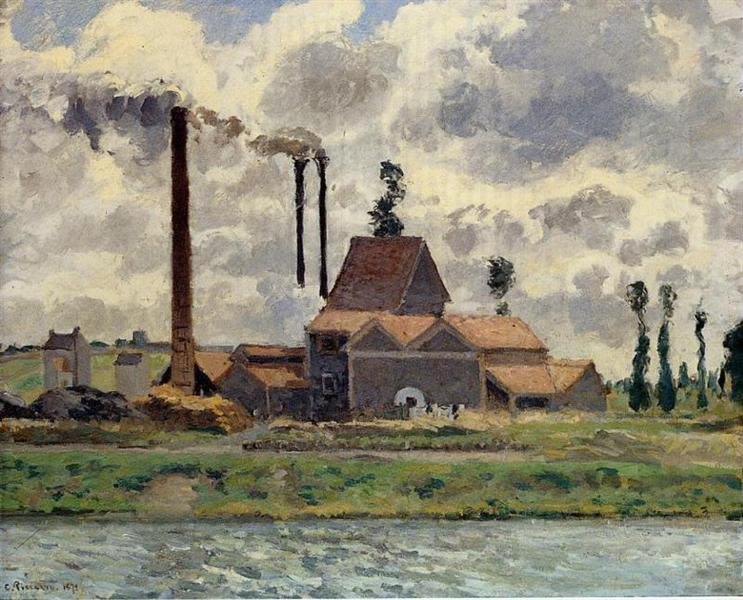
With the end of the war, they returned to France, and the artist discovered that much of his initial work had been destroyed. Pissarro began working alongside Paul Cézanne, Edgar Degas, Auguste Renoir, and Claude Monet. It was during this time that Pissarro, along with these artists, participated in the collective exhibition at the Société Anonyme des Artistes, which allowed for public exhibitions of artists who were not accepted at the Paris Salon. The first exhibition in 1874 was received with relative success and helped to consolidate the Impressionist movement.
One of the characteristics of Impressionism was to paint outdoors, when the artist would leave for the countryside, in direct contact with nature with his easel and a canvas. Pissarro was a strong defender of this method and encouraged younger artists to do the same.
On April 10, 1879, the fourth Impressionist exhibition was held in Paris. Pissarro, who was the only artist to include works in all seven exhibitions, presented thirty-eight works. Auguste Renoir, Alfred Sisley, and Paul Cézanne, who felt disillusioned with the lack of recognition they had achieved, did not participate. Despite the decrease in the number of the original group from the first exhibition, Pissarro was eager to continue with the series, and the subsequent fifth and sixth shows were held with an interval of one year, in 1880 and 1881.
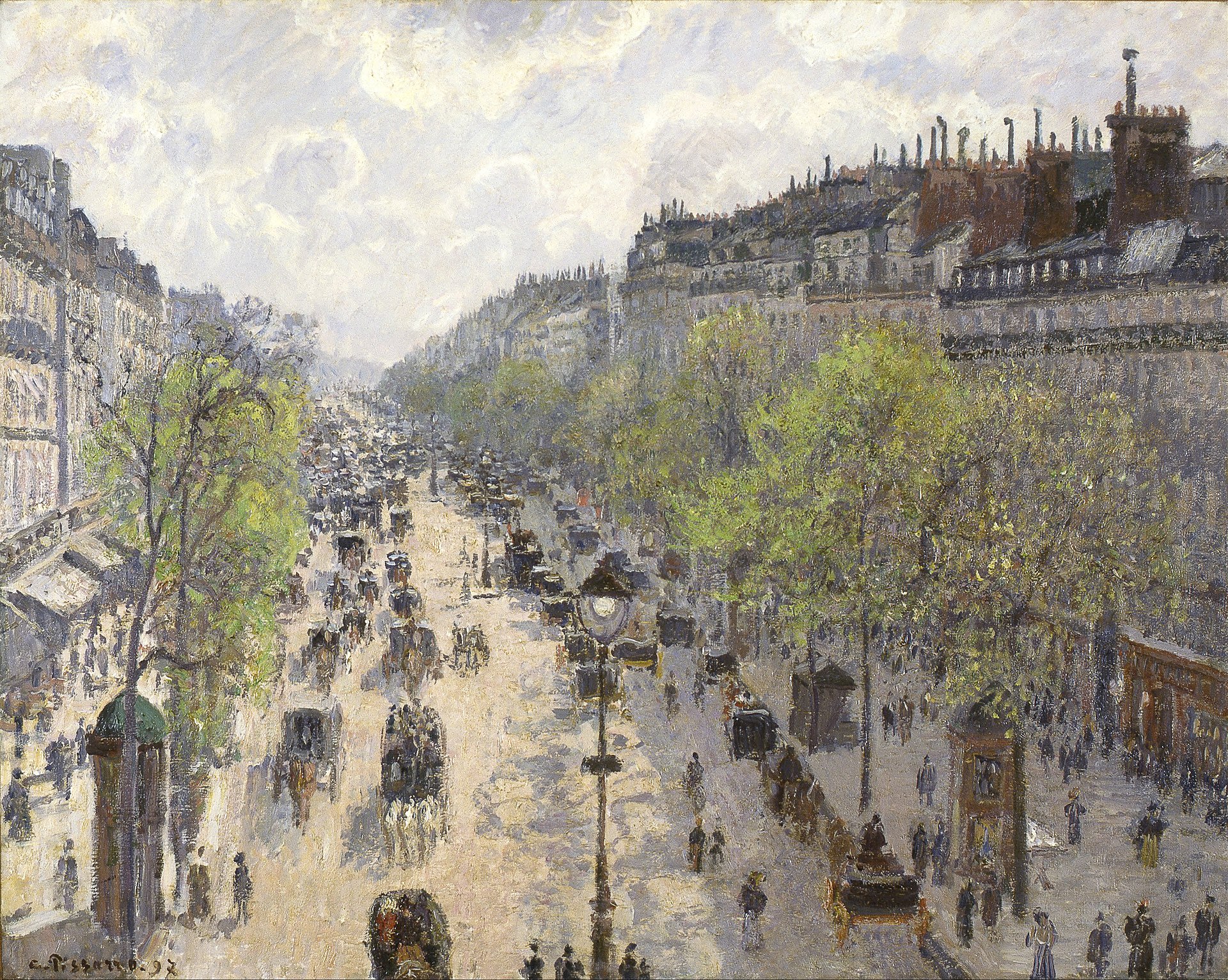
When Pissarro could no longer paint outdoors due to an eye disease that caused him to constantly tear up, he began to substitute the French countryside with urban landscapes, where Paris would be the main protagonist. This change began to take shape in 1888, the year he also sent a series of drawings bound in a book to his nieces, Esther and Alice Isaacson. Pissarro would not allow his eye disease to prevent him from painting, and although he experimented with capturing the scene with only one eye, he found a better solution in enclosed spaces. It was thus that he wrote to his son Lucien in a letter: “I will do a series of boulevards, where I intend to show the effects of light, I will go to Paris, it will be fun for me to overcome the difficulty of perspective seen from above, we have taken a spacious room at the Hotel de Russie from where all the avenues are dominated in succession, if you decide to come to Paris, there are two beds in the room."
To continue understanding this journey, please read our next article: Biography of Camille Pissarro: The Legacy and His Most Famous Works.


