Biography of Carl Larsson, Swedish Realist Painter
Discover the life and works of Carl Larsson, a renowned Swedish realist painter.
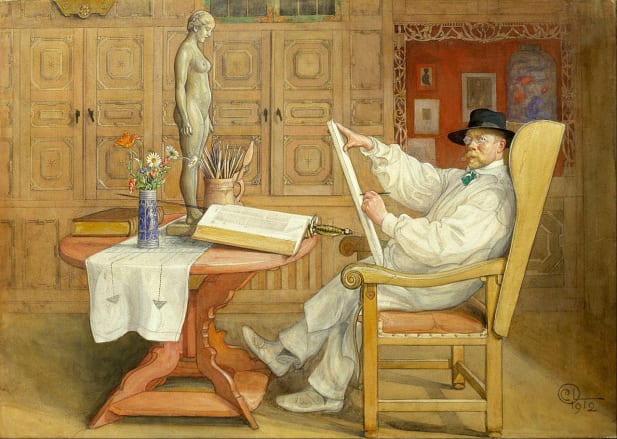
Carl Larsson was a prominent Swedish painter and illustrator, celebrated for his realistic style and captivating depictions of everyday life and Swedish homes.
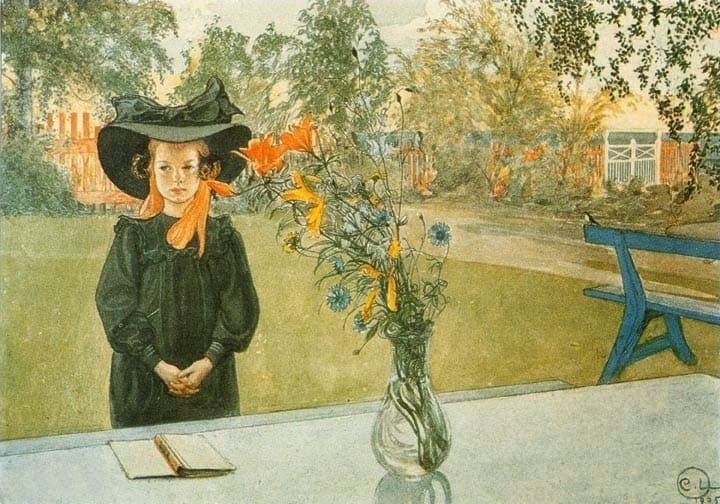
Famous for his beautiful watercolors showcasing family life, interiors, and surroundings of his historic Dalecarlia province home in Sweden.
BIOGRAPHY
Carl Larsson was born in Stockholm, Sweden, on May 28, 1853, to a humble family, and his artistic talent became evident from an early age.
Initially facing difficulties in pursuing an artistic career due to financial constraints, he eventually received a scholarship and was able to study at the Royal Swedish Academy of Arts in Stockholm.
At the Academy, he learned various techniques and styles, including oil painting and drawing. During this period, Carl also developed an interest in Italian Renaissance and medieval art, which influenced his later work.
After completing his studies, Larsson began working as an illustrator and painter, achieving notable success. His illustrations were published in popular magazines and books of the time, and his work gained recognition and admiration in Sweden and abroad.
In 1877, Carl traveled to Paris for the first time and in 1881 joined the Scandinavian Artists' Colony in Grèz-sur-Loing, where he started painting in watercolor and met Karin.
Carl and Karin Larsson married at the end of 1882, and in 1884, their first daughter, Suzanne, was born. Their second child, Ulf, was born in 1887, but unfortunately, he passed away at the age of 18.
In 1888, the couple returned to Sweden with their two children and decided to settle permanently in Sweden. Their father-in-law, Adolf Bergöö, gave them a wooden cabin in the central Swedish countryside, which belonged to relatives.
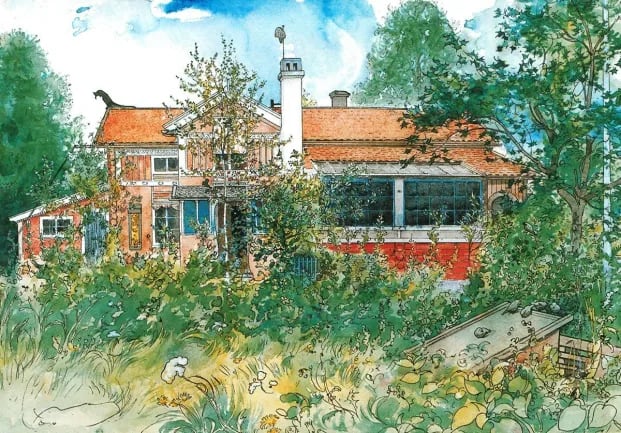
Karin Larsson was a young mother, but above all, a ambitious woman who, although she had distanced herself from painting, had replaced the canvas with other artistic objectives that would see her use needles, threads, and silks instead of brushes and paint.
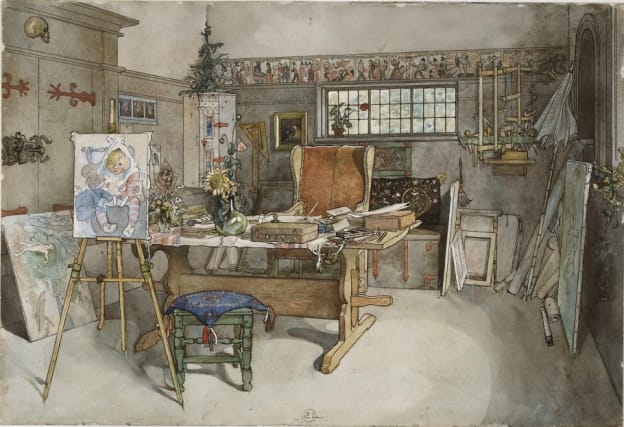
Carl created a series of twenty-six watercolors, titled The Home, which depicted the beautiful interior designs of their home, featuring his wife and children.
Carl and Karin had eight children. After Ulf, came Pontus in 1888, Lisbeth in 1891, Brita in 1893, Mats in 1894, but he died at just two months old, Kersti in 1896, and finally Esbjörn in 1900.
However, it was with his interior paintings and family scenes that Larsson achieved his greatest fame. Alongside his wife, Karin Bergöö Larsson, he created moving and detailed images of their life in the countryside, in their home in Sundborn.
In 1911, his sketches for Midvinterblot were rejected. The painting depicts a Norse mythology legend in which the Swedish king Gustav Vasa is sacrificed to prevent famine, during the Winter Solstice.
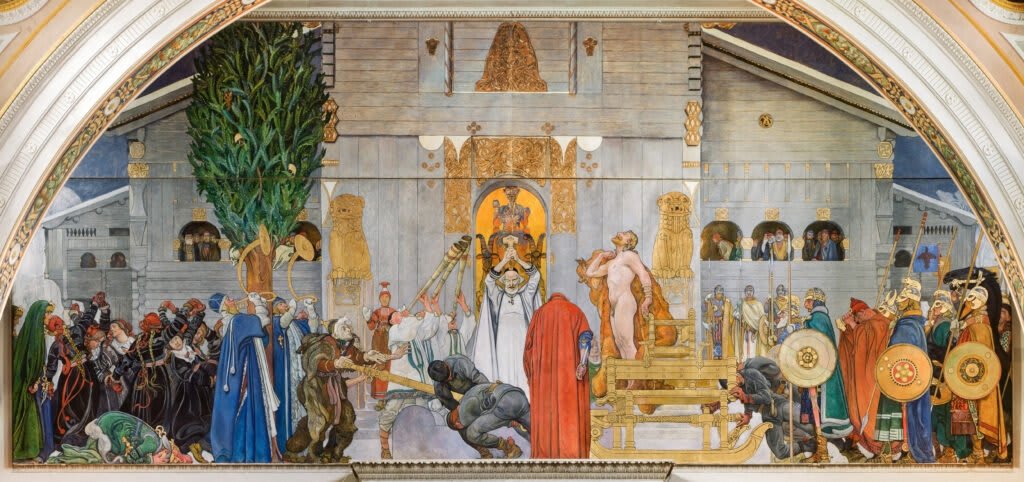
In 1992, in celebration of the artist's bicentenary, the National Museum held a major exhibition of Carl Larsson's work, and Sacrifice of the Winter Solstice, was loaned from its Japanese owner and displayed in the entrance hall for the first time since 1915.
Three hundred thousand visitors attended the exhibition, and the majority were positive about the painting.
In 1997, after long negotiations and thanks to the generous financial support of private donors and foundations, the National Museum was able to acquire Larsson's masterpiece and return it to its homeland.
COMMENTED ART - MIDVINTERBLOT (Sacrifice of the Winter Solstice)
When Carl Larsson completed his painting showing the Swedish king Gustav Vasa entering Stockholm, there was only an empty wall panel in the museum.
As opposition to the proposed painting grew, his determination to complete the project also increased. As the most famous painter in Sweden, he invested all his artistic prestige and completed the vast painting at his own expense.
In 1915, he finished the massive painting, which was temporarily hung in the National Museum, but after much debate, the painting was rejected.
He passed away on January 22, 1919, due to a cerebral hemorrhage.