
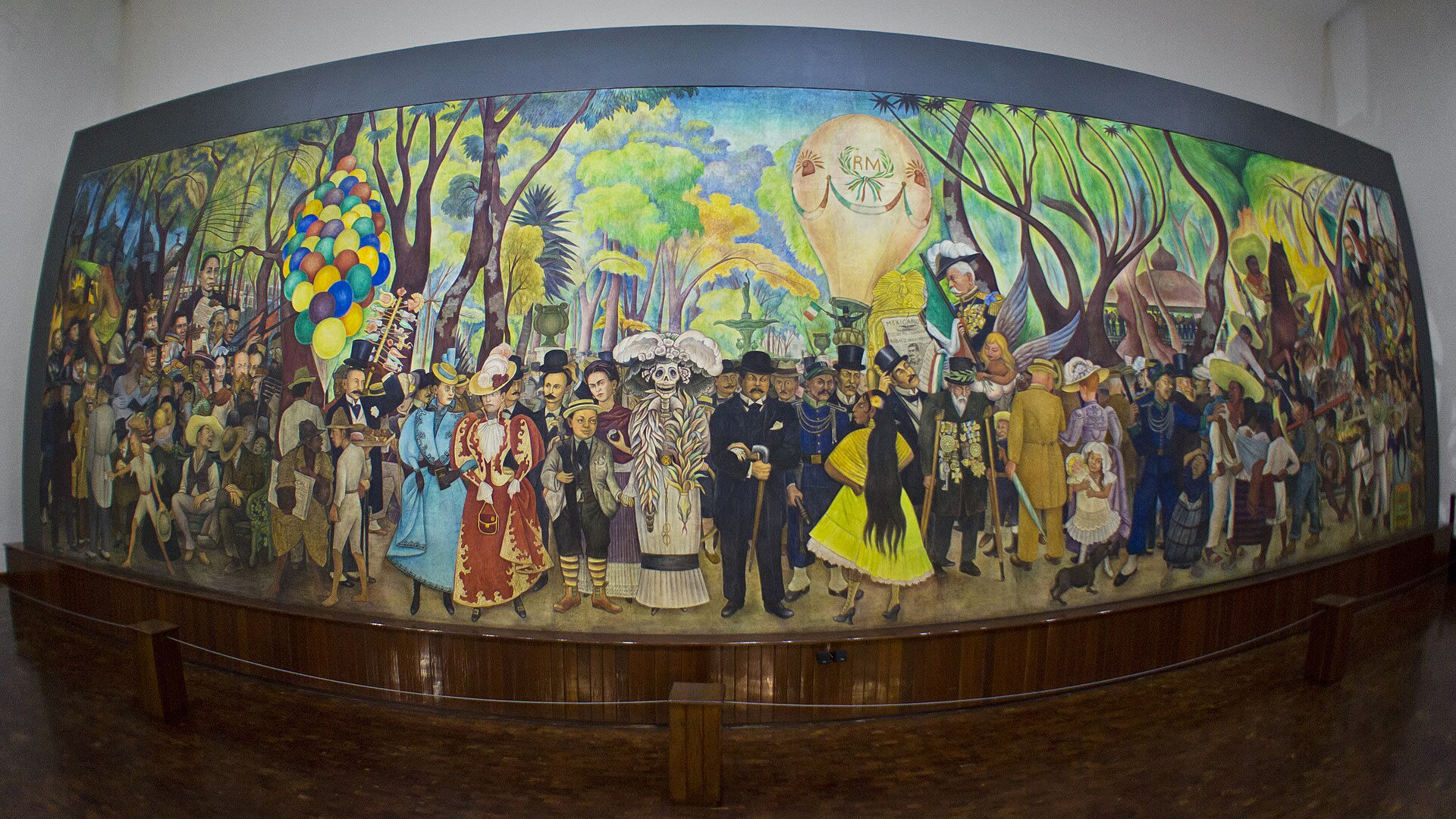
Biography of Diego Rivera: Rise, Loves and Artistic Revolution (Part 1)
Biography of Diego Rivera: Rise, Loves and Artistic Revolution (Part 1)
Diego Rivera was a renowned Mexican artist who revolutionized the art of his nation by creating murals that made him a global icon, not only for his art but also for his strong political convictions and his personal involvement with Frida Kahlo.
BIOGRAPHY
Diego Rivera was born on December 8, 1886, in the Mexican city of Guanajuato. In 1892, his family left the city due to the unpopularity of his father, who was a liberal.
At the age of ten, he already demonstrated great artistic talents. In 1907, he received a scholarship to study abroad. He lived in Spain and traveled throughout Europe, where he was influenced by the work of fauvist painters, Cézanne, and especially by the primitivism of Rousseau.
In 1910, he had his first successful exhibition in Mexico City. The following year, he returned to Europe and settled in Paris. His main artistic contracts at that time were with the Russians.
In Paris, Rivera was influenced by the work of the cubists, as seen in the painting "Portrait of Two Women", but in 1917, he broke away from that artistic style.
In 1919, he traveled to Italy, where he discovered the affresco works of great artists. Two years later, he returned to Mexico, where he used the affresco technique to paint murals. Although he adopted this classical technique, Rivera abandoned the European style for a new and popular visual, influenced by the Aztecs, cubists, and Henri Rousseau. During this period, he joined the Communist Party and his political affiliation inspired the right-wing students to a revolt at the National Preparatory School, where Rivera was working.
At this time, Rivera was drawn to the attention of the student and artist Frida Kahlo, who would later become his wife.
In 1923, Rivera began working on a series of murals for the Ministry of Education. His work was heavily criticized due to its political content, but it attracted attention from abroad.
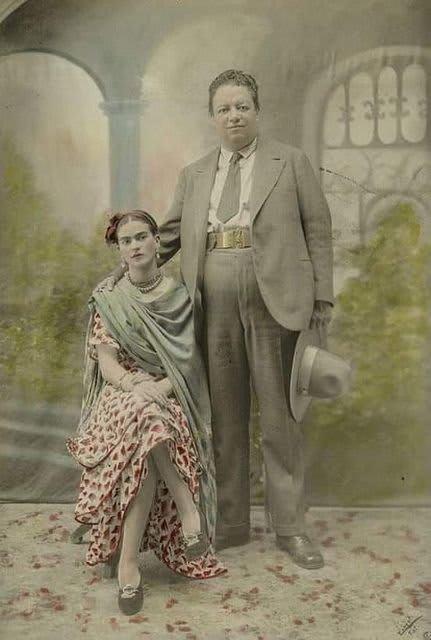
In 1927, he was invited by Russia to participate in the tenth anniversary of the Revolution. He agreed to paint a mural for the Red Army Club in Moscow, but he encountered difficulties and disagreements while working. A year later, he was sent back home by the Latin American Secretariat of the Comintern, and in 1929, he was expelled from the Communist Party.
Back in Mexico, Diego married Frida and created some of his most important works by painting numerous frescoes in the Cortez Palace.
In 1931, Rivera and Kahlo traveled to New York, where they became celebrities after Rivera's retrospective at the MOMA broke all attendance records. The greatest scandal of his career occurred during this trip when he portrayed Lenin in a mural for the Rockefeller Center. Rivera was not allowed to complete the work, which was eventually destroyed. After the controversy surrounding this mural, it became difficult for him to find commissions.
After his expulsion from the Communist Party, he sided with the Trotskyists, and the couple Rivera and Kahlo received Leon Trotsky and his wife in Mexico in 1937.
The passionate and tumultuous relationship between Rivera and Kahlo ended in divorce in 1940, when Frida discovered that Diego was having an affair with her sister Cristina Kahlo. However, the couple reconciled and remarried.
By the end of the 1940s, Rivera began his campaign to be readmitted to the Communist Party. He achieved his goal in 1954, but by then, with Frida's death and his poor health, he was unable to enjoy his success.
The artist was married four times. The Russian painter Angelina Beloff was his first wife, with whom he had a son. After Angelina's death, he married Guadalupe Marín, with whom he had two daughters. As a widower again, Frida Kahlo was his third wife. His last wife was Emma Hurtado.
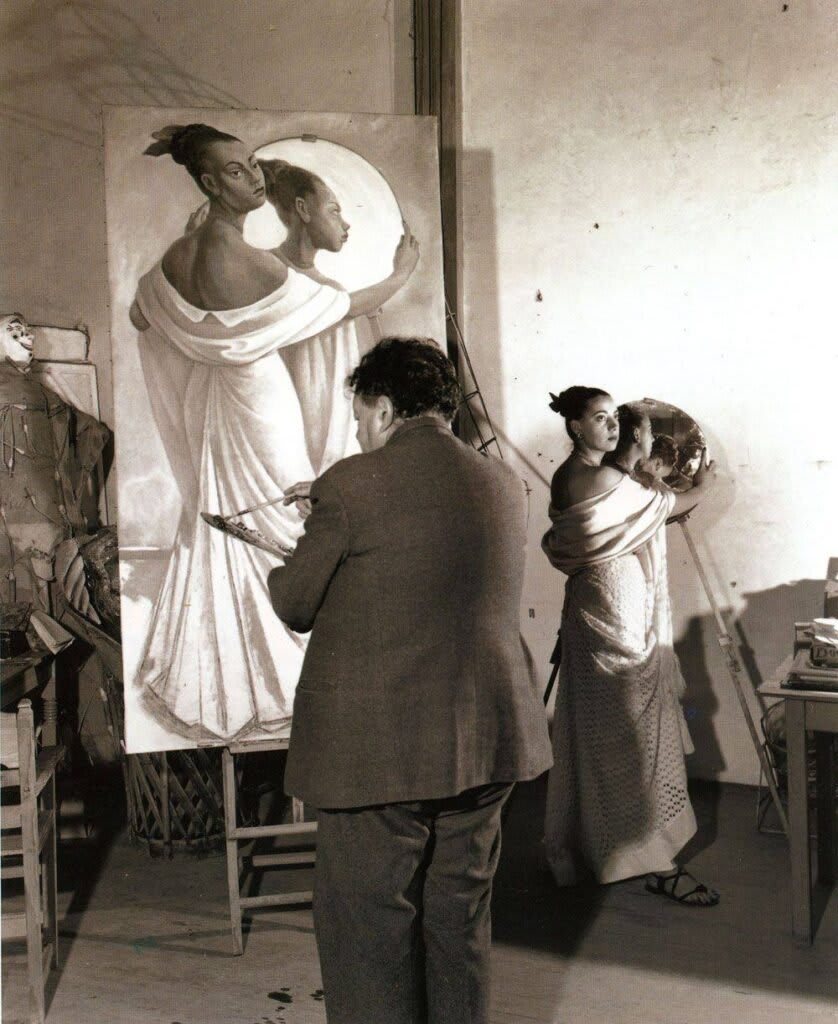
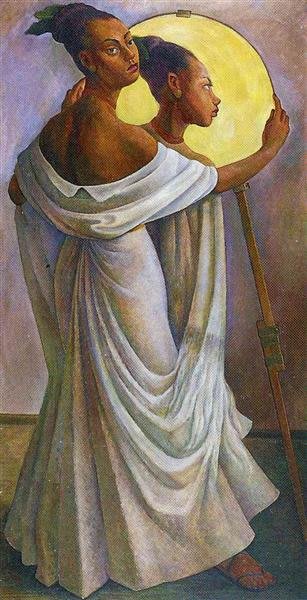
We have a photo of Diego Rivera in his studio in 1949, painting his daughter Ruth Rivera, the fruit of his second marriage with Guadalupe Marín.
Diego Rivera passed away in 1957, due to cancer. Before his death, he requested that his ashes be mixed with those of Frida, who had died three years earlier, and be kept in the Blue House, the couple's residence. His wishes were not respected by his wife at the time, Emma Hurtado.
Commented Work
To understand the rest of this journey, continue to our next article: Biography of Diego Rivera: Masterpieces, Murals, and Immortal Legacy (Part 2).


