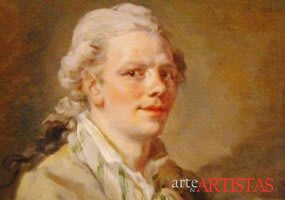
Biography of Jean-Honoré Fragonard
Discover the life and works of Jean-Honoré Fragonard, a French painter of the 18th century.
Article Index
Jean-Honoré Fragonard was a French painter who lived in the 18th century and worked mainly during the worst excesses of the French aristocracy, just before the French Revolution.
He is considered the most intelligent of the late Rococo painters and, in fact, one of the most refined artists of the century.
His works represent all the joy of life and lightness, all the grace of this peculiar style of the artist.
BIOGRAPHY
Jean-Honoré Nicolas Fragonard was born on April 5, 1732, in Grasse, a village on the French Riviera.
He was born into a family of artists; his father was a perfumer and his maternal grandfather was a painter.
When he was just six years old, his family moved to the big city of Paris, where he began working as a clerk in a law office.
Fragonard was fired for constantly drawing instead of working.
In 1747, he fulfilled his desire to receive official artistic training when he worked in the studio of the renowned painter Jean-Baptiste-Siméon Chardin, as an apprentice.
Being a very dedicated worker, he quickly progressed and the following year moved to the studio of François Boucher, the most famous Rococo artist of the time.
During this period, he spent some years in Italy and enrolled in the Royal Academy of Painting and Sculpture.
Although his teachers considered him unexpressive, he spent a lot of time in the Italian countryside drawing famous gardens and perfected the pastoral style.
In 1765, he returned to Paris and was admitted to the Royal Academy, producing a moderate work with scenic paintings based on his Italian landscape drawings remembered during his stay in that country.
It was between 1765 and 1770 that Fragonard really stood out and became a great success, initially executing fanciful, suggestive, and erotic portraits of prominent city figures.
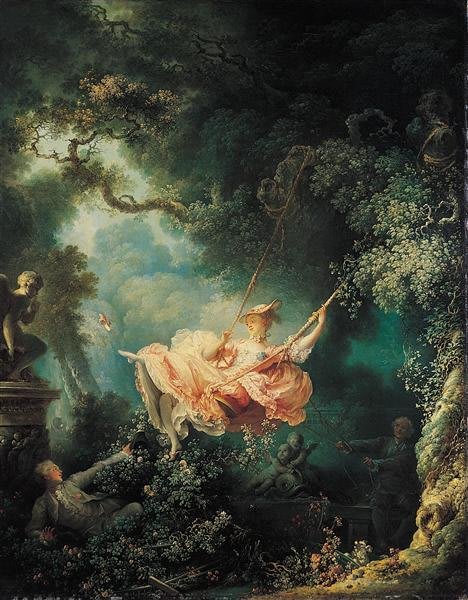
His work in this period exemplified his style with pastel colors, a quick brushstroke that gave immediacy to his paintings and a prismatic lighting scheme; he completed his erotic masterpieces, such as The Swing, which truly represent the Rococo movement.
Although attacked by French Enlightenment philosophers, such as Denis Diderot, who proclaimed his works silly to an embarrassing degree, the artist received many commissions.
Although they came from the government, private commissions also arrived, particularly from Madame du Barry, the notorious mistress of Louis XV.
In 1773, Fragonard married Marie-Anne Gerard, a miniature painter.
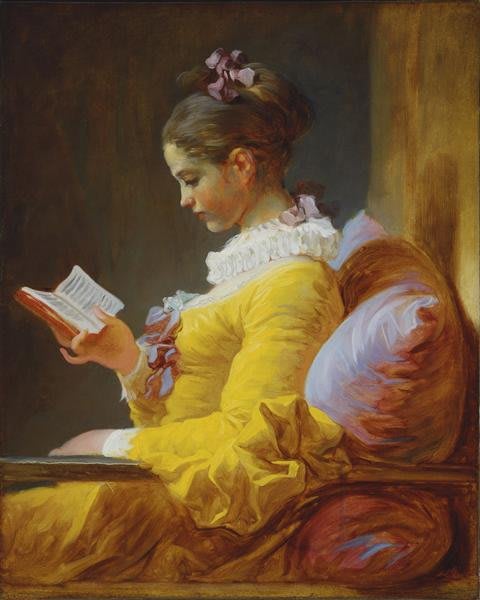
They had a daughter, Rosalie, who became one of his favorite models, he executed a series of portraits of young girls reading, with his daughter as his model, until her death around 19 years old.
Later, he had a son, Alexandre-Evariste, who also became an artist.
In 1789, during the most turbulent phase of the French Revolution, Fragonard's main client base was eliminated under the merciless guillotine.
Without business in Paris, he traveled to Provence to wait out these somber days with his family.
However, not being a man to be defeated, the artist returned to Paris just a year later and became essential in working with the new government to help administer the National Museum in the Louvre.
Fragonard was one of the last great exponents of Rococo, a artistic style replaced by Neoclassicism in the 1780s.
Although his style fell out of favor, his works were rediscovered in the 19th century and have since been highly valued for their delicacy, sensuality, and beauty.
Fragonard died in Paris in 1806, and his work continues to be a great influence on the history of French and European art.
His portraits made him the admired favorite of modern impressionists, coincidentally, the impressionist painter Berthe Morisot is his distant relative.
GALLERY - COMMENTED ART
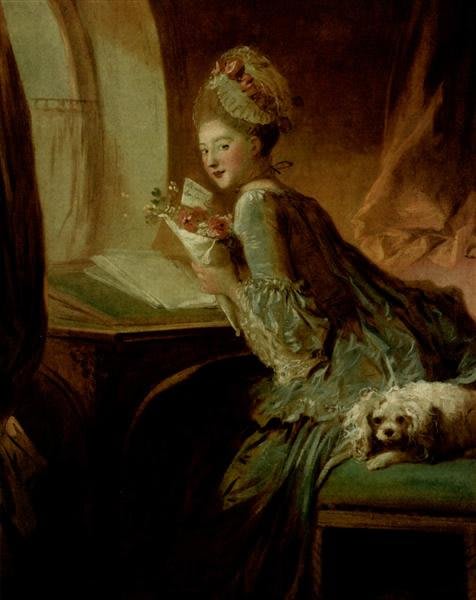
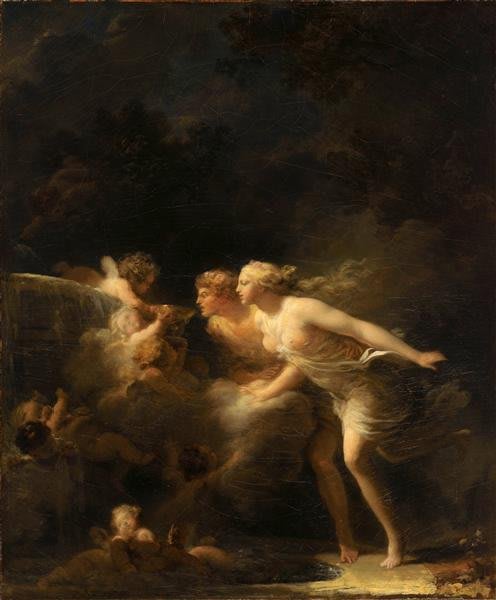
His most famous works reflect his ability to capture the beauty, elegance, and sensuality of life in the aristocracy of the time.
The Swing - Considered his masterpiece, at first glance, the painting appears to be a simple image of an innocent young girl playing, but it soon becomes clear that the scene is deliberately risqué and quite mischievous.