
Biography of Joan Miró and His Works: Consolidation, Wars, and Global Recognition
Explore the life and art of Joan Miró, from his early works to his global recognition during World War II and beyond.
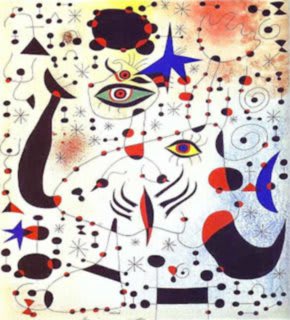
The start of World War II coincided with his most famous series, titled Constellations. "It was a long and hard work. Some forms suggested others, which, in turn, claimed others to balance them. And these, others, was the endless story,"
confesses Miró with his picturesque language and accent.
Art has long served as a profound response to the chaos of conflict and social revolution. Liberty Leading the People - Eugène Delacroix
From the period of World War II, some of Joan Miró's most lyrical and famous works are those that make up the series "Constellations," in which he seems to conjure entire skies to counter the blind fury unleashed by war.
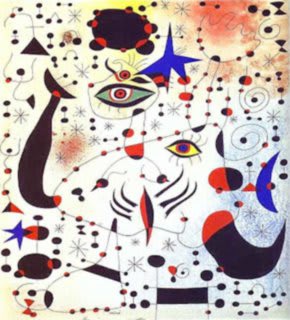
Thanks to the creation of works in this series, Miró was able to survive without spiritual shipwreck in the collective hell, declaring: "I deliberately enclosed myself: the night, the music, the stars, from then on played a much more important role in my painting".
But history holds a strange detail:
In 1941, Miró exhibits his works on the American continent. Recognized worldwide in his first retrospective, which brings together 73 canvases in a show at the Museum of Modern Art in New York.
From 1944, Miró began working on his works with ceramics and sculpture. He used different materials from the conventional, such as scraps.
The evolution of a master's style across different mediums is a fundamental aspect of an artist's career trajectory. Raphael: Biography and Work: Birth, Training and Rise (Part 1 of 3)
After eight years of absence, he returns to Paris and exhibits at the gallery of a new Marchand, Maeght, who, after a few years, will raise his Foundation.
After dedicating himself to ceramics and engraving for these years, in 1959 he returns to painting. Paris gives him the recognition he deserves with a great anthological exhibition, 241 works at the Museum of Modern Art. Many honors and awards follow, such as the commission of the great mural of ceramics for the Guggenheim of New York.
In 1969, it was the turn of the Motherland to recognize his value. He holds a retrospective with 396 works in the Hospital of Santa Creu, which welcomed the death of Gaudí, his compatriot.
The great Palais of Paris, in 1974, brings together his sculpture, ceramics, and painting, nothing less than the patronage of the French Government. The following year, the Miró Foundation is inaugurated. He paints tirelessly, with pencil or brush. The more life and strength are shortened, the larger his canvases and murals are.
One of his greatest works was the mural of the Congress Palace in Madrid.
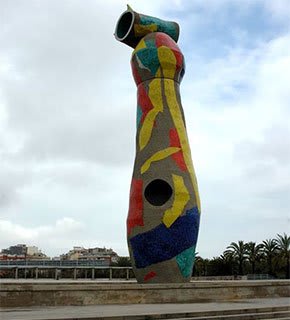
The world bows to his art with anthologies to commemorate the artist's birthday. Madrid commissions him to create the great mural of the Palace of Congresses and names the adjacent square after him. He creates two 12-meter sculptures in Chicago and Kansas City and another 22-meter sculpture in Barcelona.
Much like Miró, other contemporary artists have left an indelible mark on history through their unique visual language. Romero Britto and His Work
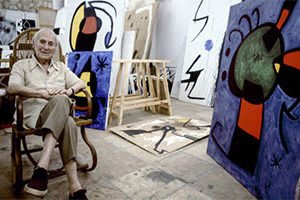
On November 30, 1981, at three o'clock, the plane took off from Palma that would take Miró for the last time to Barcelona, to complete some sculptures. On December 17, he returned exhausted to Palma. Six days later, a thrombosis marked the beginning of the end. The more he aged, the larger his projects and the more difficult they were to realize.
Miró and his art survived the conflicts of the two great wars and gained definitive international recognition. Painter of intense reds, blues, greens, and yellows, of puppets at the same time wise, infantile, and unsettling, he died at three o'clock on a Christmas Day, on December 25, 1983, in Palma de Mallorca at the age of 90, rich and successful, celebrated all over the world as one of the greatest artists of the 20th century.
"He was the most surrealist of us all," the leader of the movement, the writer André Breton, once said.
Biography of Joan Miró: A Detailed Gallery of His Greatest Creations
To understand the rest of this journey, continue reading our next article: Biography of Joan Miró and His Works: A Detailed Gallery of His Greatest Creations.


