
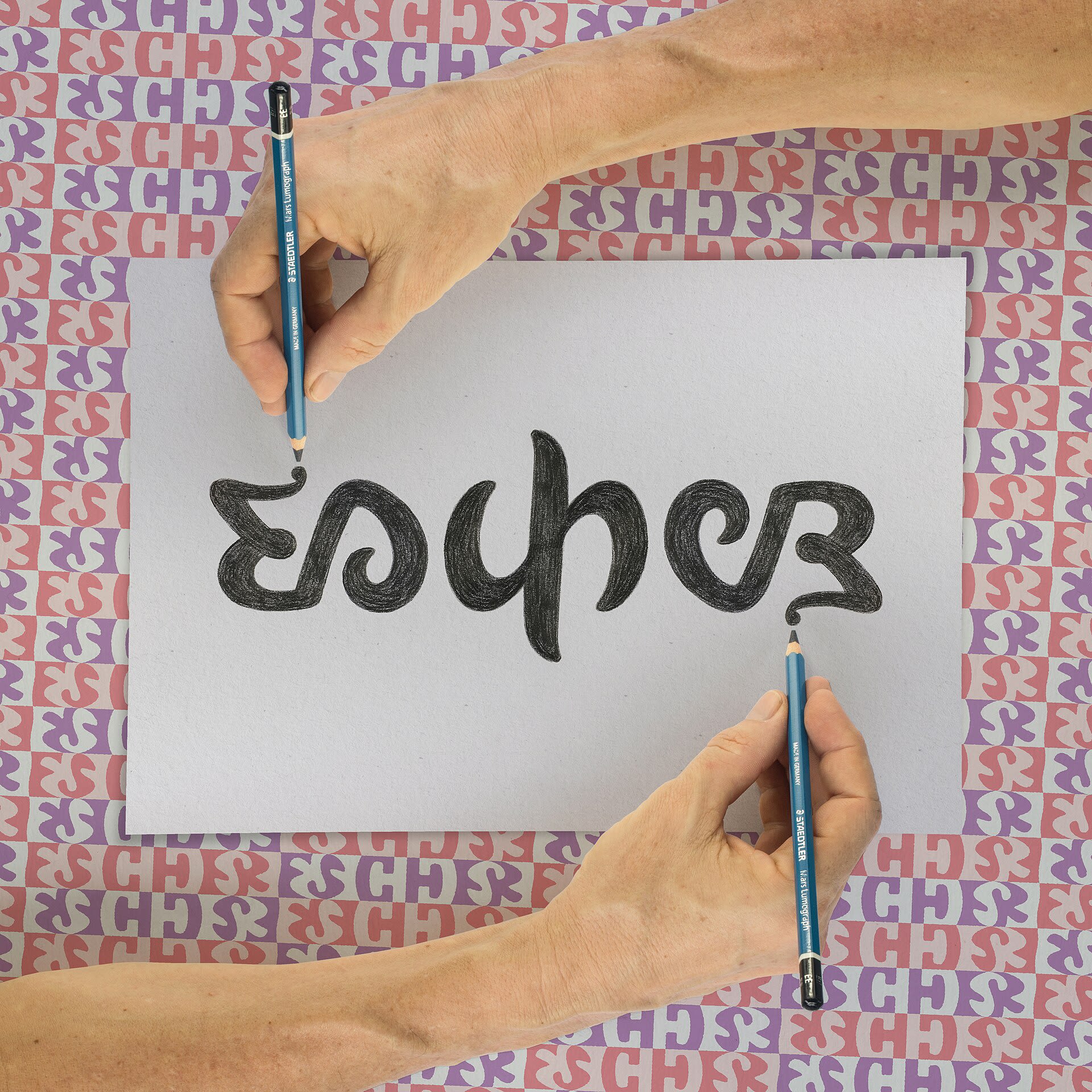
Biography of Maurits Cornelis Escher: Childhood, Education and the Quest for Infinity
Discover the fascinating story of Maurits Cornelis Escher, from his childhood in the Netherlands to his first steps in exploring the infinite in his art.
Maurits Cornelis Escher was one of the most important illustrators of the 20th century, whose innovative works explored patterns of perception, space, and transformation.
Known for his highly detailed, realistic prints that achieve bizarre optical and conceptual effects, he has a unique style.
He did not fit into any artistic movement, although some critics relate his work to surrealism.
Biography
Maurits Cornelis Escher was born on June 17, 1898, in Leeuwarden, Netherlands. He was the youngest of five children to Sarah and George Escher.
From an early age, Maurits had the ability to visualize distinct spatial patterns, and despite not doing well in many of his earlier studies, he attended the Haarlem School of Art and Architecture.
There, Escher decided to specialize in graphic arts under the recommendation of his mentor, Samuel Jessurun de Mesquita.
His earlier work included innovative nudes and portraits made in xilogravures, linocuts, and litographs, such as the interconnected Eight Heads of 1922.
Maurits Cornelis Escher traveled to the Mediterranean in the early 1920s and was deeply influenced by the wonders of the Alhambra Palace, designed by Moors, in Granada, Spain.
In 1923, he met Jetta Umiker and soon married her, having three children.
Establishing a home in Italy, in Rome, with his family, Escher worked on prints that captured natural landscapes, playfully experimenting with perspective, orientation, and shadow.
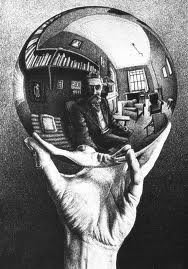
He also created work focused on the human figure, including a representation of his wife in 1925 and several self-portraits, such as Hand With Reflecting Sphere (Mão com Esfera Refletora), from 1935.
Works and Influences
In 1935, with the rise of fascism in Italy, the Eschers moved to Switzerland but soon made a sea journey to Spain, returning to the Alhambra Palace and visiting La Mezquita de Córdoba.
From his admiration for the mosaics of Arab palaces, Escher developed a technique that allowed him to insert figures and shapes into polygons without altering the original area.
Representing space (three-dimensional) in a plane (two-dimensional) was a mathematical challenge for Escher, resulting in fantastic works of optical illusion.
In La Mezquita, he was inspired by the complex designs of the structures and focused even more on the patterns of mosaico and repetition, often presenting intertwined and overlapping images that transformed into something more, as seen in the series titled "Metamorfose".
Post-War Period
In 1937, the family had moved to Belgium, but with the Nazi forces' invasion, they moved back to the Netherlands in 1941.
From 1940, Escher worked on the idea of creating infinity in finite space.
Going beyond perspective and creating infinite space in the two-dimensional paper, as seen in the print Each Time Smaller.
Final Works
Escher continued to create surrealistic landscape works such as Up and Down - 1947 (Up and Down), Drawing Hands - 1948 (Drawing Hands) , Gravity - 1952 (Gravity), Relativity - 1953 (Relativity), Print Gallery - 1956 (Print Gallery) and Ascending and Descending - 1960 (Ascending and Descending).
From 1962 to 1970, he worked regularly, except when some health problems forced him to temporarily step away from his artistic life, undergoing several surgeries.
After a series of operations, he settled in the Rosa Spier House nursing home in Laren, in the north of the Netherlands.
Despite his fragile health and the many concerns it raised, he still managed to attend the publication of the book "The World of M. C. Escher."He died on March 27, 1972, at the age of 73, in the Hilversum Hospital in Laren, Netherlands.
Legacy
Besides becoming an internationally acclaimed artist with numerous exhibitions, Escher was supported by mathematicians and scientists, while many of his works precisely studied incorporate concepts around geometry, logic, space, and infinity.
He left a legacy of over 2000 works. His work continues to be exhibited and admired.
Many scholars continue to explore the mathematical implications of his unique and peculiar art.
Continue Reading
To understand the rest of this journey, continue to our next article: Maurits Cornelis Escher: Esthetics, Techniques, and Visionary Works (Part 1).


