
Dadaism
Dadaism: A Movement of Rebellion and Innovation
The Dadaism was an artistic and literary movement that originated in Zurich, Switzerland, and reached its peak between 1916 and 1923.
Influenced by other avant-garde movements such as cubism, futurism, constructivism and the expressionism, its production was extremely diverse, ranging from performance art to poetry, photography, sculpture, painting, and collage.
The Dadaist aesthetic, marked by its mockery of materialist and nationalist attitudes, proved to be a powerful influence on artists in many cities, including Berlin, Hanover, Paris, and New York, who formed their own groups.
The movement dissipated with the establishment of Surrealism, but the ideas that gave rise to it became the cornerstone of various categories of modern and contemporary art.
World War I and, as we all know, millions of people died all over the world.
Life itself seemed like an unbearable hell.
On one side were the cannons that shattered bodies, and on the other a economic crisis that affected every living being.
Dadaism sought to create an anti-art style, an open provocation to the use of reason and established order.
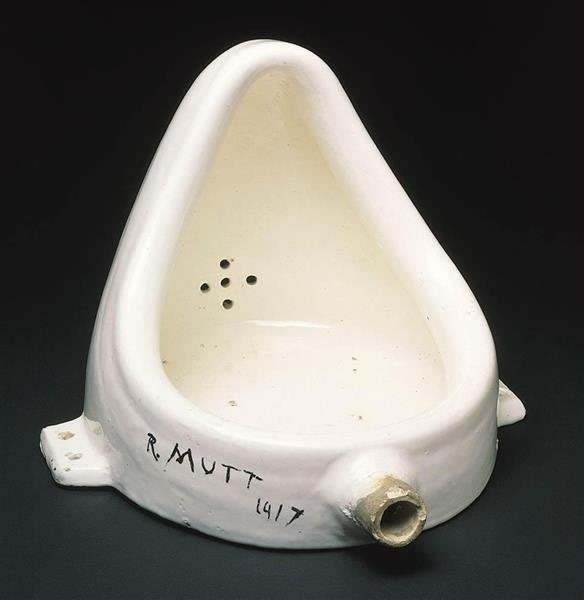
Like Duchamp's readymades, the Dadaists did not shy away from experimenting with new media.
For example, Jean Arp– a pioneering Dadaist sculptor – explored the art of collage and the potential of randomness in his creation.
Man Ray also played with the arts of photography and aerography as practices that distanced the artist's hand and thus incorporated collaboration with chance.
Alongside these artistic means, the Dadaists also probed the literary and performative arts.
Hugo Ball, for instance, the man who wrote the unifying manifesto of Dadaism in 1916, investigated the liberation of written language.
By freeing text from conventional page restrictions, Ball played with the power of meaningless syllables presented as a new form of poetry.
These Dadaist poems were often transformed into performances, allowing this network of artists to move easily between media.
GALLERY - COMMENTED ART
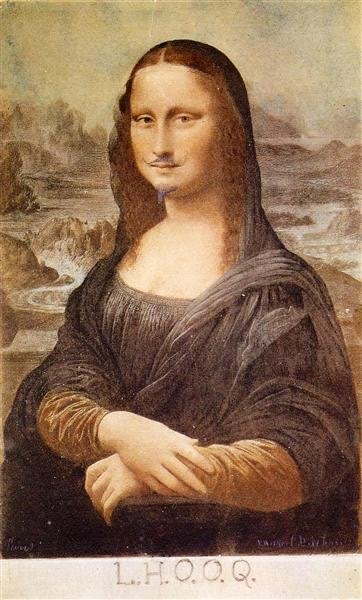
To mock the most visceral and cynical bourgeoisie, Marcel Duchamp takes one of the most representative works of art, intervenes comically, and concludes by placing the letters LHOOQ below the image, which, when spelled out in French, sounds like "Elle a chaud au cul", meaning "She has heat in her ass."
Dadaism also helped to communicate a person's cultural origin through patterns.
Moreover, people also thought that this style of art influenced the war, as it had a significant response to World War I, nationalism, and rationalism.
It was used to express the feelings of artists about how furious they were with the situation regarding the war.
It was also used to mock and communicate the message of nationalist attitudes.
The wooden block head of the mannequin is an inversion of Hegel's statement that "all is mind".
For Hausmann, the man is a headless being "with no more abilities than those that chance has stuck to the outside of his skull".
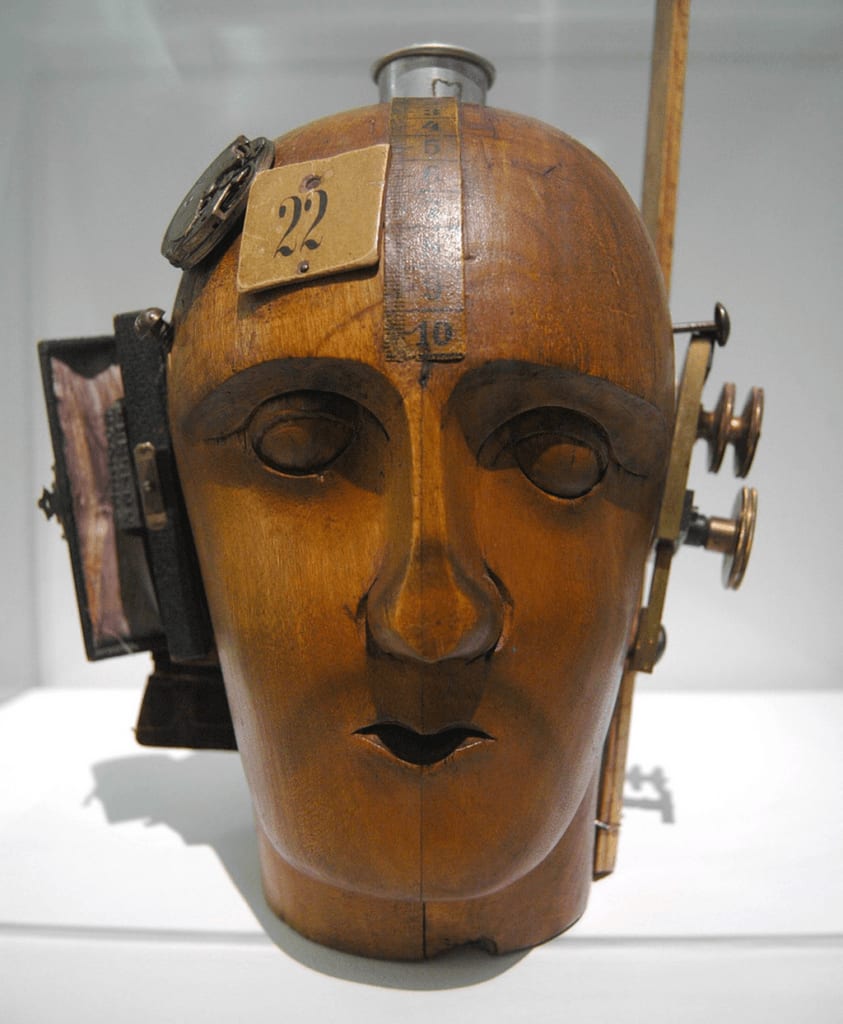
The Dadaists represented objects with a curious appearance, whose function was entirely unknown.
To make their analysis even more difficult, the titles chosen never had any relation to the function of the object used.
In fact, the artists expressed their repulsion towards society, demonstrating that the mechanization of these objects was causing the destruction of the world.

The Violin of Ingres is an illustrated poem in which the author Man Ray presents the back of the model Kiki de Montparnasse, reminiscent of the nudes represented by the neoclassical artist Jean-Auguste Dominique Ingres.
The title came from a popular French expression, meaning "hobby," in reference to the fact that Ingres used to play the violin as a hobby when he wasn't painting.
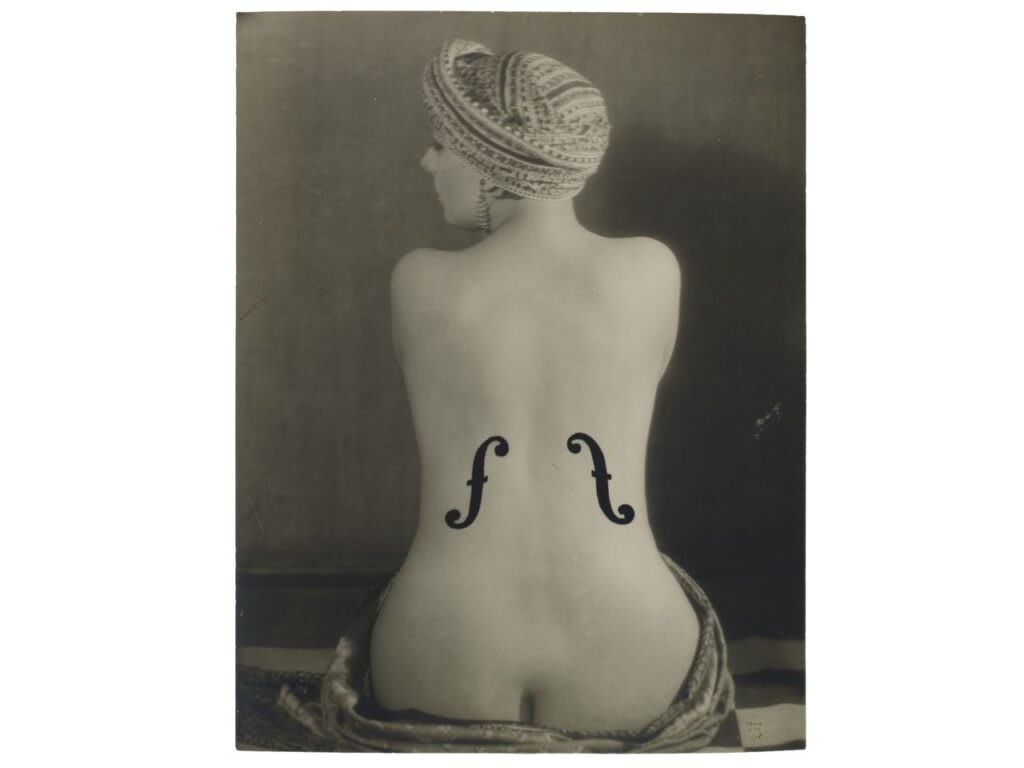
Kiki de Montparnasse was Man Ray's lover and model, as well as a portraitist for important figures in the art world, such as Pablo Picasso, Tristan Tzara, Salvador Dalí, and Peggy Guggenheim.


