Edward Hopper Biography and His Major Works: A Detailed Analysis of Famous Paintings
Edward Hopper Biography and His Major Works: A Detailed Analysis of Famous Paintings
More than almost any other American artist, Hopper had a pervasive impact on how we see the world, so pervasive that it's almost invisible.
A stubborn realist throughout the development of a series of abstract movements, his paintings are clean, smooth, and almost too real. Consistently restrained and subtly suggestive, his works invite us to contemplate the narrative. Depicting individuals who were often isolated and disconnected from their surroundings, Hopper focused on the solitude of modern life. Suggesting much about his emotional experience, as well as the inner psychological life of his subjects, Edward Hopper paved the way for abstract expressionism.
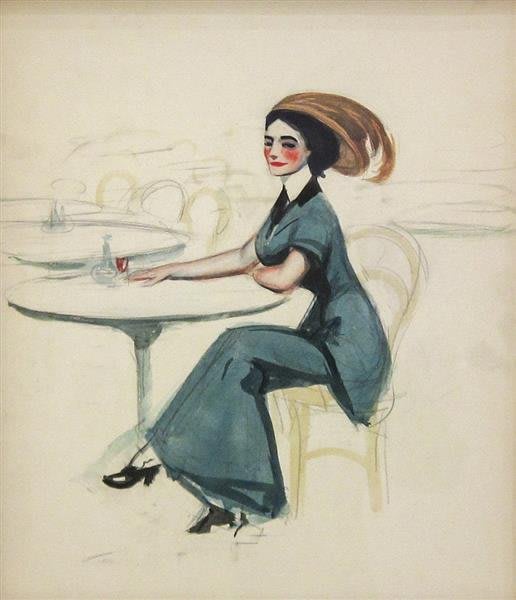
Summertime Interior - Influenced by Degas, this work features a disconsolate female figure who is the primary focus of the piece. The woman depicted sits on the floor beneath a fallen sheet from an unmade bed, adding to the silent chaos of the work; she is entirely engrossed in her own thoughts, paying no mind to the staring viewer. The painting's forms are not abstract, yet there is something hurried in Hopper's brushwork. The woman's right hand, for instance, appears more like a conglomerate of paint than a distinct corporeal form. The window is merely a rectangle with horizontal lines crossing it, as if the painter repeatedly dragged the brush along the outline of the frame.
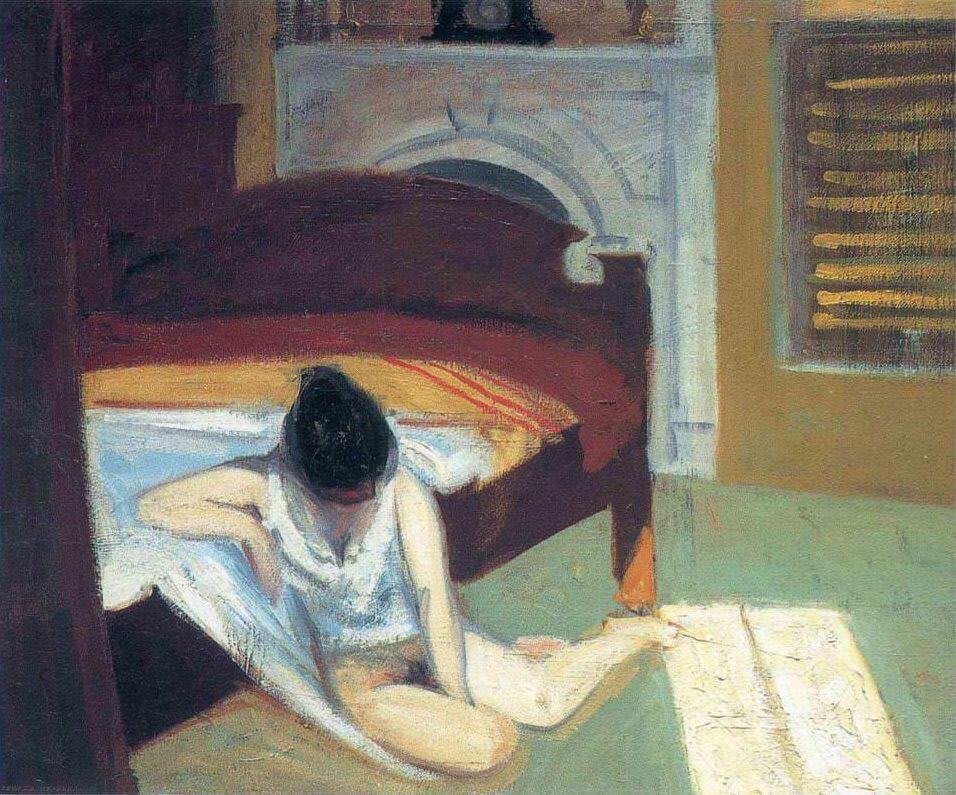
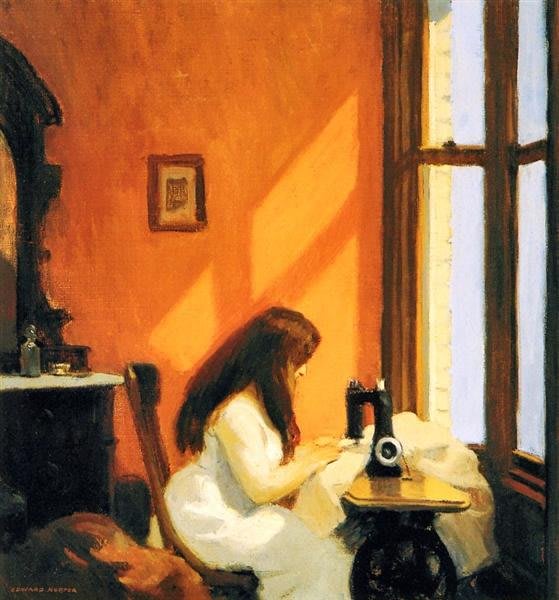
Girl at a Sewing Machine - By the time Hopper painted this work, he had fully consolidated his style. In the center of an urban domestic interior, a young woman with long hair that practically hides her face is absorbed in working at a sewing machine near a window. The composition recalls similar interior scenes painted by 17th-century Dutch school artists.
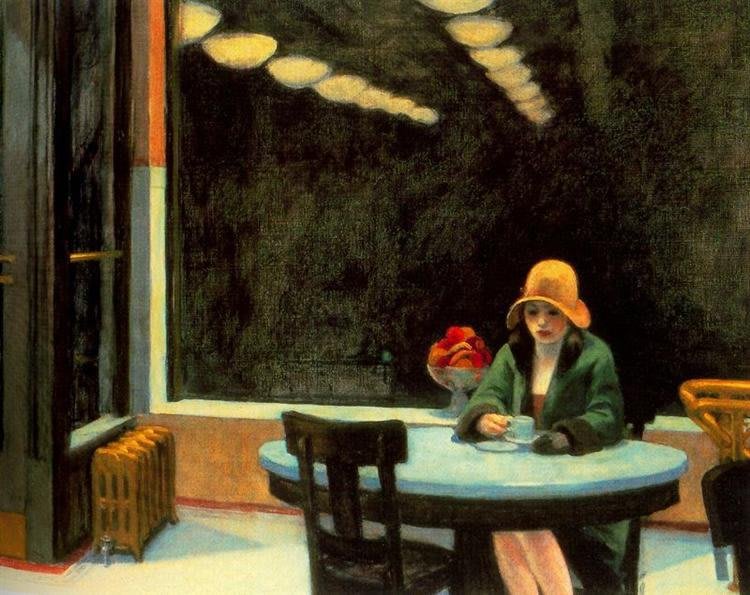
Automat - Hopper captures a woman who has left the busy urban scene fraught with human interaction, taking refuge in a restaurant where she is depicted sitting alone at a table, gazing thoughtfully at her coffee. Characters portrayed in solitary environments are a striking characteristic of the artist's themes. Psychological nuance is added by focusing on a woman immersed in solitude, despite being in a place constantly bustling with people.
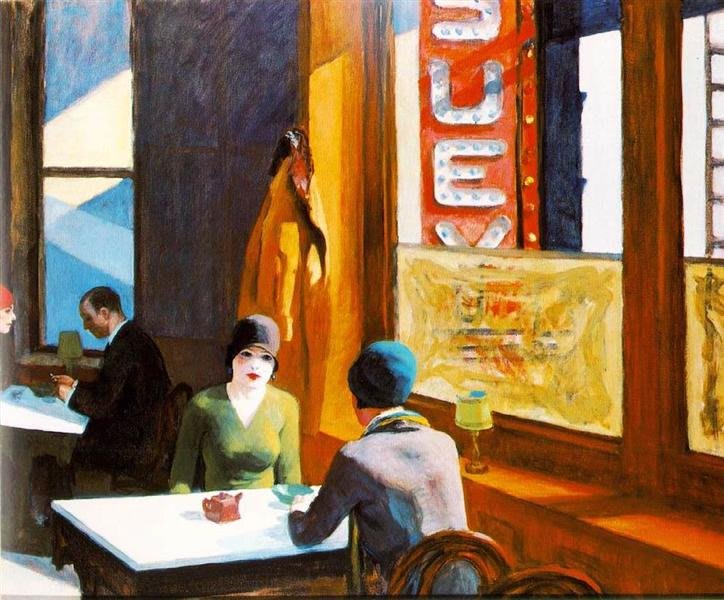
Chop Suey - Hopper's works were highly influenced by 19th-century French painting. In Chop Suey, the artist explicitly references the café scenes of Van Gogh and Édouard Manet, while simultaneously updating and relocating them to modern America. The painting focuses on two women seated at a restaurant table. Despite this company, however, each woman appears alone, lost in her own thoughts in a world of silence, while the couple in the background seems equally uncommunicative. All the details in the painting add a sense of strangeness and alienation to the scene.
In a 1953 interview for Reality Magazine, Hopper stated that “great art is the outward expression of an inner life in the artist, and this inner life will result in his personal vision of the world.”
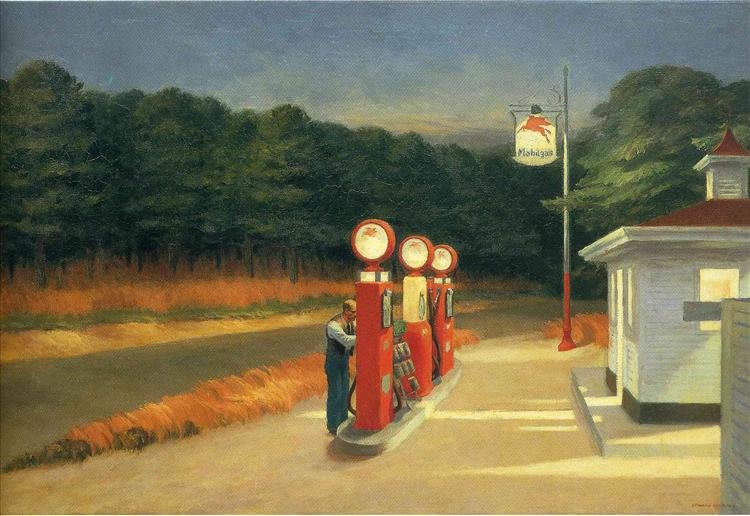
Gas - This painting depicts a single figure, a solitary gas station attendant, in a quiet and somber environment, slightly enlivened by the presence of gas pumps. The insignificance of the figure within the overall effect of the image is clarified by the dramatic treatment of the surroundings. The presence of light spreading across the ground and illuminating the surrounding space, as well as drawing the observer beyond the station to a dark mass of trees through the obvious use of linear perspective, emphasizes its focus.
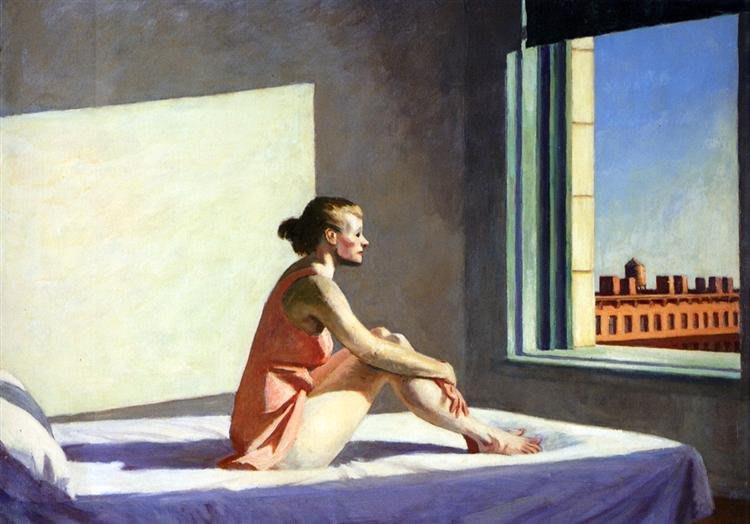
Morning Sun - In this painting, the artist portrays his 68-year-old wife Jo, observed sitting on a bed. The morning sun entering through the window she gazes out of strikes the figure and the empty wall. Hopper obscures the details of her face with a distinct lack of specificity, rendering her expression ambiguous—perhaps thoughtful, perhaps regretful. As in many of his works, the human figure is included to capture a state of mind or suggest a psychological effect, rather than serving as the portrait of a specific individual.
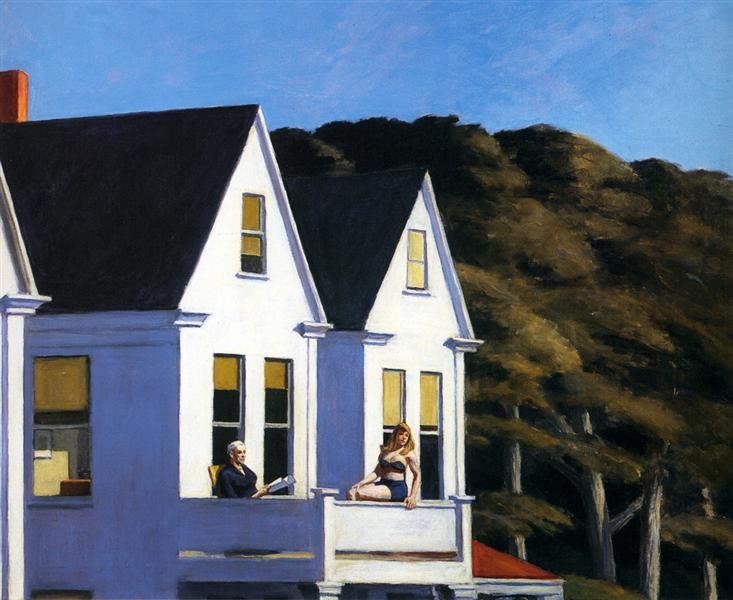
Morning Sunlight - Two figures are seated on the porch of one of the houses; one is a semi-nude young woman sitting on a balcony railing, and the other, an elderly woman reading a book seated in a chair in the sunroom. Hopper's wife, Jo, was the model for both figures, as well as for almost all his paintings. As Hopper said: "I don't think there's any idea of symbolism in the two figures. I was more interested in the sunlight and the figures than in any symbolism."