
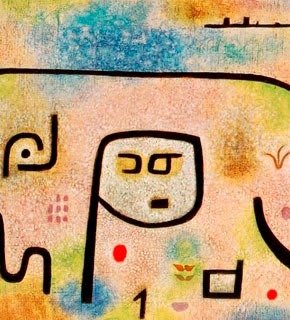
Island of Dulcamara (Democrart) - Paul Klee
Island of Dulcamara (Democrart) - Paul Klee
Island of Dulcamara (Democrart) by Paul Klee is an intriguing work that transports the viewer to an imaginary world full of symbolism and abstraction.
In this text, we will explore the details of this fascinating painting, revealing the complex layers of meaning that Klee infuses into his art.
Join us as we unravel the 'Island of Dulcamara' and dive into the unique and visionary universe of this modernism master, where every line and color tells a deep and enigmatic story.
A World of Imagination
Island of Dulcamara is a work by Swiss artist Paul Klee, and one of his greatest paintings, so much so that his author considered it a panel.
The title has its meaning in Latin Insula (island) and Dulcamara, derived from two words, dulcis (sweet, pleasant) and amarus (bitter).
The Ambiguity of the Island
It is therefore, an ambiguity, which can be a Sweet and Bitter Island.
In 1938, Klee painted seven large panels in horizontal format, among them, we highlight The Island of Dulcamara.
A Joyful Work
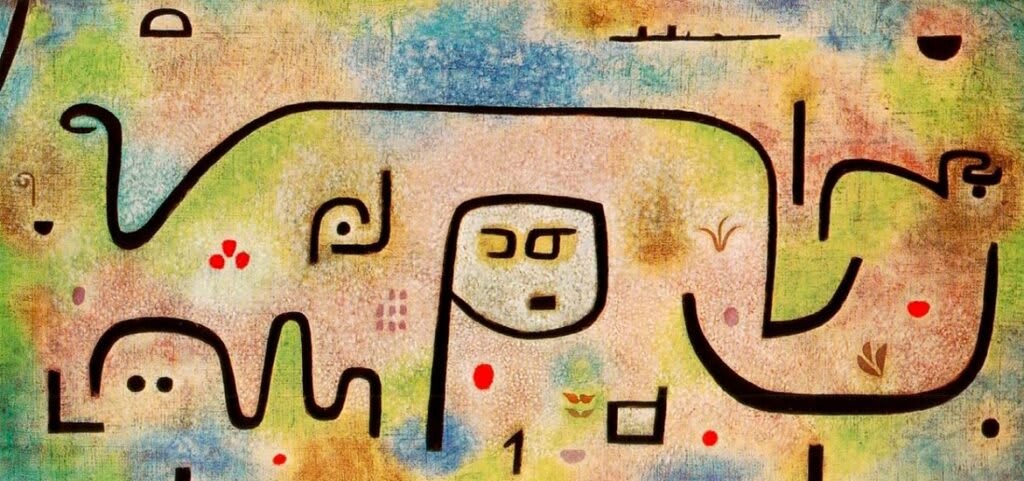
The Island of Dulcamara is a joyful work, with its scattered accessories on a colorful background.
The artist rejected the suggestion that this painting be called Island of Calypso as being too direct, but its design fits into this idea.
The black contours are coastlines, the head is an idol, the other curved lines point to some tragic entanglement.
In the distance, a steamship is sailing;
this does not affect the mythology involved in the theme, more than the celestial signs are contradictory - one represents the sunrise, the other, the setting moon.
The colors are spring-like - a May green, a blooming pink, and a celestial blue.
This is spring in one of the Cyclades, which Ulysses passed on the way to Ithaca.
The Homeric era has not yet ended, but our own has long since begun, and the future with it.
Transparency of time and transparency of space, to where the latter would begin or end, where would be the difference between the sea and the land?
For this, Klee entered the multidimensional without realizing it, although in his youth he thought of this state as his ultimate goal.
A Letter from Paul Klee
About this work, he wrote in a letter:
“We should not fear to be involved in the midst of more indigestible elements. We only have to wait for the most difficult things to assimilate not to disturb the balance. In this way, life is, certainly, more passionate than a very orderly bourgeois life. And each one is free, according to their gestures, to choose between the sweet and the salty of the two plates of the balance. […] With prudence and wisdom, no one will commit great mistakes!” - Paul Klee


