
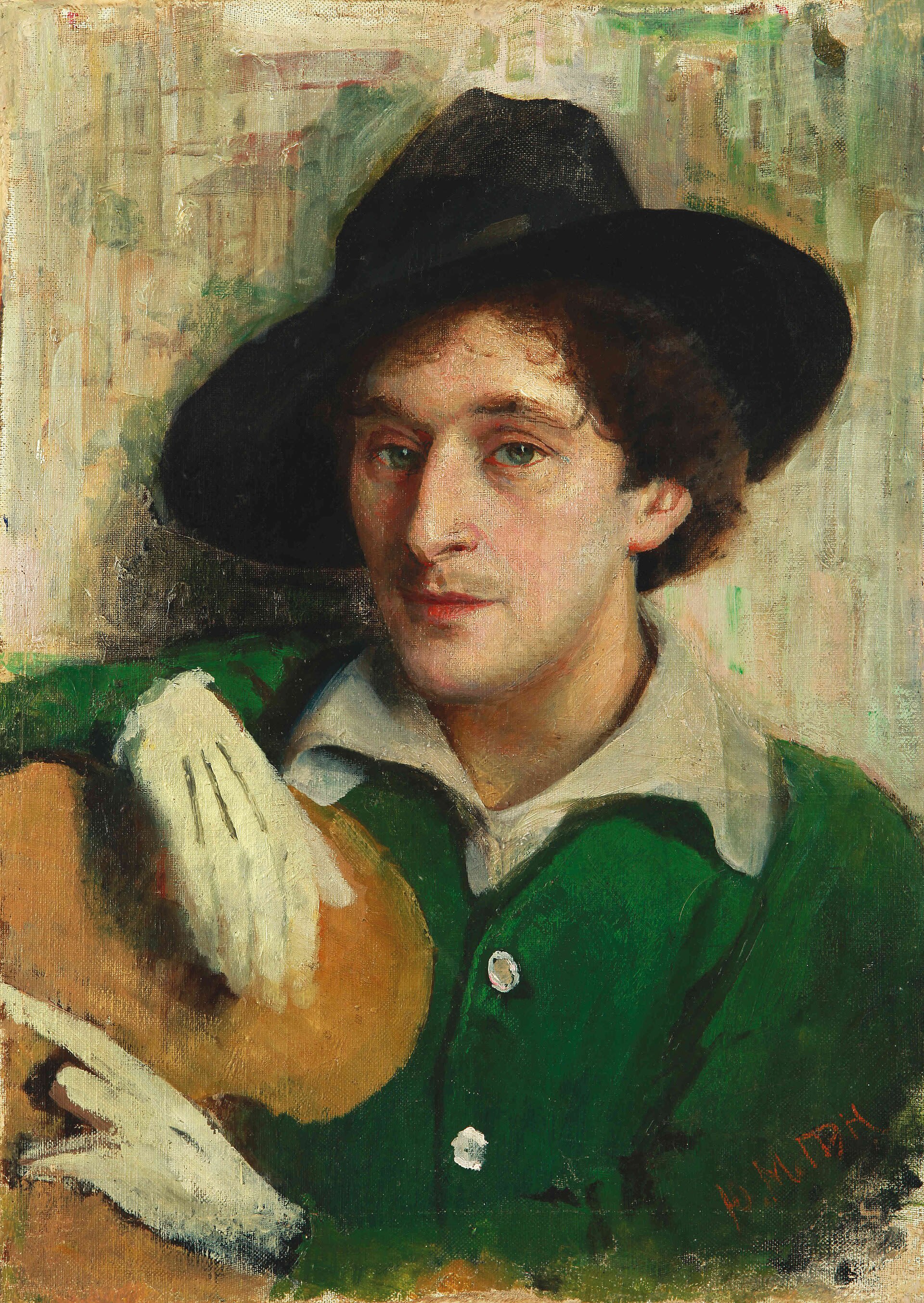
Marc Chagall Biography: Life, Art, and Early Legacy of the Russian Master
Marc Chagall Biography: Life, Art, and Early Legacy of the Russian Master
Article Index
Marc Chagall was a prominent Russian artist who navigated through various art movements throughout the 20th century.
He was a draftsman, painter, and printmaker who moved to France in the early 20th century, becoming a prominent figure in the so-called École de Paris.
Later, he spent time in the United States and the Middle East, journeys that reaffirmed his self-image as an archetypal "wandering Jew."
BIOGRAPHY
Marc Chagall was born on July 7, 1887, in Vitebsk, Russian Empire (now Belarus).
He was the eldest of nine children born to Khatskl Shagal and Feige-Ite in the town of Liozna, near an area boasting a high concentration of Jewish people.
During his childhood, Chagall attended local Jewish religious schools, mandatory for Russian Jews at the time, as discriminatory policies prohibited the mixing of different racial groups, where he studied Hebrew and the Old Testament.
These teachings would greatly inform the content and motifs of the paintings, prints, and stained-glass windows Chagall produced in posterity.
During this period, he adopted the habit of drawing and copying images from books, which quickly developed into a love for art and a choice to pursue a career, a decision that did not please his parents.
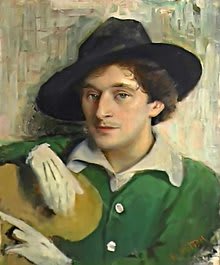
In 1906, he began studying art with the renowned Russian portraitist Yehuda Pen, who ran an all-Jewish private school for drawing and painting students in Liozna, Vitebsk.
Though grateful for the free formal instruction, Chagall left the school after several months.
Later that same year, he moved to Saint Petersburg to continue his studies at the Zvantseva School of Drawing and Painting, where he apprenticed under artist and stage designer Leon Bakst.
It is believed that Bakst, being a devout Jew, encouraged Chagall to introduce Jewish imagery and themes into his work, an unpopular practice at the time, especially due to the hostility of the Russian Empire towards the religion.
In 1910, he moved to Paris at a time when Cubism was emerging as the leading avant-garde movement.
He was twenty-three years old and did not master the French language; nevertheless, Chagall aligned himself with Cubism and enrolled in a small art academy.
While living in Paris, Chagall kept his hometown close to his heart, often using themes of memory in his paintings.
Subjects included pastoral village scenes, weddings, and fiddlers playing on rooftops.
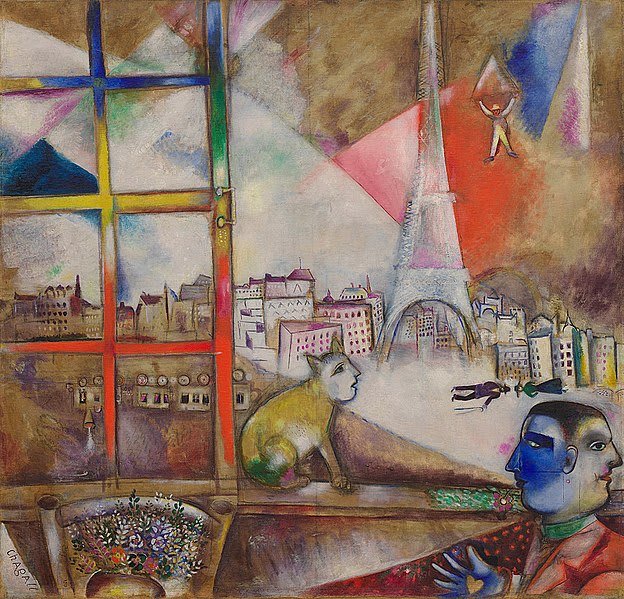
Parisian scenes also entered his repertoire, as depicted in his painting 'Paris Through the Window,' which alludes to the work of Henri Matisse and his friend Robert Delaunay.
Complementing these elements, his work contained almost supernatural qualities that are considered key precursors to Surrealism.
In 1914, Chagall returned to Vitebsk, his hometown.
During a brief visit to Russia, he met, fell in love with, and became engaged to Bella Rosenfeld, a Jewish writer who would become the subject of many of his paintings.
Passing through Berlin, Germany, he had a well-received exhibition of about 200 works at the Sturm Gallery, all of which he would never recover, with plans to marry Bella and then return to Paris.
In 1915, Marc and Bella married, but the outbreak of World War I interrupted their plan to return to Paris, and for the next nine years, they remained in Russia.
LEGACY - MARC CHAGALL AND HIS WORK
The artist declared: "No matter what I paint, it is about love and our destiny. That is what my art is about. It is within me, it is stronger than I am."
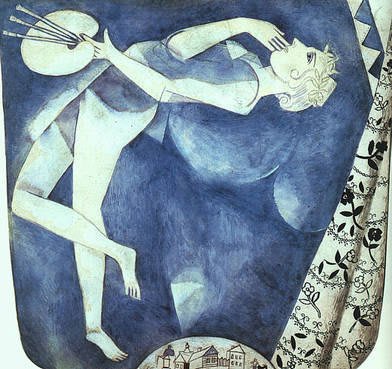
Marc Chagall's influence is as vast as the number of styles he assimilated to create his work.
Although he never fully aligned himself with a single movement, he intertwined many visual elements of Cubism, Fauvism, Symbolism, and Surrealism into his lyrically emotional aesthetic of Jewish folklore, dreamlike pastorals, and Russian life.
Picasso once stated that when Matisse died, Chagall would be the only one who truly understood what color was, adding that his canvases were genuinely painted, not just thrown together.
Pablo Picasso and Marc Chagall were contemporaries and friends of yesteryear.
They pursued different styles, yet their similar life experiences and successes made them perfect companions, as well as providing the catalyst for their eventual rivalry.
Their lives and world events led them down very distinct paths, and they only met after World War II.
It was at this time that Chagall sent Picasso a letter requesting a meeting with him, from the United States where he resided under political asylum.
To understand the rest of this journey, continue with our next article: Marc Chagall Biography: Detailed Analysis of Works and the Impact of His Unique Style.


