
Raphael: Biography and Work: Birth, Training and Rise (Part 1 of 3)
Raphael: Biography and Work: Birth, Training and Rise (Part 1 of 3)
I invite you to discover the life and work of Raphael, one of the great masters of the Italian Renaissance.
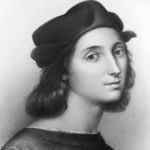
Born in 1483 in Urbino, Italy, Raphael was a prolific painter and architect who produced some of the most iconic and influential works in the history of Western art.
Influenced by artists such as Leonardo da Vinci and Michelangelo, Raphael developed his own style characterized by harmony, grace, and technical perfection.
His masterpieces include 'The School of Athens,' 'The Marriage of the Virgin,' and 'The Sistine Madonna,' which demonstrate his exceptional ability to portray human beauty and emotion.
Along with his contribution to painting, Raphael also left a lasting legacy in architecture, particularly in his work at the Vatican.
His influence was so significant that he is often considered one of the three greatest artists of the Renaissance, alongside Leonardo and Michelangelo.
By exploring the life and work of Raphael, we are transported to the vibrant and intellectually stimulating world of the Renaissance, where art and knowledge merged in a quest for beauty and truth.
Infancy and Early Career
When he was born, he lived in a time of peace and prosperity.
This allowed him to grow up in an era marked by the emergence of a thriving cultural scene.
The Duchy of Urbino was teeming with art.
Even his father, Giovanni Sanzio, welcomed Piero della Francesca, a friend of the renowned Perugino, into his home, but Giovanni would not see his son's adolescence.
He died when Raphael was just eleven years old.
The young boy, however, was not left without guidance.
Under the tutelage of a uncle, he received instruction from Evangelista di Pian di Meleto, a former student of Perugino.
By around 1500, at the age of seventeen, he was an apprentice in the workshop of the painter Pietro Perugino.
The young artist was eager to learn new techniques of painting, and his remarkable technical ability meant that he could soon reproduce his master's paintings.
His reputation as a talented artist spread quickly.
It is known that, at the age of eighteen, he was already in such high demand that he worked independently - even though he was not attached to a master, as was customary at the time.
In his early works, and in a somewhat precocious manner, the religiosity of the themes was interpreted through a unique perspective.
Maturity and the Vatican
In 1504, he signed his first work - The Nuptials of the Virgin.
Raphael began to aspire to more prestigious spaces.
In the same year, he set out, full of hope, for Florence, where the talents and fame of Michelangelo and Leonardo were already emerging.
He stayed for four years in the city and came into contact with all the artistic techniques and concepts, painting with fervor and producing numerous madonnas.
His fame grew, and he received invitations to work in France, which he declined for a good reason - Raphael had become the preeminent painter at the Court of the Medici Family.
In 1508, Pope Julius II summoned Raphael to the Vatican and gave him important commissions.
The pope hoped to see an artistic revival and recreate the prestige of ancient Rome; he was so impressed with Raphael's work that he ordered other frescoes to be removed so that Raphael could have more space to paint.
In 1511, he was painting in the Stanze Raffaello, in the Vatican, a cycle of great complexity that was meant to reflect the humanist principles of the Renaissance.
While working on the monumental School of Athens, Michelangelo was painting the ceiling of the Sistine Chapel.
It is said that Raphael would often sneak into the chapel to create impressions of Michelangelo's work in order to improve his own painting.
Death and Legacy
In 1514, he became engaged to Maria Bibbiena - the niece of a cardinal, although he seems to have lost interest in her, he never married, despite having several affairs, he was a very loving person, who greatly enjoyed women and was always ready to serve them.
In 1515, he was granted legal powers to oversee the extraction of ancient stones; Raphael was also concerned with the architecture of Rome and the inscriptions of antiquity, but his premature death was unfortunate, as he was never able to complete an archaeological map of the city that he loved so much.
Raphael Sanzio died in 1520, on the same day he was born, April 6th, at the age of 37.
So much work proved to be fatal - he contracted, allegedly, in the subterranean tunnels of St. Peter's Basilica, the mysterious disease that killed him.
Thousands of people attended his funeral.
He was buried in the Pantheon in Rome, located below an altar with a sculpture of a Madonna.
On the tomb, there is an inscription in Latin that reads:
To understand the rest of this journey, continue to our next article: Raphael: Biography and Work: Legacy, Tributes, and First Masterpieces (Part 2 of 3).


