
Raphael: Biography and Work: Legacy, Tributes and Early Masterpieces (Part 2 of 3)
Raphael: Biography and Work: Legacy, Tributes and Early Masterpieces (Part 2 of 3)
Article Index
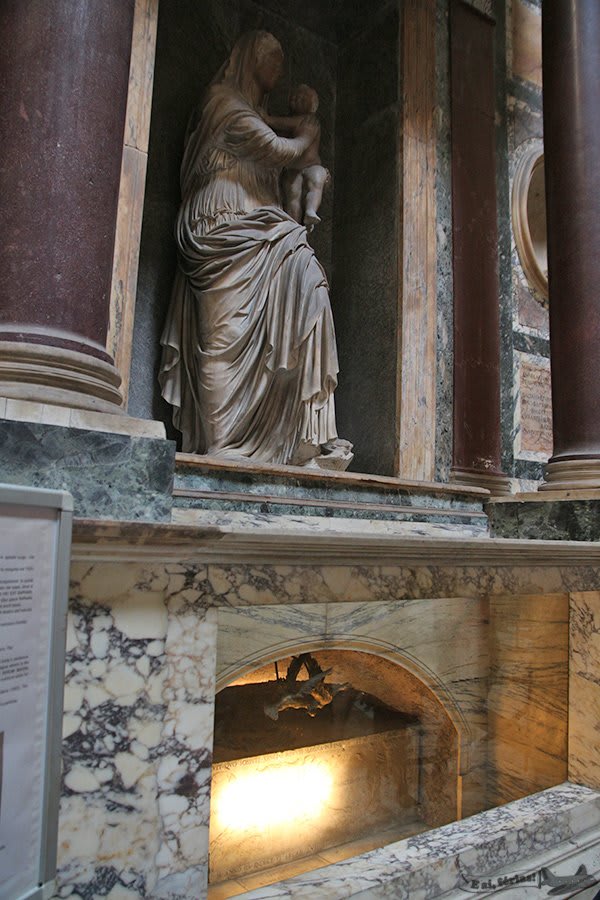
Here lies the famous Raphael, whom Nature feared to be conquered while he lived, and when he was dying, feared that she would die.
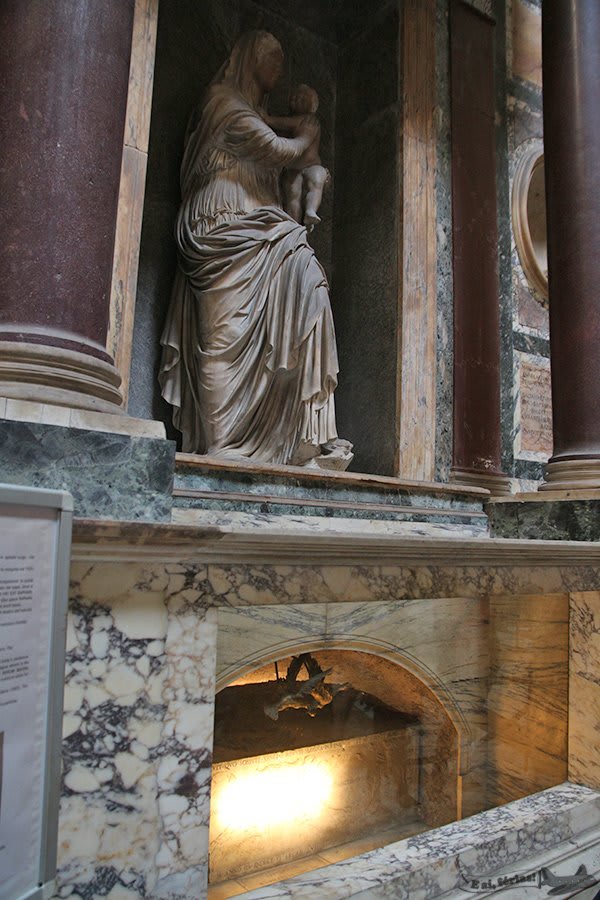
Unlike many other great painters, only recognized years after their death, Raphael died young, but at the peak of his career.
His work, in pursuing an idealized earthly beauty, ultimately conferred on the images a divine graciousness, as if to suggest that true human essence should be its resemblance to God.
LEGACY
Not only was Raphael a great painter, but he was also an outstanding teacher, capable of inspiring his colleagues to higher standards.
He had one of the largest art schools in Rome, with over fifty students.
His enthusiasm and talent helped his school become a famous art location.
The strength of his school also allowed Rafael's painting style to be neutralized throughout Italy.
Raphael's influence paved the way for other masters of the era who sought to bridge cultural traditions across Europe, much like the journey detailed in the Biography of El Greco: The Greek Origins and Journey to European Renaissance
For many years, his style of perfect form and balance was taught in the great art academies.
"The possessors of such rare and numerous gifts as those seen in Rafaello da Urbino are not only men, but mortal gods." (Giorgio Vasari)
GALLERY - COMMENTED WORKS
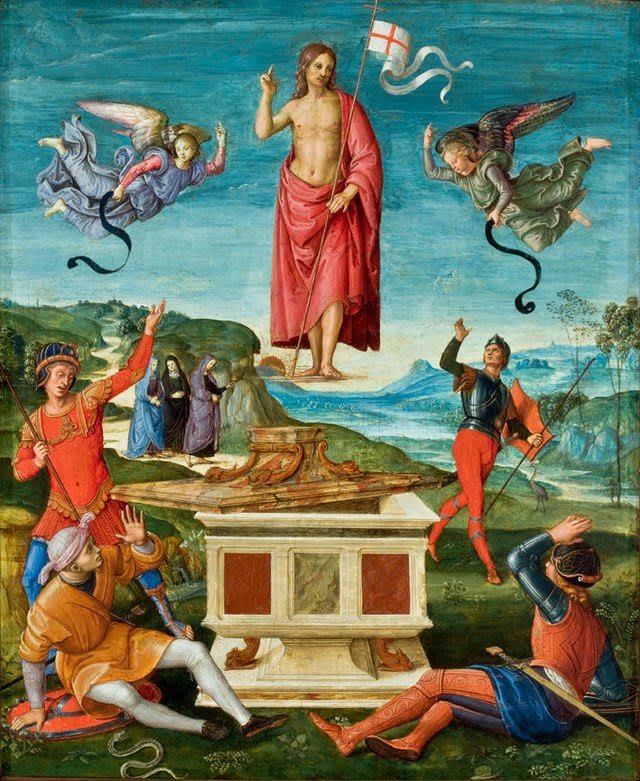
Resurrection of Christ - This work, which took time to be attributed to Raphael, is now fully accepted by art specialists.
We perceive typical characteristics of his compositional style, still in his Florentine phase.
It belongs to the collection of the Museum of Art in São Paulo, Brazil.
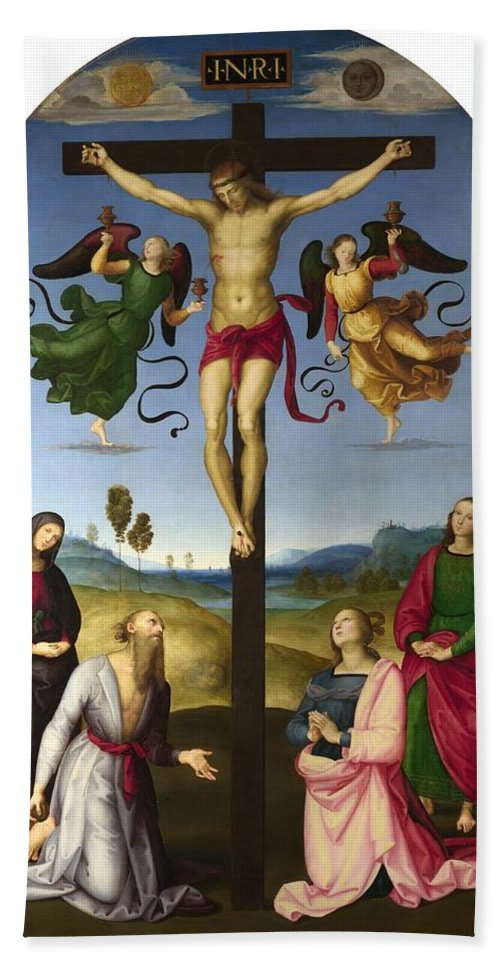
Crucifixion - This is one of his first works where we can see the influence of his master Perugino.
Originally, it was a retablo made for the Church of San Domenico in Città di Castello, near Raphael's hometown of Urbino.
The painting shows Jesus nailed to the cross surrounded by angels taking his blood in chalices.
On the left of Jesus, Mary Magdalene kneels, with John the Evangelist standing behind her.
On the right of Jesus, standing is Mary, mother of Jesus, and Saint Jerome kneeling.
At the foot of the cross is the inscription in silver letters RAPHAEL / VRBIN / AS /.P.[INXIT] (Raphael of Urbino painted this).
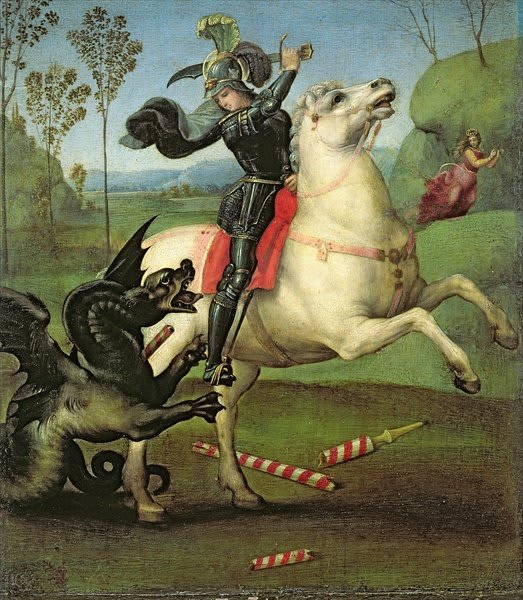
Saint George and the Dragon - This is probably the first version in which the artist addresses this theme.
It was commissioned by the Duke of Urbino, who intended to present the painting to the King of England, a country that has this saint as its patron.
The spiritual depth found in these early commissions reflects a broader history of sacred artistry, such as that preserved in the Hagia Sophia Basilica
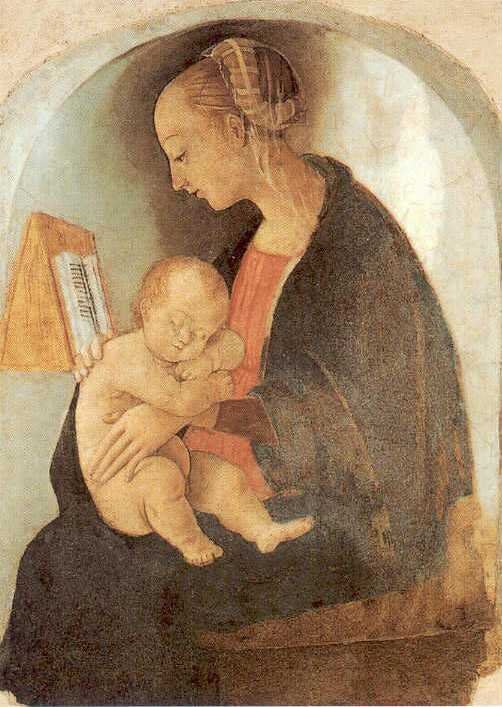
Raphael entered history as the painter of madonnas simultaneously mystical, sweet, and sensual.
This fresco located in one of the rooms of the artist's house in Urbino, until recently, historians attributed the painting to his father, but it is believed that the author was Raphael himself, who painted it in his adolescence, under the guidance of his father Giovanni Santi.
Madonna in the Meadow - This is a classic example of Raphael's art.
The composition uses the same technique as Leonardo da Vinci to paint figures using a triangle as a base.
He also designed many tender and compassionate images of the Madonna, infusing the painting with grace, tenderness, and serenity.
A contrast to the turbulent political times of the Renaissance.
Raphael’s dedication to harmony and form set a standard that later visionaries would expand upon in different artistic fields, including the works of Antoni Gaudí: Biography and Work: The Masterpieces that Shaped Barcelona and the World
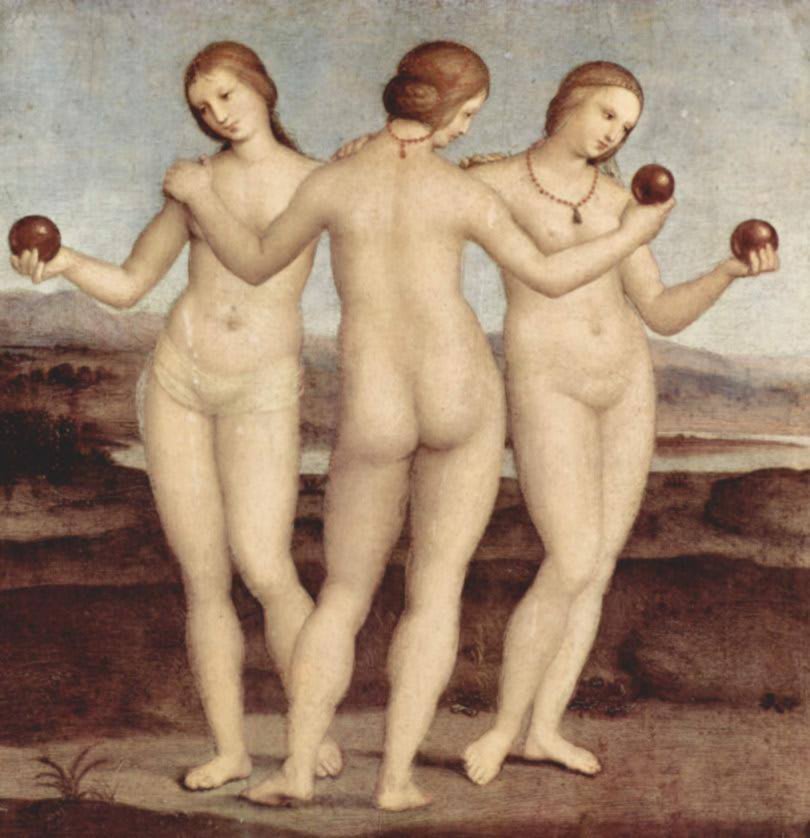
Raphael used geometric forms as a base in almost all his paintings, and the three famous mythological sisters painted by him, "The Three Graces", also have an irregular hexagon formed by the hands holding the apples, the feet of each of them and their heads.
It is the first study in which he portrays the female nude in frontal and rear views.
It is believed that he was not based on live models, but that he was inspired by a similar classical sculpture, located in Siena, a city located in northern Italy.
To understand the rest of this journey, continue to our next article: Raphael: Biography and Work: Great Frescoes and Eternal Legacy (Part 3 of 3).


