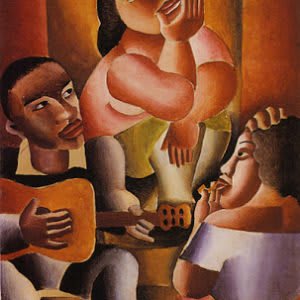
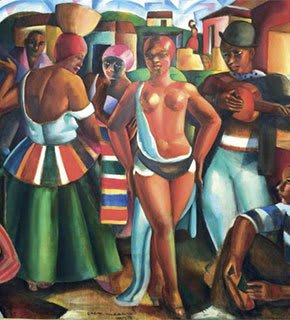
Samba, Emiliano Di Cavalcanti
Discover the vibrant world of Brazilian culture through Emiliano Di Cavalcanti's iconic painting, Samba.
We invite you to explore Samba by Emiliano Di Cavalcanti, a work that captures the energy and vitality of Brazilian culture.
Created in 1956, this painting is a tribute to the contagious rhythm of samba, featuring dancing figures in a festive and colorful setting.
Di Cavalcanti, one of the great names of Brazilian modernism, used vibrant colors and sinuous forms to convey the movement and joy characteristic of samba.
As you contemplate Samba, you will be immersed in the festive atmosphere and the expressiveness of Di Cavalcanti's art, which celebrate the richness and diversity of Brazilian culture.
Samba, Carnival or Mulatos de São Cristovão?
A painting with three titles? Which title will the author give it?
This is 'Samba', a nearly 2m x 1.60m canvas signed by Di Cavalcanti in 1927
The canvas features three recurring figures in his works, such as the mulata with exposed breasts, the violinist, and the pandeiro player.
Purchased directly from the artist by Luis Quintanilla, a Mexican diplomat and writer who was friends with artists and intellectuals of Brazilian modernism.
The canvas accompanied him in the posts where he served.
During the Second World War, when he was ambassador in Moscow, he kept it rolled up, protected from the bombings.
He carried it to Paris and Washington, and finally to Mexico.
Di Cavalcanti, a true Carioca, passionate about samba, carnival, and mulatas, titled several of his paintings as 'Samba'.
This one, in particular, was considered false because it lacked proof of its authenticity.
Thus, the painting remained in obscurity for many years.
Acquired by Martin Castillo during an art fair in the Netherlands, the dealer did not hesitate to ensure the authenticity of the work.
Castillo participated in the Rio art fair 'ArtRio', when he met Elisabeth Di Cavalcanti, the painter's daughter.
The conversation eventually led to the painting in question.
He asked her if she had any documents that could prove the authenticity of the work.
Elisabeth returned to him a few days later with good news.
She discovered in the magazine 'Para Todos', of 1928, where the canvas appears with the name of 'Samba', in a black and white reproduction illustrating an article — she says.
— It's even an irony that a 'Samba' painting by him has disappeared for five years and another appears now.
Samba of 1925, which Elisabeth commented belonged to a collector and was unfortunately destroyed in a fire in August 2012.
What an interesting irony, that in a short period where we lost a Di Cavalcanti painting, another one emerges with the same title.
Brazilian art thanks you!
SAMBA, by Di Cavalcanti
1. 1925 - The painting was worth $10 million in 2012, owned by the dealer Jean Boghici, when it was destroyed by a fire in his apartment on the night of August 13 of the same year.
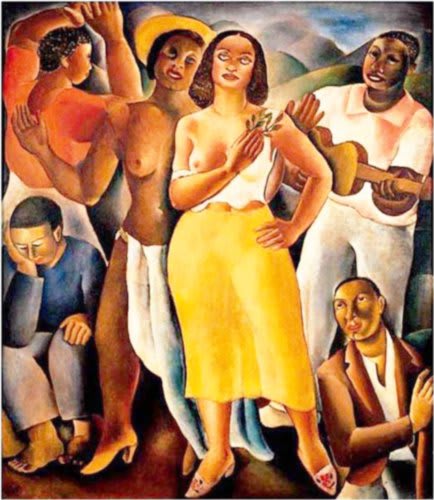
2. 1927
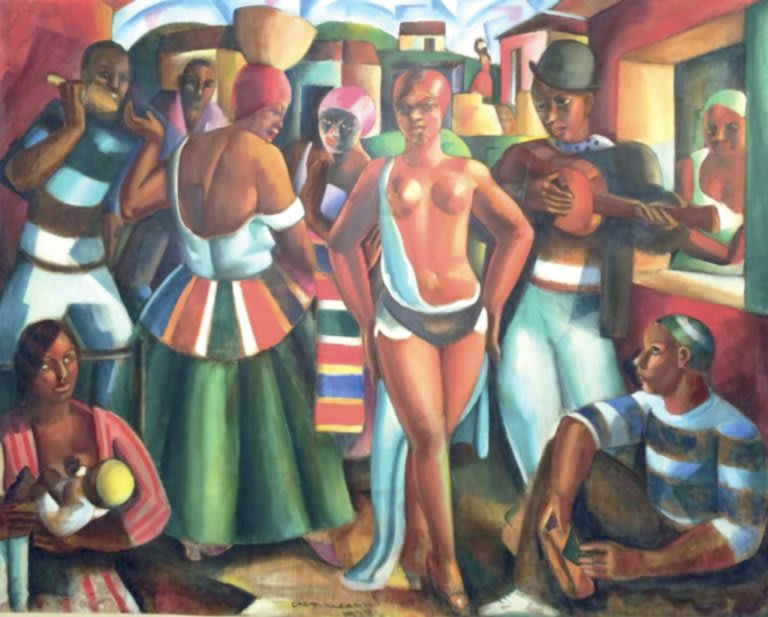
3 - 1928