
School of Athens, Raphael Sanzio: Interpretation, Composition and Central Philosophers (Part 2)
School of Athens, Raphael Sanzio: Interpretation, Composition and Central Philosophers (Part 2)
School of Athens, represents the Philosophy
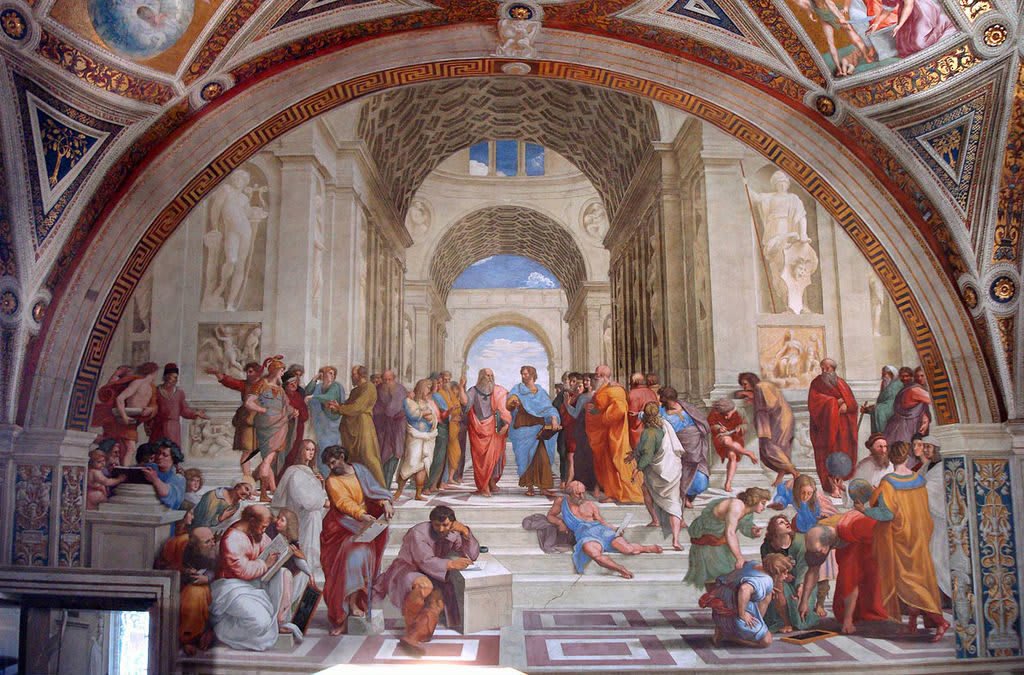
School of Athens. Raphael Sanzio - c. 1510 1511. Fresco (440 × 770 cm) - Stanza della Segnatura, Apostolic Palace, Vatican
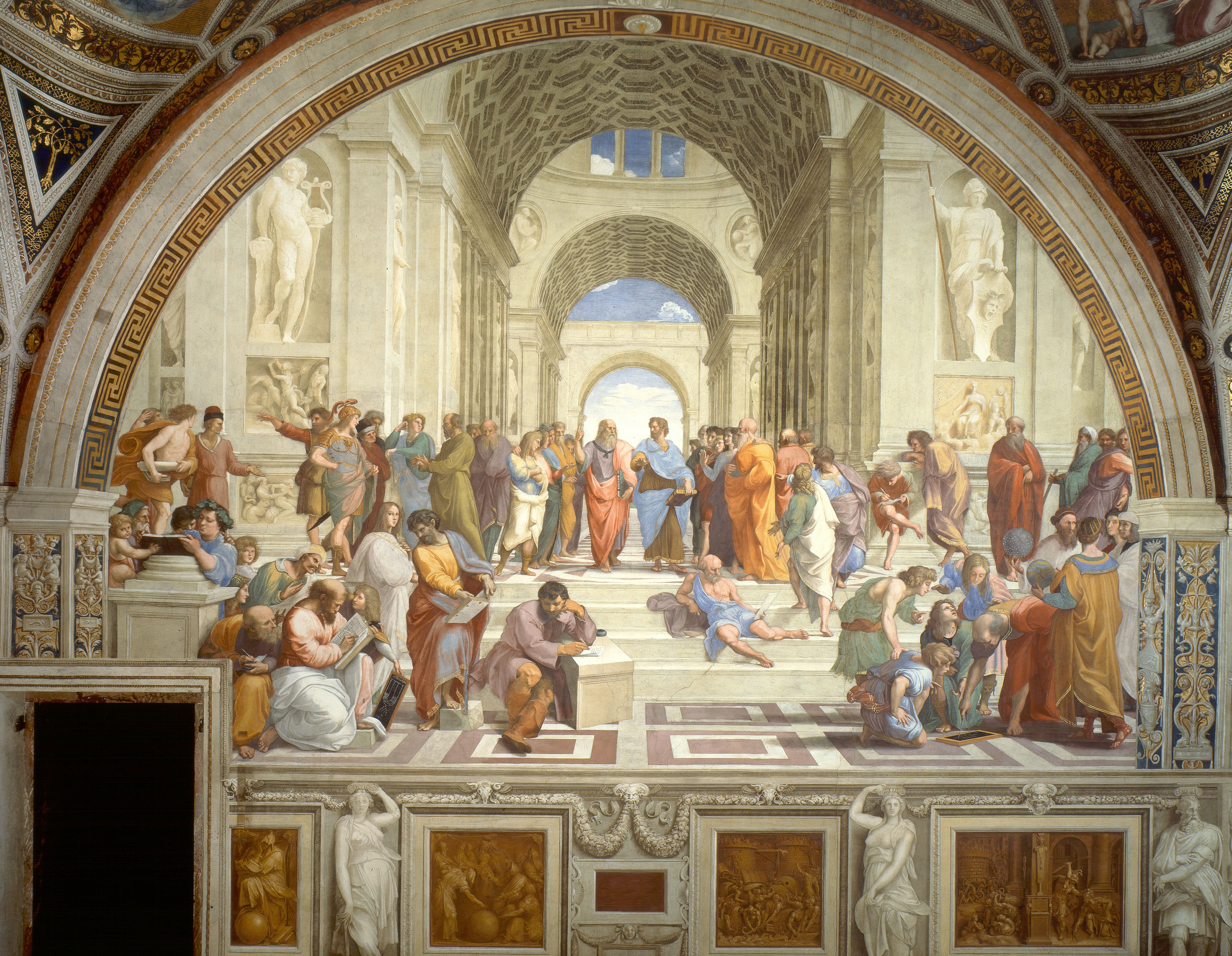
The School of Athens describes the interpretation of philosophy as a branch of knowledge that symbolizes philosophical thought and the search for truth. Showing a gathering of Greek philosophers engaged in various activities, the fresco is considered an excellent example of Renaissance art and considered Raphael's masterpiece.
We find in the painting about sixty Greek philosophers arranged in a very large room, they are talking to each other, discussing theories or mathematical issues. Raphael used contour lines with domes and real lines to define the figures. The personalities are organized like actors in an architectural setting with perfect perspective.
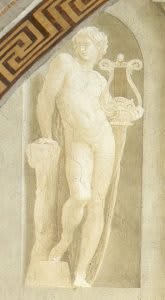
Most of the figures are male and it is believed that they represent all the significant Greek philosophers. Raphael also includes images of statues within the school, reminding the importance of sculpture in ancient Greece. He highlighted the statue of Apollo, the Greek god of light, archery, and music, holding a lyre. The other is Athena, the Greek goddess of wisdom, shown in her Roman form as Minerva.
Another curiosity is the building itself, represented in the form of a Greek cross, with the figures in the foreground and the interior receding behind them. The figures are spread out on stairs and walkways, and the fresco is framed by a Roman arch decorated with arabesques.
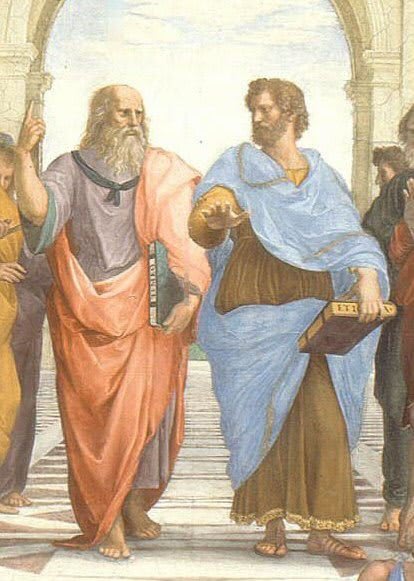
Centered in the vanishing point that divides the School into two equal parts of the represented architecture, we have the central figures of the School of Athens, Plato and Aristotle. The entire composition is linked to the philosophy of these two thinkers. Observe, for example, that Plato is depicted barefoot and in simpler attire, while Aristotle is shown wearing a sandal and a more sophisticated outfit with golden details. We know that Plato defends abstract and theoretical philosophy, while Aristotle defends empirical and natural philosophy.
To the right is Plato, holding in his left hand a bound copy of Timaeus and is represented as an older, wiser, and gray-haired man. The fact that he is pointing upwards with his right hand indicates the world of ideas. In contrast, his student Aristotle is shown as a younger man looking at his teacher. Aristotle carries a bound copy of Nicomachean Ethics in his left hand and walks a little ahead of Plato, directing the book downwards, indicating the earthly world. Plato gestures upwards in the chest, while Aristotle gestures horizontally in front of the figures, they converse deeply.
In the same line as Plato, to the left, stands out Socrates, where we perceive that he is conversing with common Athenians, or possibly his disciples. Below in the foreground, we find Pitágoras, writing and presenting something to a group of his disciples. Sitting in the foreground, lost in thought, we find the philosopher Heráclitus who is considered the father of dialectics. One of the few women represented in the scene, we can assume that it is Hypatia of Alexandria, considered the first woman mathematician in the Western world. Hypatia is dressed in white in the painting, above and close to Pitágoras.
To understand the rest of this journey, continue to our next article: School of Athens, Raphael Sanzio: Diogenes, Euclides and Hidden Portraits of the Masters (Part 3).


