
The Battle between Carnival and Lent - Pieter Bruegel's Masterpiece
The Battle between Carnival and Lent - Pieter Bruegel's Masterpiece
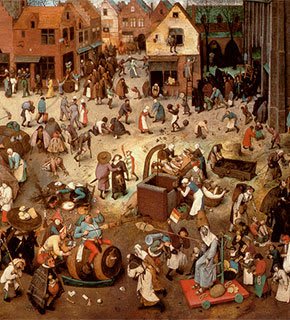
The Battle between Carnival and Lent is a painting by Pieter Bruegel, the Elder.
It is considered one of the masterpieces of the Renaissance and one of the oldest works depicting Carnival.
In it, Bruegel describes these Flemish customs in curious details, representing a festival that was common in southern Holland in the mid-16th century.
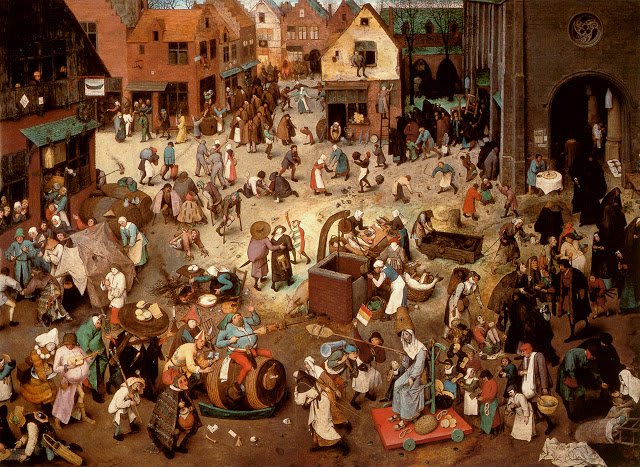
The large composition is full of countless figures seen from above.
The elevated viewpoint allows us to see all the events and activities that take place simultaneously in the main square of a small town.
The painting is divided into two parts, representing respectively, Carnival and Lent.
The central and left part symbolizes all the excesses typical of Carnival: music, games, drinks, food, disorder, and euphoria.
The opposite half, to the right, represents the austerity of Lent, a period of renunciation, penance, and recollection.
The painting is known for its contrast with contemporary life, as can be seen by the religious practice observing the church to the right and the enjoyment of the clients by the inn to the left.
The two contrasting figures are connected by the well in the center, showing the connection and unity of all the people represented.
Other scenes in the painting show fish stalls with two competing allegorical carts.
This work shows modern Europe as a battle fought between the figures present during these celebrations.
It represents the different seasonal kitchens, as the cattle that were not to be kept during the winter were slaughtered, creating an abundance of meat.
As the preparations for Easter were made, butchers closed their shops and bought cattle for the next spring in the countryside.
Bruegel's masterpiece has always been rich in symbolism and allegories that have led to its study over the centuries.
This painting is often seen as the triumph of Lent, when the Carnival figure says goodbye with one hand while its eyes look up to the sky.
Another more general meaning that is often attributed to the painting is the belief that Pieter Bruegel had that human activities were motivated by egoism and madness.
The painting in detail ...
This is a composition in which Bruegel lets his entire palette shine, with bright and festive colors.
The characters represented are all worthy of observation, for their richness of details.
Whether they are young or old, or even deformed like the one riding a wine barrel, the sad ones like the one playing an instrument and seems to reflect all the misery of the world through the expression of his face.


