
The Coffee Planter, an Interpretation of Candido Portinari's Work
A close look at the iconic painting by Candido Portinari
I invite you to delve into the depths of 'The Coffee Planter', one of Candido Portinari's most emblematic works.
In this painting, Portinari masterfully portrays the harsh reality of rural workers in Brazil, highlighting the dignity and strength of the Brazilian people.
Upon analyzing 'The Coffee Planter', you will be led to reflect on social, economic, and cultural issues that permeate the history of our country, as well as appreciate the unique technique and sensitivity of the artist.
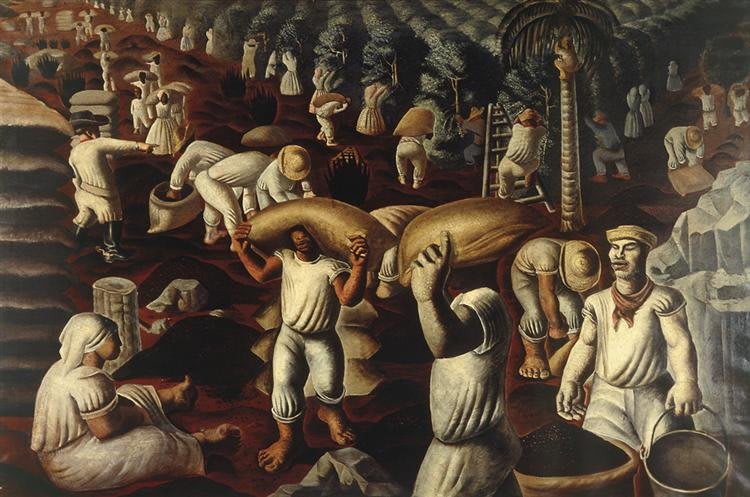
This is an important painting by the Brazilian artist Candido Portinari in which he used coffee to create the composition, a theme that was extensively explored in his work.
According to the Projeto Portinari, on this theme, the artist painted exactly 56 works involving the same theme, with the painting simply titled Coffee being his masterpiece.
In The Coffee Planter, Portinari presents the real action of the rural worker in the coffee plantation.
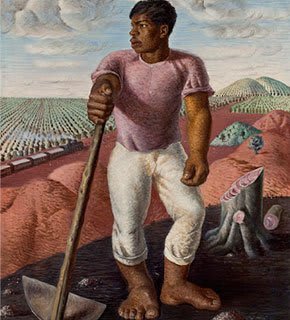
With a sky covered in clouds, we find in the foreground a man who suggests being a field worker, as he holds in one hand a hoe, a typical manual tool.
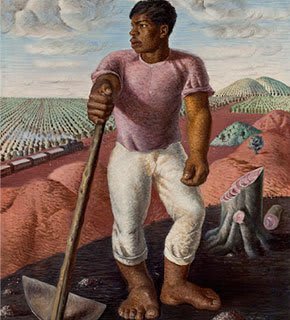
The felled tree to the right connotes deforestation, the end of the natural forest.
This is the change in the landscape provided by coffee cultivation.
In the background, we see the hills of the already harvested grains.
The lighting highlights the peaks of the hills, in a yellowish color.
Among them, one of the hills appears in green and on it are some small trees.
In the background, we have numerous figures of coffee plants, both on the flat surface and on the hills.
It is noticeable that part of the coffee plantations is going towards the space reserved for selection and packaging.
With these details, we notice the overproduction registered here.
The planter's gaze is expressive, and in it, concern predominates.
It is felt that he senses the devastating action of the exploitation that man makes of nature.
Upon observing these details that make up the painting, we begin to understand the effect of the planter's figure that immediately stands out in the landscape.
The scene placed on a hill from which one sees an extensive and distant landscape with a strip of sky in the background, highlights the upper part of the planter.
The large plantation that extends beyond the hill is relatively small in contrast to the size of the planter.
Another element present in the painting is the train, placed between the coffee plants and the hills of grains.
It is known that it was the means of transportation used to send the coffee production to Santos to be exported to various countries, especially the United States.
There is a discrepancy in the dating of The Coffee Planter. According to the technical sheet of the Masp (Museum of Art of São Paulo), it is from 1939, while on the website of the Projeto Portinari, which is headed by the professor João Cândido Portinari, son of the artist, the work would be from 1934.


