
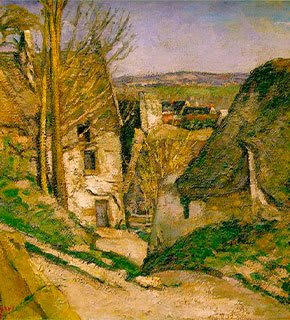
The House of the Hanged Man, Paul Cézanne
The House of the Hanged Man, Paul Cézanne
This hauntingly named painting is one of the first works by Paul Cézanne and was one of the three canvases exhibited at the 1874 impressionist show.
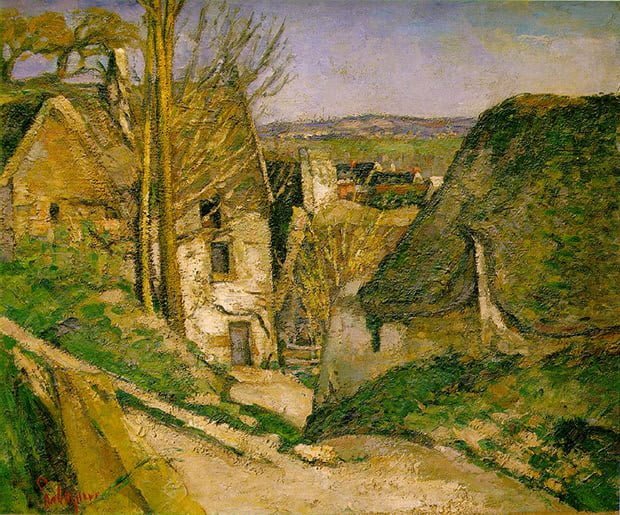
The House of the Hanged Man was painted when Cézanne was 33 years old and marks the stage in his career when he was heavily encouraged and assisted by his friend Camille Pissarro.
The artistic friendship that united them since they met in 1861, solidified over the next two decades and marked one of the major moments of definition of modern art.
Together they traveled to the region of Auvers-sur-Oise and Pontoise, to visit the Dr. Gachet, the same doctor who cared for Vincent van Gogh.
Cézanne stayed with his friend at the Hermitage Inn in Pontoise and devoted himself to the division of color in the impressionist style, according to his own principles of Pissarro, they together realized some paintings, among the valleys, forests and streets of that village and other nearby localities, they painted outdoors the same scenery, as Monet and Renoir, often side by side.
To carry out this painting, Cézanne obeyed the severe discipline of his friend, whose tendency had been to let himself be carried away by the romantic violence in colors and somber themes, but the result was a magnificent work.
Cézanne also painted with more impasto than Pissarro , found it suitable and applied extra layers that created flaking, although he softened the weight in the light areas with a spatula.
The artist already shows a greater concern with the solidity of objects than other impressionist painters, but there is serenity of atmosphere, as well as force in his composition.
According to art critic Lionello Venturi, “no one was ever hanged in that house”.
The painting with a haunting title, presents a complicated composition.
There are several strong axes that depart from a central point: a path that rises to the left; another that descends towards the center of the painting; a bench curving to the right; the branches of the trees forming an angle towards the top of the painting.
The planes are close.
The thickness of the broken brushstrokes seems to "freeze" the painting.
The lack of people, the rigid and austere vegetation and the cold colors help to create a strong sense of loneliness.
This is a landscape and is one of the most interesting and beautiful of Cézanne's period in Auvers.
They illustrate his conversion to impressionism.
Many of the landscapes of this period, including this one, testify to his hesitations.
The broken brushstrokes with a light brush did not completely eliminate the heavy brushstrokes, nor the spatula, his usual weapons until then.
Traces of color placed with the spatula can be found in the sky and some walls.
Other parts are more lightly worked.
The complete color scheme is definitely impressionist.
The same applies to its construction.
The choice of theme suggests a desire to create large masses;
those steep roads isolate the house and make it emerge from a hole.
Although the painting confused the critics when it was first exhibited, it was the first that Cézanne was able to sell to a collector, the French aristocrat Count Armand Doria, one of the first collectors of impressionist paintings,
he already possessed works by Auguste Renoir, Camille Pissarro, Claude Monet and Alfred Sisley.
A milestone in Cézanne's career
The House of the Hanged Man is a milestone in Cézanne's career, marking the beginning of his journey as an impressionist painter.
He began to experiment with new techniques and styles, and his work became more expressive and emotive.
The painting is a perfect example of Cézanne's evolution as an artist and the influence of impressionism on art at the time.
Cézanne's art
Cézanne is known for his impressionist landscapes, but his art goes beyond that.
He explored different styles and techniques throughout his career, always seeking to innovate and create something new.
Cézanne's art is a mix of realism and expressionism, and is considered one of the most important in the history of art.
Cézanne's influence
Cézanne had a significant influence on modern art.
His works inspired many artists, including Pablo Picasso and Salvador Dalí.
Cézanne's art is considered one of the most important in the history of art, and its influence can be seen in many modern art works.
Conclusion
The House of the Hanged Man is a masterpiece of Cézanne's art.
It is a perfect example of Cézanne's evolution as an artist and the influence of impressionism on art at the time.


