
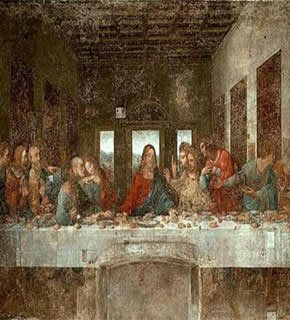
The Last Supper - Leonardo da Vinci
The Last Supper - Leonardo da Vinci
The Last Supper is one of the most famous and revered works of the Italian Renaissance artist Leonardo da Vinci.
Completed around 1498, this mural painting depicts the moment described in the Bible when Jesus announces that one of his disciples will betray him.
The composition is known for its complexity and da Vinci's ability to capture the emotion and interaction between the characters.
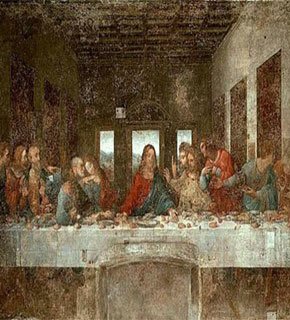
The Last Supper, by Leonardo da Vinci, is a mural painting located in the city of Milan (Italy), in the refectory of the Convent of Santa Maria delle Grazie.
This work, along with the Mona Lisa, contributed to establishing Leonardo's fame as a painter.
It belongs to the period of the Renaissance.
The work was commissioned by the Duke Ludovico Sforza, patron of the painter.
Leonardo worked on this piece between 1495 and 1498, and for those who do not know, it is not a true fresco, because he preferred not to paint the work on wet plaster, as this would have limited the time he could spend on the work.
Instead, he sealed the stone wall with a layer of resin and chalk, and then painted over the sealant with tempera.
Although this technique allowed him to depict the scene in fine detail, unfortunately, it did not prove to be very durable.
The painting began to deteriorate just a few years after its completion.
Despite the theme being traditional for the refectories of the time, Leonardo's realistic style and dramatic representation of the figures gave the works much more realism and depth in the perspective used, influencing all subsequent paintings of the Last Supper.
Specifically, Leonardo's work shows the moment immediately after Jesus' announcement that one of those sitting at the table would betray him.
The twelve apostles, react with different demonstrations of emotions: outrage, shock, and doubt.
The fourteenth-century interpretations of the Last Supper alluded to the moment of the institution of the Eucharist; the apostles aligned along the table - only Judas remained isolated - seemed to meditate, while Saint John reclined his head on the side of Christ.
Leonardo chose another situation: that which follows the announcement of Christ: "One of you will betray me." Surprised by the Master's words, the apostles, gathered in groups of three, give free rein to their first impulses.
From left to right, the groups are:
Group 1 - Bartholomew, James (the Lesser) and Andrew
Group 2 - Peter, Judas Iscariot and John
Group 3 - Thomas, James (the Greater) and Philip
Group 4 - Matthew, Thaddeus and Simon
In the center, solemn, majestic, the only one in a totally frontal attitude, is Christ, with his head crowned by the light of the window in the background; everything in the composition leads to his figure.
Even the apostles who, to the right, turn their heads towards what is situated at the end of the table, refer us to him with the movement of their hands.
As an tireless observer and perfectionist, Leonardo spent days without touching the work, just looking, reflecting, and examining the figures, alone.
He was an excellent observer and a deep artist, who studied continuously and reflected on his artistic techniques, revising and retouching his paintings repeatedly in search of perfection.
This famous painting has been restored several times and as a result, it is now very different from its original work idealized by the artist.
Regardless of this, its strength is enormous, and it continues to generate controversy around its interpretation.
They question, for example, the absence of some important symbols of the Church ignored by Leonardo, such as the Holy Chalice (Holy Grail).


