
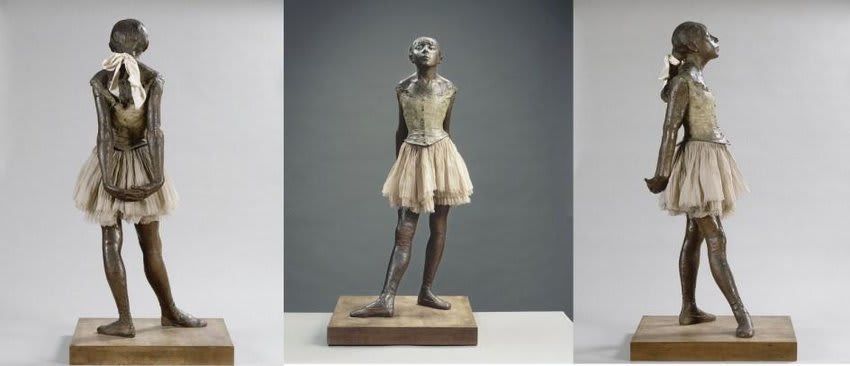
The Little Dancer of Fourteen Years, by Edgar Degas
The Little Dancer of Fourteen Years, by Edgar Degas
The Little Dancer of Fourteen Years is a sculpture by the French artist Edgar Degas, considered one of the most beloved works of art and one of the most famous sculptures. The work was exhibited at the sixth impressionist exhibition held in 1881 and was the only sculpture he had ever shown in public.
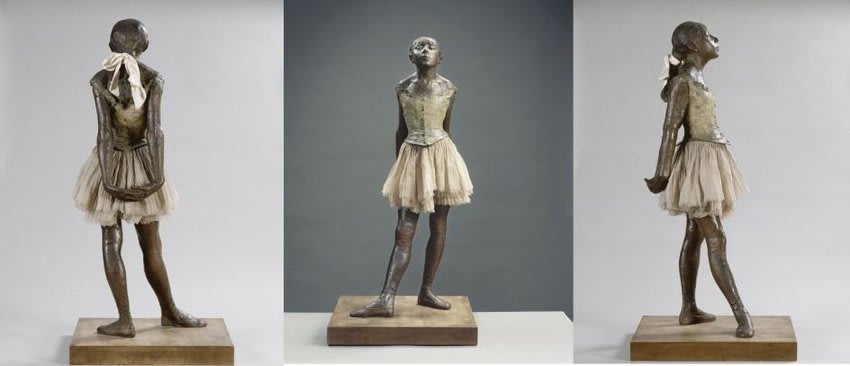
At this exhibition, the sculpture was not received cordially by the critics, when it first appeared. They protested unanimously, it was described in various ways as "repulsive", "cruel" and "a threat to society". It even was criticized for being the figure of a poor girl and considered "simplistic" and even "ugly". But, at the same time, they recognized the innovative and surprising character of the work and were shocked by the unprecedented realism of the piece. The sculpture basically, was seen as a wax figurine dressed in real clothes, it broke decisively with the academic practice of the 19th century by introducing unusual mixed materials and, frankly, representing a modern and provocative subject. In the context of the evolution of the work, it was extremely pioneering, different from everything that had been done until then.
The incredibly realistic description by Degas of a "rat of the opera", as the young dancers of the Ballet of the Paris Opera were known, was a deeply disturbing challenge both to the academic tradition and to the bourgeois French society. It forced the spectators to confront the unpleasant side of the ballet, the cultural institution at the center of metropolitan life. The dancers, like the model used for the sculpture, came mainly from working-class families and were popularly considered vulnerable to moral corruption in the hands of powerful suitors. The Little Dancer is an unflinching look at a problematic issue of the working class, but it is also endowed with humanity under the artist's gaze.
Equilibrated between girl and woman, the model used for the realization of this sculpture, was Marie van Goethem, a dance student of the Ballet of the Paris Opera. Initially, Degas made a wax sculpture of her nude. Then, aiming for a naturalistic effect, he dressed her in real clothes made of fabric. Her molded body is at the same time vulnerable and imposing. Her posture on a wooden base that reminds an exercise floor, is casual for ballet standards, but far from being vulgar. The right foot is placed well in front, as if it were to turn. Her arms are uncomfortably stretched behind her back and her fingers of both hands intertwined. With her shoulders back and her head raised and slightly turned upwards, her posture is erect and dignified, even arrogant, a posture common in ballet training, but here particularly moving.
From 1922, after Degas' death, his heirs decided to make replicas, using the original and unique sculpture with many bronze molds produced. That's why we find versions of bronze of The Little Dancer and other of his sculptures in many Art Museums around the world. In Brazil, we can find the ballerina at the MASP, in São Paulo.
The work has also inspired the book "Degas and the Little Dancer," by the English writer Laurence Anholt, which has a collection of children's books about great visual artists, such as Van Gogh, Cézanne, among others. The book has beautiful illustrations and an enchanting narrative about Marie's life.
Based on the curiosity about Marie Van Goethen, the musical "Marie, Dancing Still" is a musical directed and choreographed by Susan Stroman, book and music by Lynn Ahrens and was premiered in 2014 at the Kennedy Center of Arts, in New York.
In the following year, the show won the Helen Hayes Awards in the category Outstanding Choreography, Musical—HAYES Production.
TITLE: The Little Dancer of Fourteen Years
AUTHOR: Edgar Degas
MATERIAL: beeswax-pigmented, clay, metal armor, cord, brushes, human hair, silk and linen ribbon, cotton corset, tutu of cotton and silk, linen slippers
SIZE: 984 × 419 × 365 mm, 31 kg (integral base included)
YEAR: 1878-1881
LOCATION: * National Gallery of Art, Washington - United States
* Musée d'Orsay, Paris - France
* Museum of Art of São Paulo (MASP)
Among other art museums around the world


