
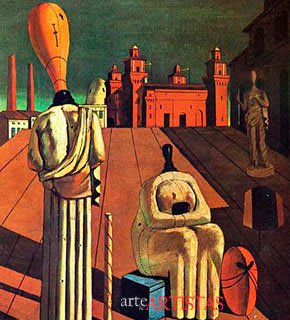
The Restless Muses, Giorgio de Chirico
The Restless Muses, Giorgio de Chirico
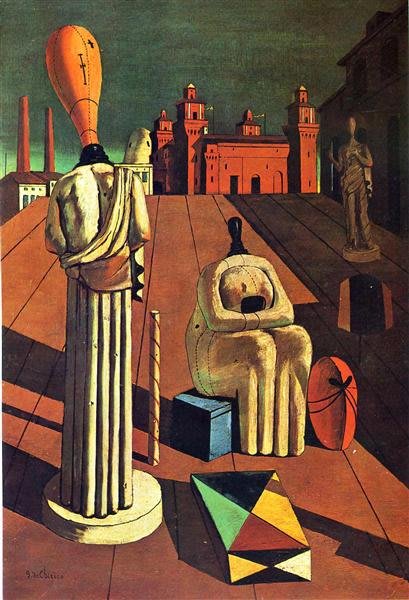
The Restless Muses is one of the most important works in the career of Giorgio de Chirico, originally painted during the period when the artist resided in Ferrara, Italy.
It was clearly inspired by classical Greek culture and, although provocatively, exhibits influences from African traditions that inspired several painters, including Pablo Picasso, in the same period.
The Muses were also a recurring theme in De Chirico's paintings. He believed they inspired him to see beyond mere appearances and look into the metaphysical - the realm of memory, mythology, and truth.
The existence of a castle that can be seen in the background of the painting is another element that deserves attention. De Chirico was inspired by the Castello Estense in the city of Ferrara.
He disregards the true scale of the architecture and seems to represent it almost as a miniature model in which he can place symbolic forms, such as the building on the right that resembles classical architecture.
Presenting a series of disconnected perspective types, the painting mixes different styles, ranging from Medieval to Renaissance and our recent times.
These references to Art History were related in the way the artist was impressed by the city as being extremely metaphysical.
For him, Ferrara was only a symbol of a city that had once had a powerful aristocratic court, but was now reduced to an empty shell, except for its own memory.
The entire composition was built to confer a sense of unreality on the scene, configuring it as a mental representation space.
The unusually high horizon seems to open up space for an immense theatrical stage.
The bright reds, the green sky, and the shadows that stretch out allude to a summer sunset.
However, it's not just the light of day that's disappearing, but
an entire culture, symbolized by the sculptures represented in the scene.
The painting brings opposites together in a hostile world.
While the sun sets in the west in the culture that originated in the Mediterranean Basin, the Muses become restless.
This painting is an example of how the artist can create a work that is at the same time a reflection on culture and society, and an expression of his own vision of the world.
With its references to classical Greek culture and architecture, De Chirico creates a work that is at the same time a tribute to history and a critique of contemporary society.
It's a work that challenges the viewer to think about the nature of reality and the importance of memory and culture.


