
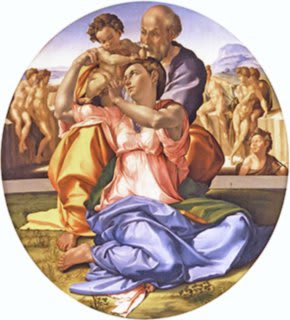
The Tondo Doni - Michelangelo Buonarroti
The Tondo Doni - Michelangelo Buonarroti
I invite you to contemplate The Tondo Doni by Michelangelo Buonarroti, one of the most important works of the Renaissance.
Created around 1504-1506, this circular painting depicts the Holy Family in an innovative and dramatic way.
Michelangelo used techniques of light and shadow to create a dynamic and emotive composition, highlighting the psychological depth of the characters.
The Tondo Doni is a prime example of Western painting, demonstrating the genius and technical skill of Michelangelo, known primarily for his sculptures.
Upon observing this work, you will be transported to the sublime and spiritual world of Renaissance art, where every detail is an expression of the search for beauty and truth.
The Significance of the Tondo
Tondo, meaning circular in Italian, were popular paintings in the 15th century.
The Tondo Doni, commissioned by the Doni family in 1503, depicts the Holy Family, with Mary turning to take the child Jesus from Joseph's hands and place him on her shoulders.
This composition features vibrant colors and monumental figures.
It is considered one of the greatest works of art in the Western canon.
The Composition of the Tondo
Like many Renaissance paintings, Michelangelo created his composition using the pyramidal form as a starting point.
He centered the Holy Family.
For the artist, who was primarily a sculptor, the work was executed as if it were a sculpture, as if the figures had been carved from a block of marble.
He attempted to resolve the problems of corporality and movement of the figures to give an illusion of three dimensions, as he could with sculpture.
The composition presents Mary, who is the most voluminous figure in the work, with her arms bare, lifting the child Jesus.
Joseph, with his long beard, appears much older than Mary, his wife.
Next to the wall, between the Holy Family and the nudes, we find the small John the Baptist, with his traditional skin of sheep;
he is holding a dry branch, with his eyes entirely turned towards the Virgin Mary, Saint Joseph, and the Child.
His presence in the painting reminds us that he is the precursor to salvation, which will come through Jesus Christ.
In the background, you can see mountains and a river, possibly a reference to the Jordan River.
The use of three primary colors, toned in areas of intense clarity, causes tonal differences, which Michelangelo also used in his magnificent frescoes in the Sistine Chapel, in the Vatican.
The Commission of the Tondo
Many paintings like this one, during the Renaissance, were commissioned to mark a wedding.
For example, the "Casal Arnolfini" painting by Jan van Eyck.
This painting was also commissioned from Michelangelo, but in the form of a Tondo for the marriage of Agnolo Doni and Maddalena Strozzi.
It is said that when the painting was delivered, Agnolo Doni tried to pay a value below what had been agreed upon before Michelangelo began the painting, wanting to pay for the work only 40 ducats instead of the 70 established previously.
Furious as he was, the artist threatened to take the painting back, unless Doni paid twice the original amount, which was enough to end the deal for both parties.
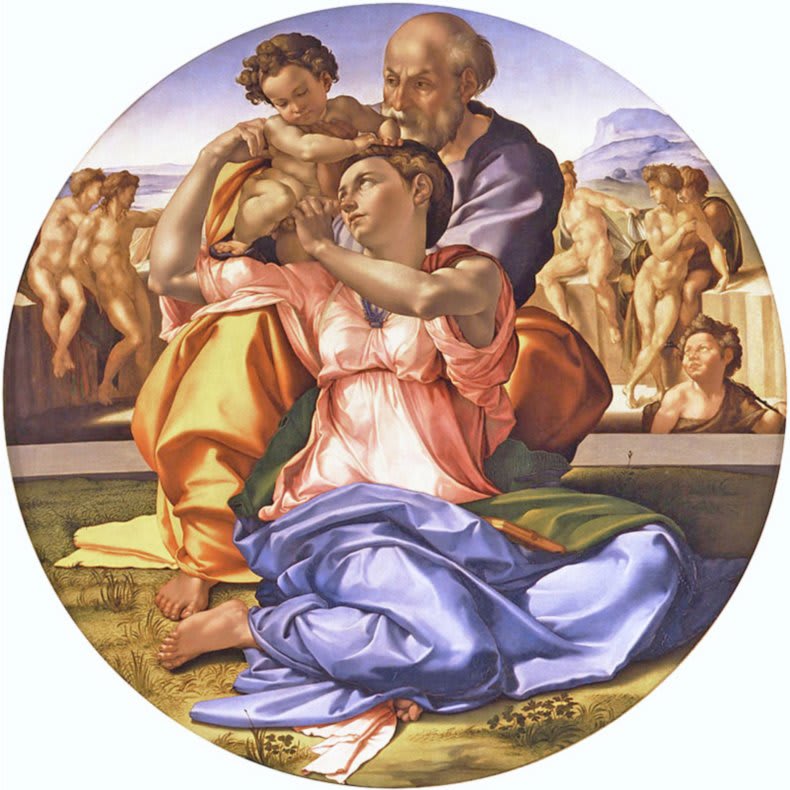
Title: The Tondo Doni, or Holy Family
Author: Michelangelo Buonarrotti
Technique: Oil and tempera on wood
Year: 1503
Dimensions: 120 x 120 cm
Location: Uffizi Gallery - Florence (Italy)


