
Tiradentes Beheaded, Painting by Pedro Américo
Tiradentes Beheaded, Painting by Pedro Américo
Article Index
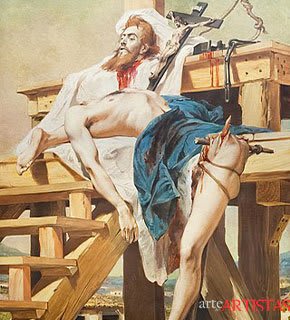
The painting Tiradentes Beheaded, is a work by the Brazilian painter Pedro Américo, completed in 1893.
The same depicts the moment when Joaquim José da Silva Xavier, better known as Tiradentes, is beheaded after being sentenced to death by hanging and beheading for his participation in the Mineiro Inconfidência.
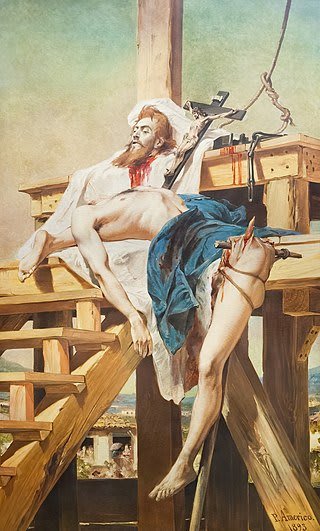
Location: Museu Mariano Procópio, Juiz de Fora (MG)
The painting that depicts his tragic fate makes an analogy with the death of Christ on the cross, which is possible because we notice the presence of a crucifix next to his severed head, referring to the religious values that Tiradentes may have possessed in life.
Pedro Américo's work is considered one of the most important in Brazilian art of the 19th century, not only for the painter's refined technique but also for its historical and political significance.
Through it, the artist criticizes the brutality and injustice of Tiradentes' execution and draws attention to the struggle for independence and freedom in Brazil.
Joaquim José da Silva Xavier (Tiradentes) became a symbol of the Republic and, from 1890, April 21 was declared a national holiday, chosen on the occasion of his death in 1792.
The painting is currently located at the Museu Mariano Procópio, in the city of Juiz de Fora, in Minas Gerais (Brazil).
The large-sized canvas makes the character appear life-size, causing a strong visual impact on the viewer, which allows him to be a witness to the tragedy.
In 1893, Pedro Américo resided in Florence, Italy, and after completing the painting in just twelve days, it was exhibited in Florence.
Initially, the artist titled the work Tiradentes Supliciado, but the name was not well received, and it became known as Tiradentes Beheaded.
1892 was the year of the centenary of Tiradentes' death. To mark the date, Pedro Américo conceived the painting a year before it was created.
At the time, the artist thought of a series of paintings on the theme of inconfidência, hoping to see his works incorporated into the National Gallery. The Tiradentes Beheaded painting was intended to be the last in the series, but it was the only one to be completed.
The Importance of the Painting
Furthermore, the painting is considered a symbol of the struggle for independence in Brazil and is an example of Brazilian art of the 19th century.
The Painting in Detail
The painting Tiradentes Beheaded is a work of great historical and artistic importance.
The painting depicts the moment when Joaquim José da Silva Xavier, better known as Tiradentes, is beheaded after being sentenced to death by hanging and beheading for his participation in the Mineiro Inconfidência.
The painting is considered one of the most important in Brazilian art of the 19th century and is an example of Brazilian art of the period.
The Painting in History
The painting Tiradentes Beheaded is a work that is part of the history of Brazil.
The painting depicts an important moment in the history of Brazil and is an example of Brazilian art of the 19th century.
The painting is considered a symbol of the struggle for independence in Brazil and is an example of Brazilian art of the period.
The Painting in Value
The painting Tiradentes Beheaded is a work of great artistic and historical value.


