Café, Candido Portinari
Café, a masterpiece by Candido Portinari
Article Index
Candido Portinari is considered one of the most important artists in Brazil.
The painting Café is considered his masterpiece, with which the artist received the second honorable mention at the International Modern Art Exhibition of the Instituto Carnegie, in New York.
As he was born on a coffee farm, this theme appeared repeatedly in his work.
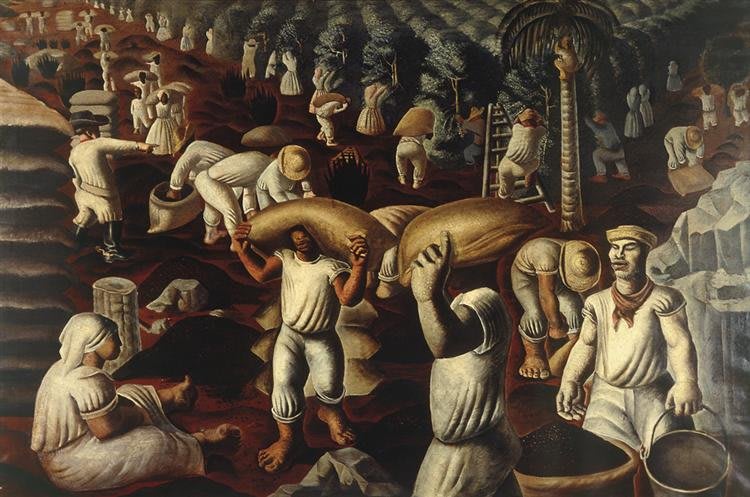
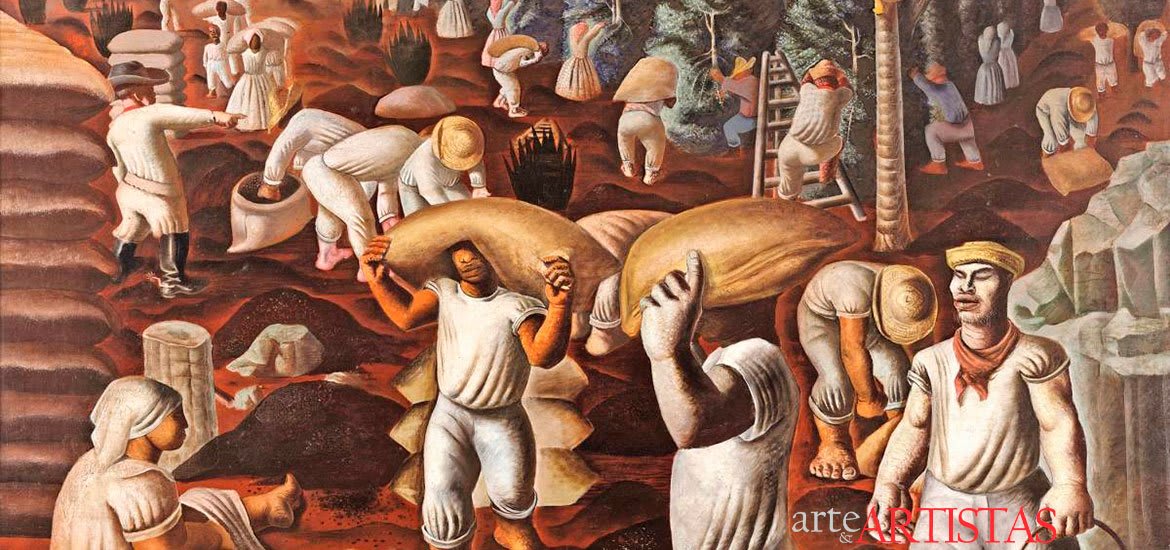
In this painting, he portrays the arduous daily work performed by women and men on a coffee plantation.
It is a realistic and at the same time symbolic portrait of the time when coffee was considered the green gold of Brazil.
In 1928, Portinari received a scholarship to study in Paris.
While he was in Europe, the artist absorbed many of the styles he encountered, from Renaissance to Cubism of Pablo Picasso.
Curiously, at this time he almost did not produce works, for which he was harshly criticized, and in 1930 he returned to Brazil.
In 1933, Portinari returned to his homeland and began a remarkably prolific and crucial period in his career.
It was during this period that he would explore continuously throughout his work: life on the coffee plantations.
Although the artist portrays the landscape and workers in a state of poverty, his paintings do not convey a sense of misery or deprivation, but rather portray a faithful representation of the world through his own pictorial style.
The rounded bodies imprint on us a physical understanding of the artist's innate understanding of volume, something that reminds us of the figures represented in the murals of Diego Rivera, with somber tones that subtly dramatize the nature of the scene.
Portinari wanted to tell the story of humble people, people who made the nation.
However, his work was not initially accepted.
Where before he had received criticism that he was "demoralizing Brazil" with his desolate landscapes, now people did not understand his work on a purely aesthetic level.
By transposing onto the canvases the concerns with the social issues of Brazil in his time, the artist became the most discussed painter in the country.
His expressionist deformations provoked many criticisms.
However, his fortune would change.
In 1935, his work Café a lively picture that showed life on a farm, with men and women performing the arduous task of carrying sacks of coffee grains, received an honorable mention at the International Modern Art Exhibition of the Instituto Carnegie.
This acclaim abroad made the Brazilian critics give another look at 'their' painter - this time, they found more things to like in the vision of the nation that Portinari presented abroad and in his country.
Café is a work that portrays the life of workers on a coffee farm.
Called by many 'the painter of big feet', Portinari dared to portray the workers with enormous and deformed feet.
Thus explained the artist:
"Suffered feet with many and many kilometers of march. Feet that only saints have. Feet that inspired pity and respect. Attached to the ground, they were like foundations, often supporting only a thin and sick body. Feet full of knots that expressed something of strength, terrible and patient".
Candido Portinari's Work
Portinari is considered one of the most important artists in Brazil.
His work Café is considered his masterpiece, with which the artist received the second honorable mention at the International Modern Art Exhibition of the Instituto Carnegie, in New York.
He portrays the life of workers on a coffee farm, showing the arduous daily journey they perform.
His pictorial style is realistic and at the same time symbolic, portraying the time when coffee was considered the green gold of Brazil.
His work was not initially accepted, but the acclaim abroad made the Brazilian critics give another look at 'their' painter.
Today, Portinari is considered one of the most important artists in Brazil.