
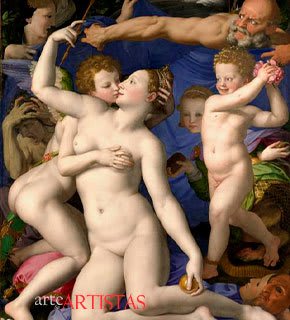
An Allegory with Venus and Cupid - Agnolo Bronzino
An Allegory with Venus and Cupid - Agnolo Bronzino
An Allegory with Venus and Cupid is one of the most famous paintings by Agnolo Bronzino and one of the most important of the Mannerism. This beautiful painting, full of mystery, is a fitting testament to one of the most talented artists to have lived and worked at the end of the Renaissance.
The painting was probably commissioned by the Duke Cosimo de Medici of Florence to present to the King of France, Francisco I. The king and his noble guests could appreciate the eroticism of the work with the certainty that their attention could be explained by their supposed interest in suggestive paintings.
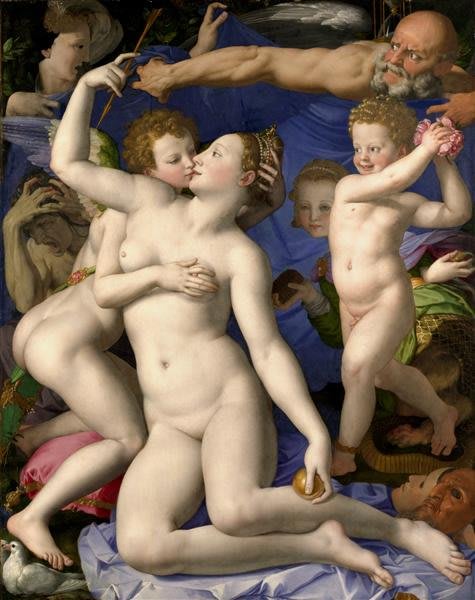
The composition presents several characters placed against a sumptuously painted background of silk with an extravagantly expensive ultramarine. The skin tones in front of this luxurious fabric are somewhat cold, as if the artist was deliberately invoking links with ancient marble statuary. Every inch is finished with a bright finish, revealing new charms as one advances. The piece is openly erotic and Bronzino does not hold back.
The work is full of hidden meanings, suggesting feelings linked to each represented figure. The identities of the main protagonists are relatively clear, but there is much debate about their identities. Venus, holding a golden apple, a reference to the Judgment of Paris, is incestuously embraced by her son Cupido who kneels on a large cushion covered with a beautiful pink silk. In the mysterious world of allegory, this cushion must be interpreted as a symbol of Luxury. Therefore, we are on safe ground to conclude that the image is concerned with love, lust and pleasure, and the often malignant consequences of this combination.
The naked child to the right of Venus is probably a personification of the Whimsical Pleasure who is about to throw a handful of rose petals in the direction of Venus and Cupid. Behind him is a terrifying representation of the Deception, whose beautiful face, we perceive with horror, is attached to an excessively monstrous body of a snake. In one hand she holds a honeycomb, but in the other is her poison. The message is not too difficult - the lascivious activity can be pleasurable in the short term, but it can also result in less pleasant consequences. However, confusingly, there is another view, that the beautiful face does not belong to the Deception, but is the Pleasure with the naked child as Madness.
Looking at the remaining peripheral figures, the interpretations of meaning become even more uncertain. Directly above the Pleasure, we find the Father Time who appears with his hourglass balanced in a rather incongruous way on his right shoulder. He extends an abnormally long arm throughout most of the composition, resisting with determination the efforts of a mysterious figure that inhabits the upper left corner of the composition and seems to be trying to pull the background fabric over the entire scene. This appearance similar to a mask is probably the Forgetfulness, as part of the head with the parts of the brain that deal with memory, are missing. Below the Forgetfulness, a figure screaming clutches its head. The presence of this figure is obscure; it may represent Jealousy or Despair. However, another theory proposes the figure as the personification of the syphilis that had recently arrived in Europe and was, therefore, a very powerful contemporary example of the negative side of lust.
In the lower left corner of the image, behind Vênus's feet, are two masks, reminiscent of the traditional masks of the Comedy and Tragedy; while in the lower right corner, a single White Dove, turned away from the forbidden scene.


