Biography of Diego Velázquez
Discover the life and works of one of the most influential Spanish painters of all time.
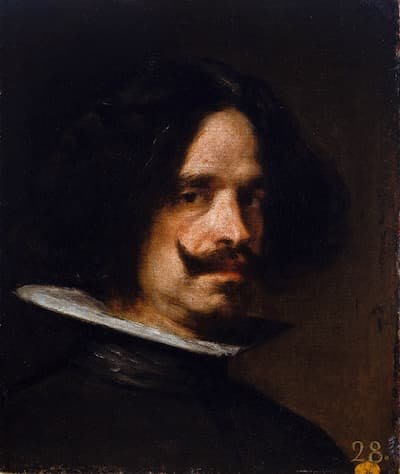
Diego Velázquez was a Spanish painter of the Golden Age, 17th century, and one of the most important in the history of art, in his case, the Baroque.
His masterful use of light and shadow to create volume and depth, as well as his ability to capture reality in a naturalistic way.
His loose brushstrokes and ability to suggest details with economy of means, deeply influenced the evolution of European painting.
His work covers a wide range of subjects, including portraits, mythological scenes, religious and genre scenes, showing versatility and exceptional talent.
BIOGRAPHY
Diego Rodríguez de Silva y Velázquez was born on June 6, 1599, in Seville, Spain.
His father, Juan Rodríguez de Silva, was of Portuguese origin, and his mother, Jerónima Velázquez, was from Seville.
At the age of eleven, he began his artistic training in the workshop of Francisco de Herrera, the Old, a prominent painter of the time.
However, after a year, he moved to the workshop of Francisco Pacheco, where he received a more complete education in the arts and humanities.
In 1618, Velázquez married Juana Pacheco, the daughter of his teacher Francisco Pacheco.
Francisco Pacheco was a mediocre maneirist painter, but it was through his teachings that Velázquez developed his initial naturalistic style.
During his stay in Seville, Velázquez developed his personal style and produced some of his most important early works.
His paintings from this period show his ability to represent reality with great detail and his interest in everyday life.
In 1623, he moved to Madrid, where he was appointed painter to King Philip IV.
This appointment marked the beginning of a successful career at the royal court, where he not only painted portraits of the king and his family but also of other members of the nobility and important figures of the time.
His ability to capture the personality and dignity of his subjects earned him the favor of the king and a privileged position at court.
In 1627, Velázquez received the prize and the title of knight porter of the king.
In 1628, he received a visit from the most renowned and respected Baroque artist from Flanders, Rubens, who spent six months at the Madrid court.
Velázquez and Rubens conversed and worked together during this period and developed a deep mutual respect.
Rubens encouraged Velázquez to visit Italy, where he believed true art was beginning.
Velázquez made two important trips to Italy, in 1629-1631 and in 1649-1651, which significantly influenced his work.
In Italy, he studied the works of masters of the Renaissance and Baroque, enriching his technique and style.
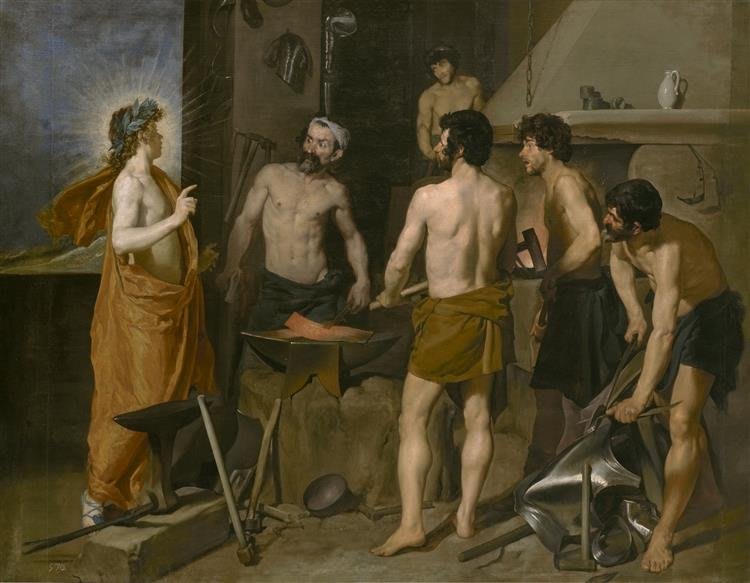
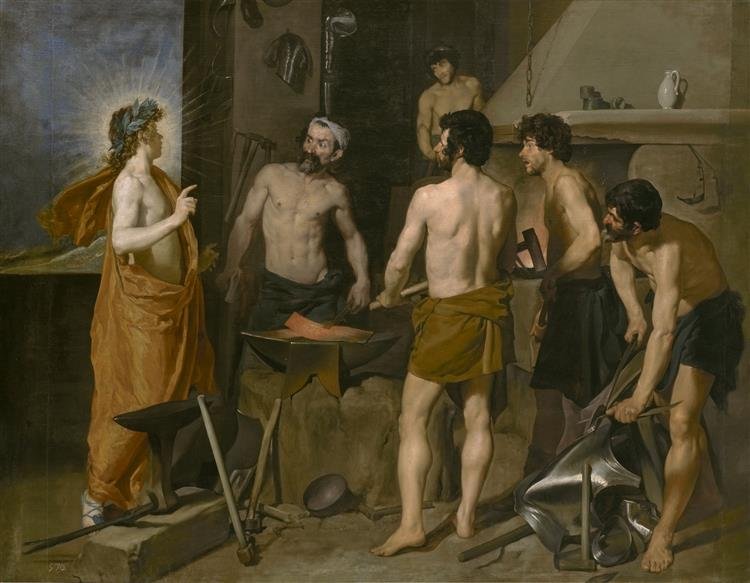
Paintings such as The Forge of Vulcan represent the influence of these trips on his work.
After returning from Italy, Velázquez entered the most productive period of his career.
He resumed his position as a portrait painter and was occasionally called upon to represent mythological themes for the decoration of the royal apartments.
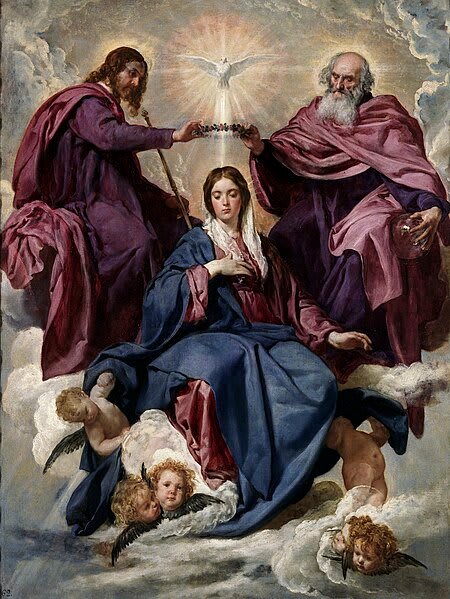
In this period, his religious works are rare and individual.
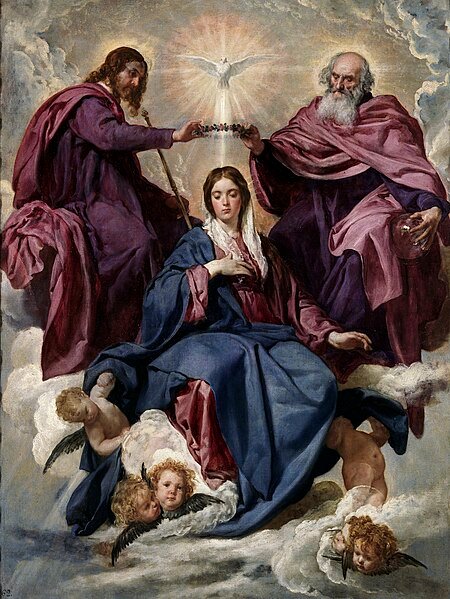
In The Coronation of the Virgin, the solemnity and dignity of the holy people are highlighted by their voluminous colored robes in an exceptional composition of splendor, especially suitable for a painting of the Queen of Heaven made to adorn the oratory of the Queen of Spain.
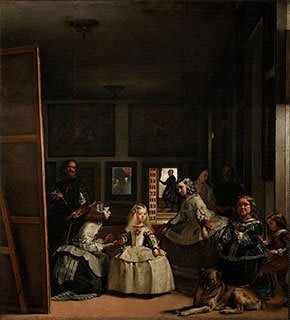
The last great work of Velázquez was a group portrait of the Spanish Royal Family, entitled The Maids, whose painting has become one of the most analyzed works in Western painting.
Velázquez died on August 6, 1660, in Madrid.
His legacy lives on through his masterpieces, which continue to be objects of study and admiration.
His influence is notable in the work of later artists, including Francisco de Goya, Édouard Manet and Pablo Picasso.
LEGACY
Velázquez is often cited as a fundamental influence on the art of Édouard Manet and the impressionists.
Calling him the "painter of painters," Manet admired the bold combination of loose brushstrokes and economy of means that characterized his style, while remaining faithful to his Baroque academic training of his contemporaries.
Manet based himself on Velázquez's motifs in his own art.
When a teenager, art student at the Real Academia de Bellas Artes de Madrid, Pablo Picasso spent some time in the galleries of the Museu do Prado, where he copied some of Velázquez's works. The Maids was so influential that it led Picasso to recreate it more than fifty times in his late cubist style in the 1950s.
READING ARTWORK
The Feast of Bacchus, also known as Los borrachos, appears to have been inspired by Titian and Rubens, but his realistic approach to the subject is characteristically Spanish and Velázquez would preserve throughout his life.
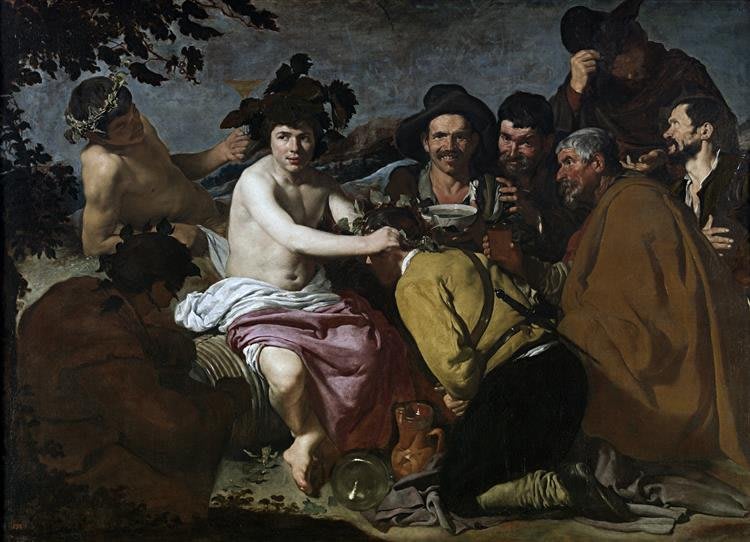
In The Feast of Bacchus, the painting is firm and solid in its figures, while the light and dark areas show an evolution of Velázquez's earlier works.
The composition was thought out using many diagonals and complex focal points to engage the viewer.
To the left, Bacchus and the satyr behind him are completely naked, except for the traditional loose cloths of classical mythology.
Bacchus is seated and vividly illuminated; he looks out of the painting while placing a wreath of leaves on a man in a golden jacket kneeling before him.
A very dark mythological figure is crouched in the lower left corner.
The right side of the composition is formed by several older men, dressed in dark clothing, drinking and talking.
Two of the men look directly at the viewer, as if inviting him to join in the fun.
The work stands out for its use of the naturalism characteristic of Velázquez, which even when transposed to a mythical theme manages to maintain a sense of realism - almost inviting the viewer to participate in the dreamlike scene.

LEGACY
READING ARTWORK
The Last Supper - Here, the precise realism and actions of the figures depicted with strong dramatic lighting remind us of the work of Caravaggio, which Velázquez may have studied from copies in Seville.
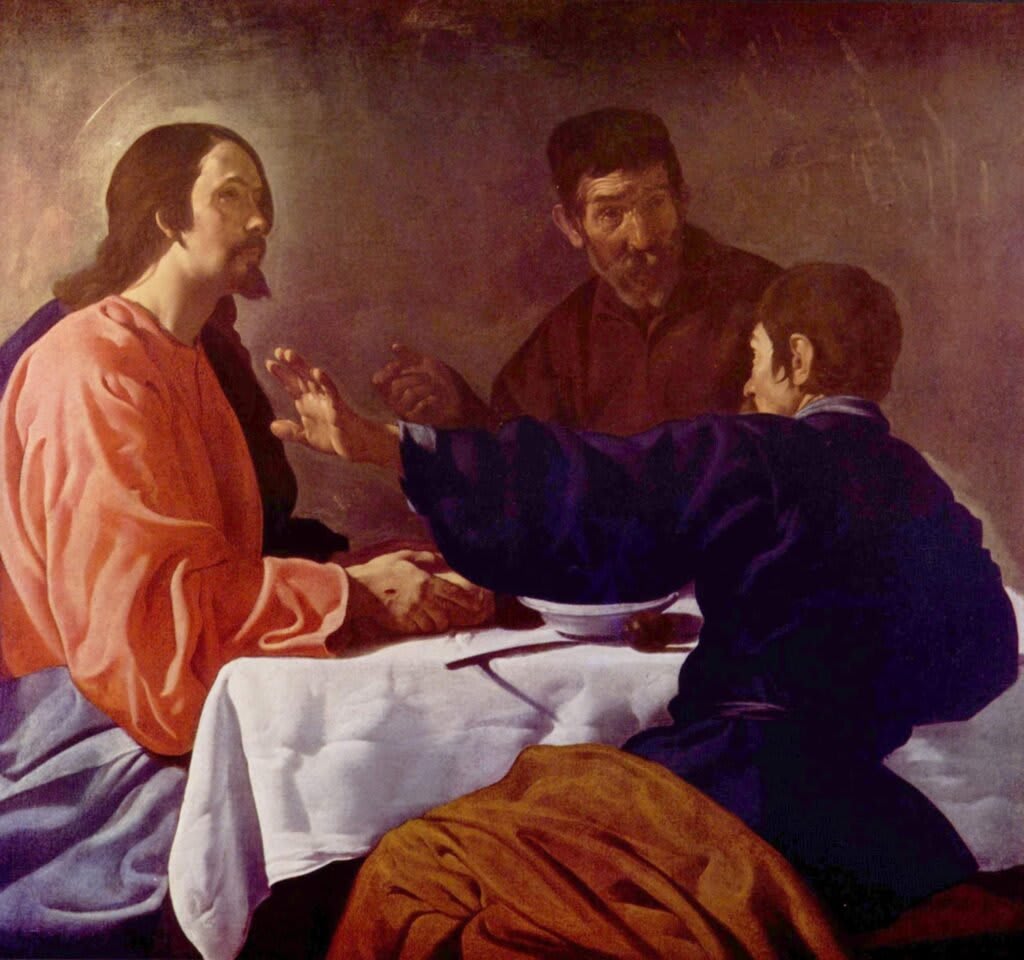
Christ is depicted in the moment of recognition by two disciples after his resurrection.
The source of light in this work enters from our left and appears centered on Christ's head or near it.
This creates illuminated faces and a darkened background.
The main focus is on Christ; he exudes a tranquil and thoughtful presence while the disciples react with movements and expressions of surprise or emotional confusion.
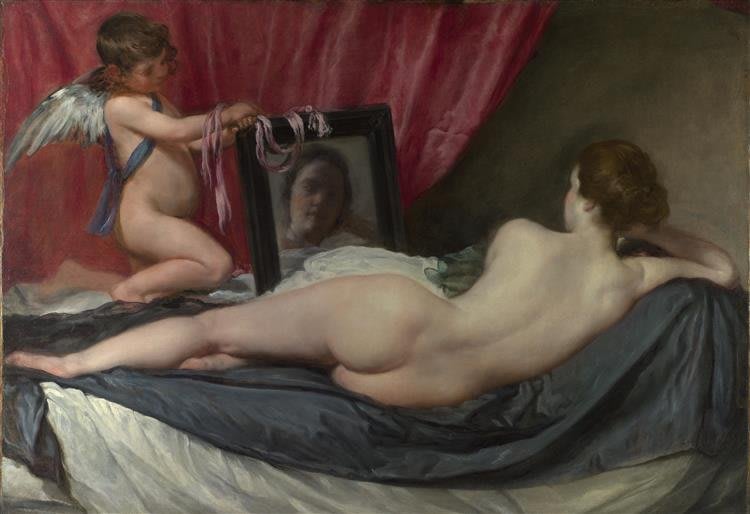
VENUS AT THE MIRROR, A PRIME WORK BY THE ARTIST
In ancient mythology, the goddess Venus personified the symbol of love, as well as the sublime and beautiful beauty of a woman.
In this painting, she is depicted reclining with her knees slightly bent on fine flowing cloths.
The artist focused on looking at the beauty of the female body, deliberately avoiding the luxury of the curtains and eliminating decorations such as flowers and jewelry.