Biography of Joan Miró and his works: The Making of a Catalan Visionary
Biography of Joan Miró and his works: The Making of a Catalan Visionary
Amidst the vibrant colors and atmosphere of spring, Joan Miró i Ferrà, the Spanish painter, printmaker, ceramist, and sculptor, was born on April 20, 1893, in Barcelona. His father was a goldsmith and watchmaker in a shop called Aquarium, located in Plaça Real. His mother, Dolors Ferrà, came from a family of cabinetmakers.
Miró undertook his initial studies at the Academia Marquês. At just 14, still a teenager, he enrolled in the Escola de Belas Artes. Shy, introverted, protective of his private world—he greeted no one. All in vain. His proverbial ineptitude for drawing, he confessed: "I can't tell a straight line from a curve." He decided to abandon the art world and began working in a drugstore. In truth, if he were to continue as an administrative employee, he would have a dark and mediocre future, his father thought, watching his son thoughtfully observe the colors of the sky. Ultimately, a bout of typhoid and a deep depression were enough for his father to make a sound decision. Seeing his lamentable state, he suggested the young man spend some time at the paternal property in Montroig, where his grandfather, a blacksmith and forger, was an artisan. There, Miró developed his keen observational skills. He became ecstatic observing the calligraphy of a tree's bark, the arrangement of roof tiles, the bustling activity of ants. Unbeknownst to him, he was following the advice of Augustine of Hippo: "If you are sad, contemplate the ants."
Energy and the will to live once again took root in the soul of the future artist. His father, finally convinced that instead of placing his son in the hands of a psychiatrist, he wisely entrusted him to his true calling. Miró enrolled in the academy of Francesc Galí, an eminent pedagogue who accepted the student's graphical limitations, instead focusing on enhancing his keen sense of color. Miró, for his part, knew he couldn't stop pedaling on the bicycle of art if he didn't want to re-submerge himself in the dark hell of total sorrow.
Very confident, at 20 years old and accompanied by the engraver Enric Guitart, he opened his first independent studio. He discovered the poetry of Apollinaire, and a friendly art dealer became interested in his work.
In 1917, he painted a series of landscapes that he exhibited at the Dalmau galleries. The result was resoundingly null. His early Expressionism, steeped in Fauve influences, found itself at a dead end.
The painting Rades, the Village is one of Joan Miró's earliest works. Belonging to Fauvism, we note a slight approximation of Cubism, a movement he also briefly embraced.
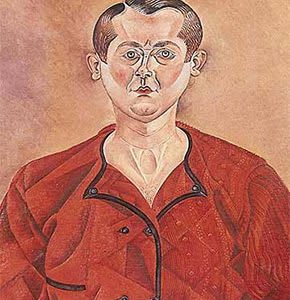
In 1919, he traveled to Paris for the first time, where he met and became very close to Pablo Picasso. He completed his Self-portrait and gifted it to his friend. Now settled in the City of Light, the capital of art, he unleashed his inner world, embracing a new, convinced, and expressive ideology, thanks to frequent contact with the avant-garde figures of the moment, such as: Paul Éluard, Aragon, André Breton, Joyce, Miller, Ezra Pound, Jacques Prévert, Erik Satie.
Four years later, the Surrealist Manifesto was published. It was the founding text of this movement, to which Miró now belonged.
In 1922, he completed the canvas The Farm and secured a distinguished buyer, Ernest Hemingway. The work was sold for two hundred and fifty dollars, thus postponing his usual companion, hunger. In this piece, a childlike verism blends with frontality and order; yet it delves into his childhood world, from which he would never truly depart.
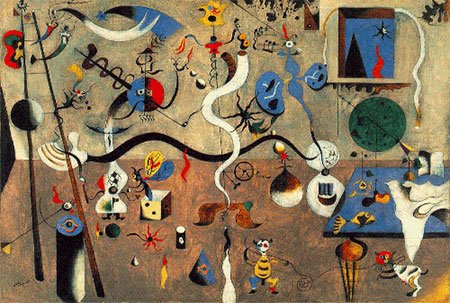
After completing La Masonera de Gigantescos Pés in 1923, he definitively broke from the reality of normal consciousness to immerse himself under the aegis of Freud and Breton. His famous The Carnival of Harlequin inaugurated this new phase: "il faut changer de vie" he had cried out in those same streets of Paris.
To understand the rest of this journey, continue to our next article: Biography of Joan Miró and his works: The Surrealist Master, Wars, and International Ascent.


