
Boulevard Montmartre at Night - Camille Pissarro
Boulevard Montmartre at Night - Camille Pissarro
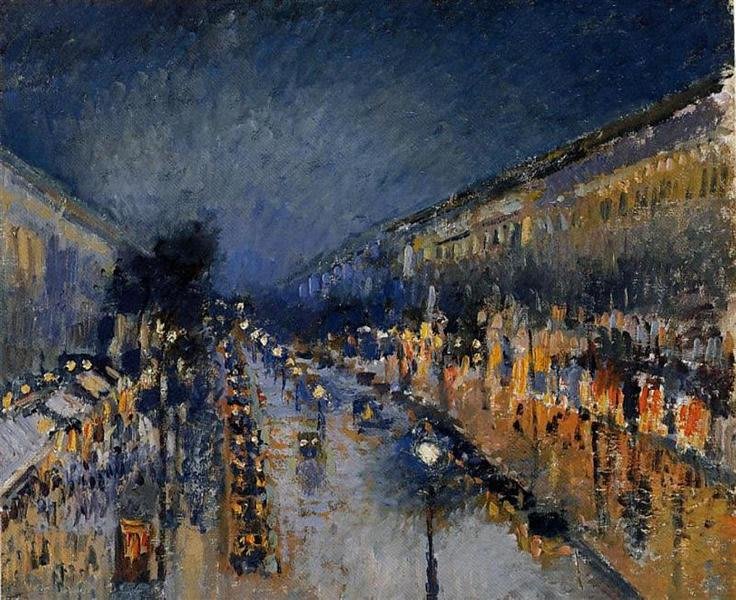
Boulevard Montmartre at Night is a painting created by Camille Pissarro, one of the leading figures of the French Impressionist movement. This painting, which depicts a nocturnal scene, is considered one of the most famous with this theme, alongside the famous Starry Night, the masterpiece of Vincent van Gogh.
In February 1897, Pissarro stayed in a room located in Paris on the corner of one of the four large boulevards, then created a series of paintings of the Boulevard Montmartre at different times.
This animated nocturnal scene, Camille Pissarro captures in bold brushstrokes of color the elegant life of this bustling street on a rainy night and the sidewalk reflecting the lights of the cafes and restaurants. For him, these late urban themes resolved one of the primary problems of his early landscapes - that of depicting recession. The architectural structure of a Paris street gave his paintings a natural spatial depth, freeing him to focus on other aspects of the painting. Here he guides the viewer's eye to the dark void with dancing lines of light - streetlights, carriage lines, and wet reflections on the sidewalks. He reinforces the receded lines of the street and buildings with extreme tonal extremes - dark shadows and bright lights - and eliminates the detail of the buildings, reducing even the picturesque horizon of the rooftops.
He tried to represent the various effects that artificial lights have on different colors: blueish and pale, as well as intense. Vertical abstract forms in the painting represent the crowds moving under the trees and beyond the shops. On one side, there is a series of carriages lined up and waiting for the exit of the guests who were at the show that took place at the Moulin Rouge, which is nearby. The sky is dark and overcast, and the clouds are seen floating in the air. But the stars visible in the sky show that the clouds will pass soon.
He probably would have added these small touches of pure paint at the very end, placing them over all the previous layers of paint.
The architecture of Paris has been loved for centuries, and artists flocked to the city to produce scenes of it in their own work. Pissarro wrote: 'I am delighted to be able to paint these Paris streets that people have come to call ugly, but which are so silvered, so luminous and vital.' With this thought, he did not limit himself to points of view in Paris; he also peeked through the windows of hotels in the bustling streets and ports of Rouen and Le Havre, painting many scenes depicted by the Impressionists in their early years.
The artist produced a series of the same scene and view, but in different weather conditions, at different times of the day. He was very impressed because he could see the entire extent of the location and also had a panoramic view of buses, carriages, and people between large trees and enormous houses that needed to be straightened. The way the main elements of the scene converge to a point in the background of the painting balances the composition and may have also facilitated his sketches - it is likely that he made some preparatory drawings first in pencil or charcoal to get the angles as he saw them in reality. After producing several paintings of the series, he would then have started working more by habit and memory, as this breathtaking view had been permanently etched in the back of his mind.
Despite living and working in the countryside for most of his life, Pissarro maintained a studio in Paris when he could afford it. However, except for a few exceptions, he showed no interest in the city as a subject for painting until the last twenty years of his life. He always considered landscape painting of the greatest importance in his work, had a sensitive eye both to light and cold, particularly to wind. This meant that, except on warm and calm days, he had to work in the shelter of an interior, and finding such a room, with a view that could sustain his interest, led him back to the city.


