
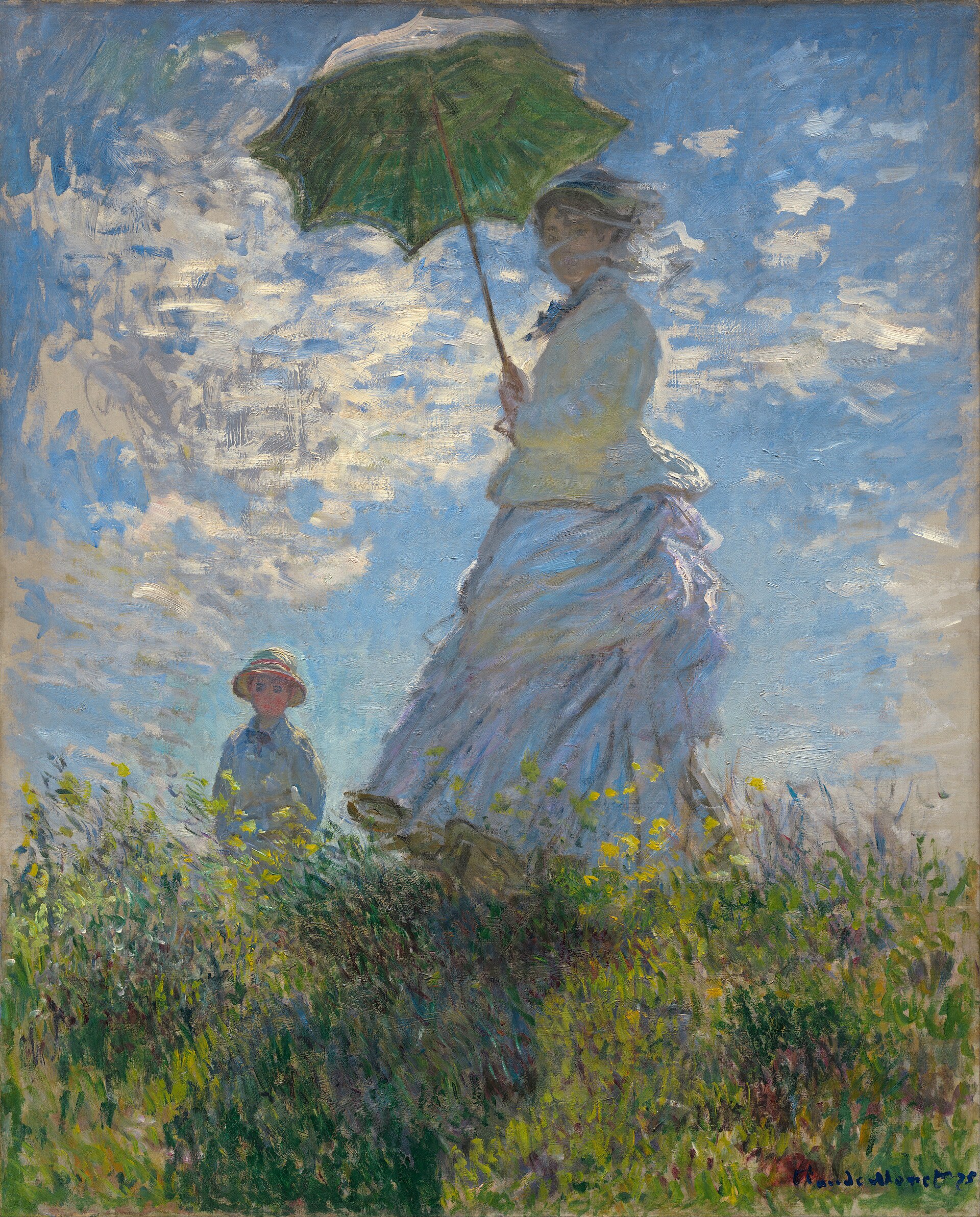
Claude Monet: Biography and Work: The Impressionist Journey and the Construction of a Legend
Discover the fascinating biography of Claude Monet, from his childhood and early drawings to the emergence of Impressionism and the works that defined his innovative style.
Claude Monet was one of the leading Impressionist painters in France and a central figure in the development of modern art.
Born in 1840, in Paris, Monet is known for his Impressionist landscapes, especially of gardens, poppy fields, the Rouen Cathedral, and his series of Water Lilies.
He is admired for his ability to capture light and atmosphere in his scenes, using loose brushstrokes and vibrant colors.
Monet was one of the founders of the Impressionist movement, which sought to capture the fleeting impression of light and atmosphere in painting.
His innovative technique influenced generations of artists and helped pave the way for modern art.
Claude Monet was an important French painter, a figure of prominence in the Impressionism, movement that he led.
His concerns in capturing light and movement were a crucial moment for the development that art passed in the late 19th century and early 20th century.
Oscar Claude Monet was born on November 14, 1840, in the city of Paris, France.
His father, Auguste, was a merchant in a maritime transportation business run by the family.
His mother, Louise, took care of the house and the children.
When Monet turned five years old, his father's business moved the family to Le Havre, a port city in Normandy.
Monet demonstrated his interest in art at a young age, loving to draw caricatures and filling his schoolbooks with sketches.
As he grew up, he spent all his time doodling, which began to annoy his father, who wanted him to focus more on running the family business.
Over time, Monet developed his talent as a caricature artist.
He had not yet shown an interest in painting until he met Eugene Boudin, a local landscape painter.
He introduced Monet to outdoor painting, which would later become the cornerstone of Monet's work.
Defying his father's wishes, Monet decided he would not follow in his father's footsteps and instead try to become a professional painter.
In 1859, Monet returned to Paris and enrolled as a student at the Academie Suisse.
The following year, Monet was drafted into the army for a seven-year term in Algeria.
After two years, an illness allowed him to leave the army.
He returned to Paris and continued his art studies.
In 1862, he refined his painting skills, studying with Charles Gleyre, who gave him the opportunity to meet artists like Auguste Renoir, Alfred Sisley, Camille Pissarro, and Frederic Bazille.
After several years of learning and evolving, Monet was accepted into the Salon of 1865, where his paintings would be judged and classified in an annual competition.
The jurors chose two of his paintings for participation, both marine landscapes.
This came at the right time, as Monet was starting to struggle financially.
The following year, he met Camille Doncieux, who would become his future wife.
At that time, he was extremely poor and unable to sell his works.
Things worsened when his first child, Jean, was born in 1867.
Good fortune came in the form of Louis-Joachim Gaudibert, who became his first dealer and a great supporter.
Monet and Camille married in June 1870 and were soon forced to flee across the Channel to London, trying to escape the Franco-Prussian War.
After the war ended, they returned to France, but not to their old home - with the inheritance he received from his father's death, the couple settled in a rented house in Argenteuil, a industrial town west of Paris, on the banks of the Seine River.
He never lost touch with his old friends, often exchanging letters with Renoir, Pissarro, and Édouard Manet. They even joined other artists and formed the Société Anonyme des Artistes, Peintres, Sculpteurs and Graveurs, which served as an alternative to the Salon, a place where art pieces were not forced to compete and were able to explore new expressive territories.
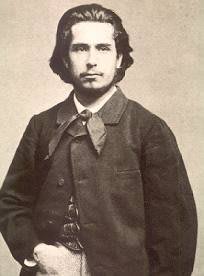
Fig. 1: Claude Monet, circa 1875
In 1872, Monet painted the famous painting "Impression: Sunrise".
The work was exhibited two years later at the first "Impressionist" exhibition held in April 1874.
A critic who attended the exhibition and observed Monet's work and the title "impression", commented pejoratively when he observed the painting and the title, that the painting was "impressionist."
The critic intended to ridicule Monet's painting - the fact that the paintings did not end with perfect lines.
However, the artists adopted the "impressionism" as an appropriate label for the art they were following.
This Impressionist exhibition was a crucial moment in the development of modern art.
It characterized the main Impressionists, such as Renoir, Degas, Pissarro, Cézanne, and having Monet as the leader.
It allowed these free-thinking artists to distance themselves from the conservative art world that dominated the Salon of Paris.
The exhibition attracted an interested public, although it still took time for Impressionism to take off.
After his wife Camille died of complications from her second pregnancy, Monet, who already knew Alice Hoschedé, started living together.
When they got married, she already had six children from her previous marriage, making a family of ten people when counting Monet and his two children, Jean and Michel.
In 1878, Claude Monet was struggling financially.
To alleviate this, he moved from Paris to Vétheuil, a rural town northwest of the capital, bordering the Seine River between Paris and Rouen.
The town was known mainly for its 13th-century Gothic church.
During the time he lived with his family in Vétheuil, Monet painted many views within and around the town, observing its various aspects over each period of the year, as the seasonal light brought different effects to the town's architecture and environment.
The artist represented various visions, using this theme in a highly selective manner, excluding all signs of heavy river traffic from one of the busiest commercial routes in western France.
Instead, he presented a view of Vétheuil that made the town appear peacefully rural, with his refined style, applying bright and sparkling tones.
In 1883, after many successful exhibitions, Monet bought a property in Giverny, a place that would serve as a source of great inspiration for the artist and prove to be his definitive home.
In Giverny, alongside Alice and her family, was the period in which he lived the most productive of his work and happy of his life.
He loved painting outdoors in the gardens he helped create.
The water lilies found in the pond had a particular appeal to him, and he painted several series with the same theme.
This proved to be an ideal setting for many painting series, such as his water lilies and a bridge over a lake, which he called the Ponte Japonesa.
For Monet, nature was a significant influence, and he spent hours observing nature, especially in his gardens in Giverny.
Monet would later say that he could have become a flower painter.
He also said that his greatest masterpiece was his garden:
“The wealth I achieve comes from nature, the source of my inspiration.” (CLAUDE MONET)
In 1911, Monet was depressed after the death of his beloved Alice and the following year he was diagnosed with cataracts.
During the time when modern art was at its peak, Monet was out of sync and did not participate in this transformation.
Nearly blind, with both eyes now seriously affected by cataracts.
During World War I, he approached Georges Clemenceau, the then French Prime Minister.
At the end of World War I, he painted a series of willows in memory of the many Frenchmen who died in the conflict.
The last years of the painter's life are marked by a near-feverish productivity.
Far from slowing down his pace of work, he shows himself particularly demanding of himself.
Out of fear of mediocrity, he burns numerous canvases.
Reminding himself of the way art dealers had pillaged Manet's atelier after his death, he wants to protect his work and avoid having studies or less valuable sketches appear on the market.
In 1919, Pierre-Auguste Renoir, his last companion, dies.
The old man is left alone at the foot of his lake.
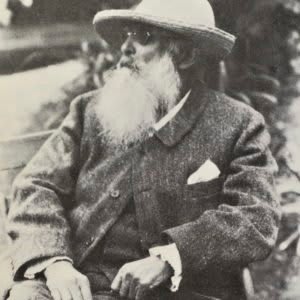
Fig. 2: Claude Monet, circa 1920
In 1923, Monet finally consented to undergo surgery, which was successful.
Despite this, he struggled with a strong depression during this period of his life.
He wrote to a friend that: "Age and disgust have exhausted me. My life has been nothing but a failure, and all that remains is to destroy my paintings before disappearing.”
Monet died on December 5, 1926, in his home in Giverny.
His tomb is located in the Giverny Cemetery Church.
Claude Monet did not realize the impact he had on the art scene and the importance of his work.
He once said: “My only merit lies in having painted directly in front of nature, seeking to give my impressions of the most fleeting effects.”
It is obvious that he achieved much more than that.
In a few words, Monet helped change the course of art, surpassing the conventions of the past, breaking rules, and being bold in creating a new method, surpassing conventional painting, he opened the way for 20th-century art.
This great artist managed to transform the course of art in a direction far from classical norms and undoubtedly one of the most influential and important painters in the universal history of art.
To understand the rest of this journey, continue to our next article: Claude Monet: Biography and Work: The Legacy in Giverny and the Gallery of Masterpieces.


