
Edvard Munch: Biography and Works – Early Life and Initial Masterpieces
Edvard Munch: Biography and Works – Early Life and Initial Masterpieces
Article Index
Edvard Munch, the Norwegian painter and printmaker, is regarded as one of modern art's most influential and electrifying figures.
Munch grappled with depression and mental illness. Fully aware of his condition, he channeled it to produce extraordinary, often hallucinatory, works.
His pessimistic view of life was conveyed through bold colors and strong lines, anticipating the Expressionist movement.
In his own words, he tackled existential themes such as life, death, and despair, in an attempt to “dissect souls.”
Edvard Munch: Biography and Early Years
Edvard Munch was born on December 12, 1863, in the village of Adalsbruk, located in Loten, Norway.
Christian Munch, a devoted physician, and Laura Catherine Bjolstadva were the parents of a family that included Edvard and four other siblings.
In 1864, his family moved to Oslo after his father's appointment as a medical officer at Akershus Fortress, a military area.
His mother died of tuberculosis in 1868, the same year his sister Inger Marie was born.
Within a decade, Sophie, his favorite sister, only a year older and a talented young artist, also succumbed to tuberculosis.
His father, an absolutist Christian, experienced fits of depression and anger after these events, as well as quasi-spiritual visions in which he interpreted the family.
In one of his accounts, Munch later confessed:
"My father was temperamental, nervous, and obsessively religious - to the point of psychoneurosis. From him, I inherited the seeds of madness. The angels of fear, sorrow, and death have been at my side since the day I was born." - Edvard Munch
In his mother's absence, his father would often read to his children the ghost stories of Edgar Allan Poe.
He also offered history and religion lessons, instilling in young Edvard a general sense of anxiety.
Consequently, this sparked in him a morbid fascination with death.
Adding to this, his fragile immune system was no match for Scandinavia's harsh winters.
Frequent illnesses kept him out of school for long periods. To make use of this time, he began drawing and painting in watercolor.
The Artist's Formation: Influences and Controversies
Art became a constant occupation during his adolescence. At thirteen, he became acquainted with the works of the burgeoning Norwegian Art Association.
This gave him a particular inspiration for landscape paintings. Through extensive observation and copying of these works, he taught himself oil painting techniques.
In the 1880s, the young artist, seeking a bohemian lifestyle, discovered the writings of philosopher and anarchist Hans Jaeger.
Jaeger led a group whose principles advocated for liberal sex, or free love, and the abolition of marriage.
Munch and Jaeger formed a close friendship. His friend encouraged him to draw more from personal experience in his work.
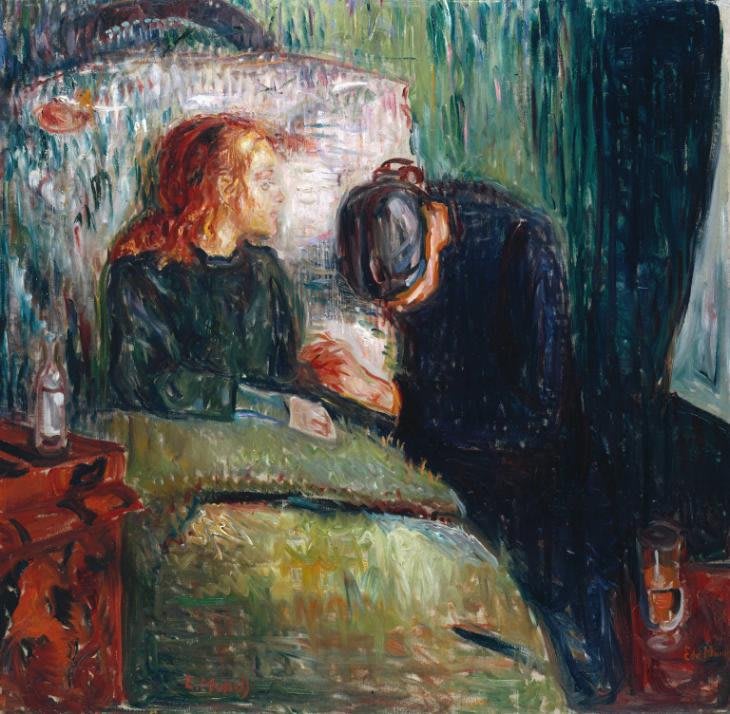
The Sick Child is a somber composition that served as a memorial to his deceased sister, Sophie.
When the painting was exhibited as A Student in Kristiania, it was attacked by critics and even by the artist's own colleagues, due to its overtly unconventional qualities and unfinished appearance.
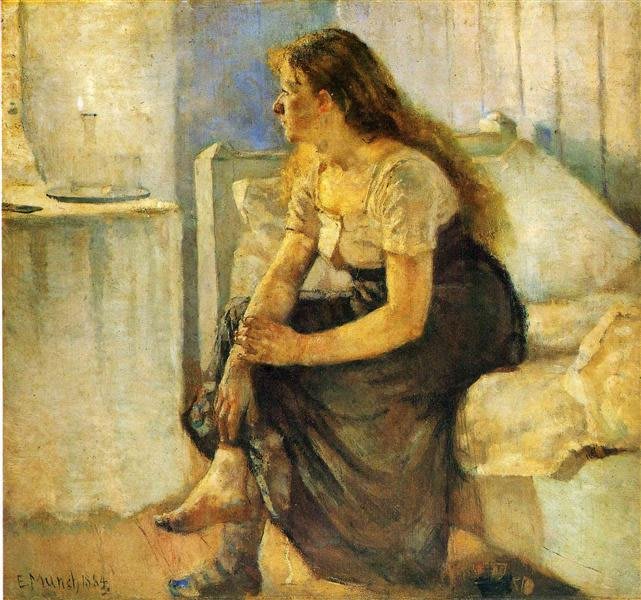
In 1889, Munch received a scholarship and traveled to Paris to study in Leon Bonnat's studio. His painting titled Morning from 1884 was included in the Norwegian pavilion that same year.
In Paris, Munch began to draw inspiration from Impressionist Edouard Manet and Post-Impressionists Paul Gauguin, Vincent van Gogh, and Toulouse-Lautrec.
His compositions sometimes diverged from the frequent dramatic themes of death and personal loss.
But a personal event would drastically alter his perspective:
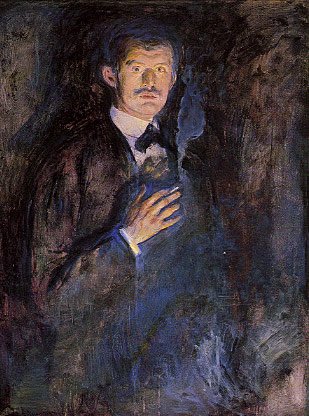
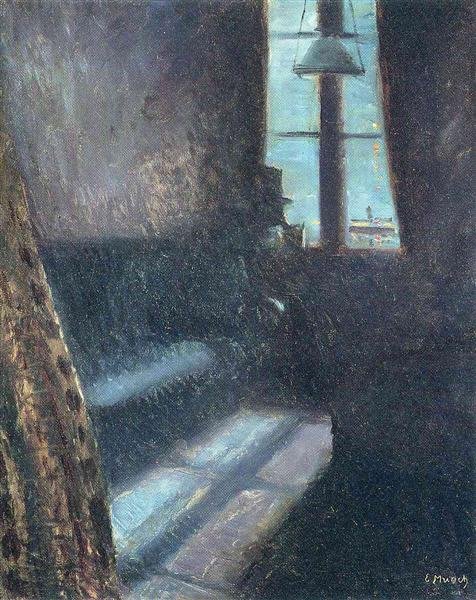
That same year, Munch's father passed away in a traumatic event that ignited in the artist a new interest in spirituality and symbolism.
He evidenced this in the somber painting Night in Saint Cloud, where the artist pays tribute to his father.
In 1892, the Berlin Artists' Association invited him to participate in the venue's first solo exhibition.
The exhibited works generated much controversy due to the radical colors employed and the somber themes presented.
Consequently, the exhibition was prematurely closed. The artist, however, capitalized on the generated publicity, and his career flourished as a result.
A year later, he exhibited six paintings in Berlin where he shifted the theme of his compositions, which would eventually evolve into the famous series A Poem about Life, Love, and Death.
Recognition and Landmark Works
In the 1890s, Munch produced the Frieze series, considered his most significant and popular works of his entire career.
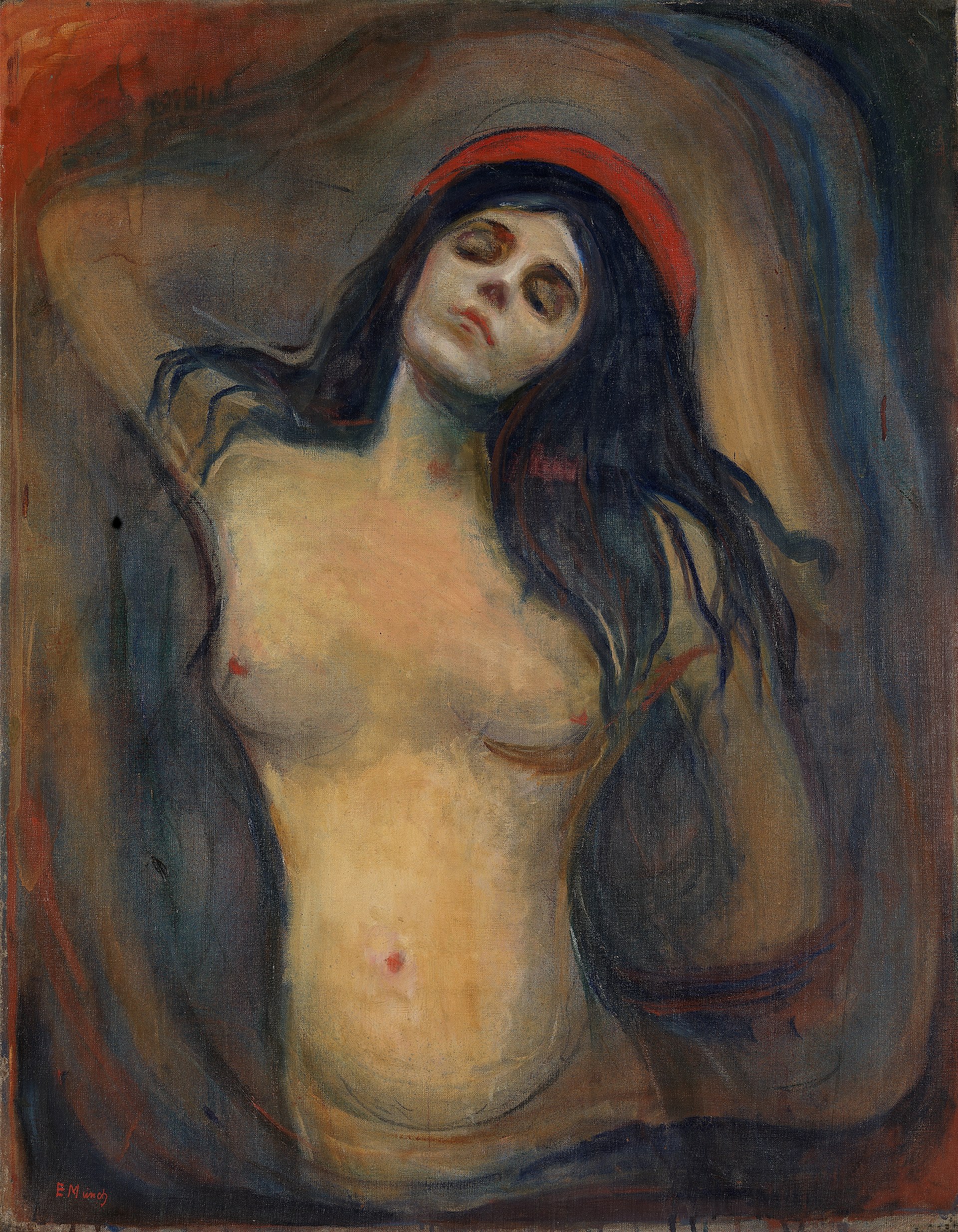
These include: The Scream, Love and Pain, Ashes, Madonna, and Puberty.
All evoke his characteristically profound poetic melancholy, based on themes of isolation, death, and loss of innocence.
Towards the end of the same decade, the artist also became interested in photography, though he never considered the artistic medium equal to painting or printmaking.
In 1908, after a trip to Berlin and a subsequent return to Paris, Munch suffered a nervous breakdown.
This was the result of a bohemian life filled with excessive drinking and brawls, stemming from the pain and anxiety of losing his sister and father.
Consequently, he was hospitalized for eight months at Dr. Daniel Jacobsen's sanatorium in Copenhagen.
While hospitalized, he converted his room into a studio and developed a new, extroverted, and more expressive style.
He created the lithographic series Alpha and Omega, depicting the relationships he had had up to that point with various friends and foes.
After being discharged from the hospital, his doctor advised him to return to Norway and seek a quieter life.
Following this advice, Munch moved to a country house in Ekely, near Oslo, where he lived in isolation.
There, he began painting themes featuring landscapes of the region's farms and workers in their daily activities.
With a new, more optimistic perspective, his work from this period features a lighter palette, with loose brushstrokes and themes revolving around life, work, and leisure.
Among the representative works from this period are The Sun and The Haymaker.
Munch nearly died from influenza during the 1918-19 pandemic, but he recovered and would live for two more decades.
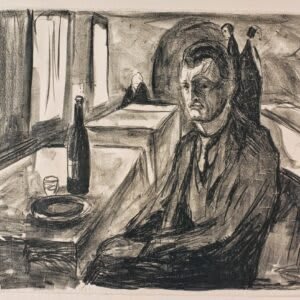
One exception was his focus on his own mortality, as reflected in several somber self-portraits created throughout the 1930s.
During this period, a blood vessel burst in his right eye, impairing his vision, yet he continued to paint.
In 1940, Norway was invaded by the Nazis; subsequently, many of his paintings were deemed "degenerate" by Hitler and removed from German museums.
Of eighty-two works confiscated during World War II, seventy-one were eventually rescued by Norwegian collectors and benefactors.
All were returned to Norway, Munch's home country, including The Scream.
Munch painted until his death, often depicting his illnesses which worsened with old age.
At 80, with his vision intermittently failing since the early 1930s, Edvard Munch passed away at his country home in Ekely on January 23, 1944.
The Enduring Legacy of Edvard Munch
After his death, it became known that Munch had bequeathed his remaining work to the city of Oslo.
With approximately 1,100 paintings, 4,500 drawings, and 18,000 prints, the collection gained its own museum.
Opened in 1963, the Munch Museum stands as a testament to the enduring legacy of this great artist.
Edvard Munch worked as an artist for over sixty years. He was creative, ambitious, and hardworking.
In addition to his output of paintings, drawings, and prints, he wrote poems, prose, and diaries.
The Scream, Madonna, and other symbolist works from the 1890s established him as one of the most famous artists of our time.
"My art is really a confession made willingly and without reservation, an attempt to clarify my concept of life… ultimately it is a kind of selfishness, but I will not give up hope that, with its intervention, I may be able to help others achieve their own clarity." Edvard Munch
Edvard Munch: Cited Works
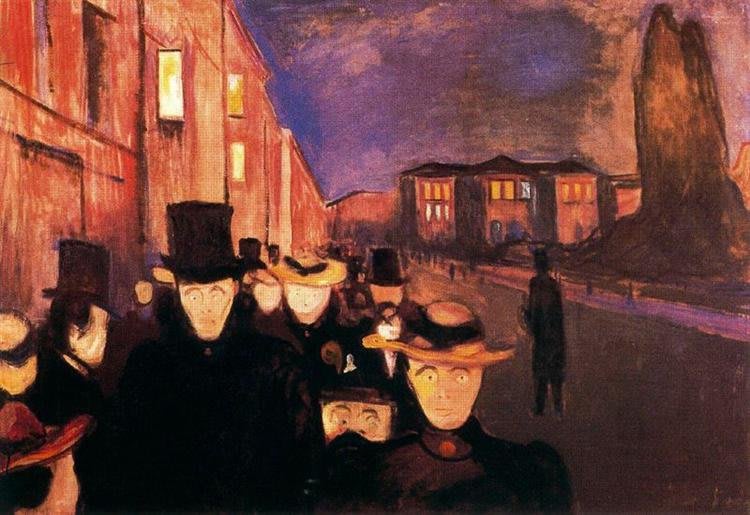
Night on Karl Johan Street - Compared to The Scream, this work is even more symbolist than expressionist.
Munch's mastery of symbolism, however, offers us personal interpretations through the faces of terror and fear in each individual figure of the irrational crowd depicted in the painting.
We must observe the great beauty of the night sky and the brilliant lamps, disguising the terror suggested by the composition.
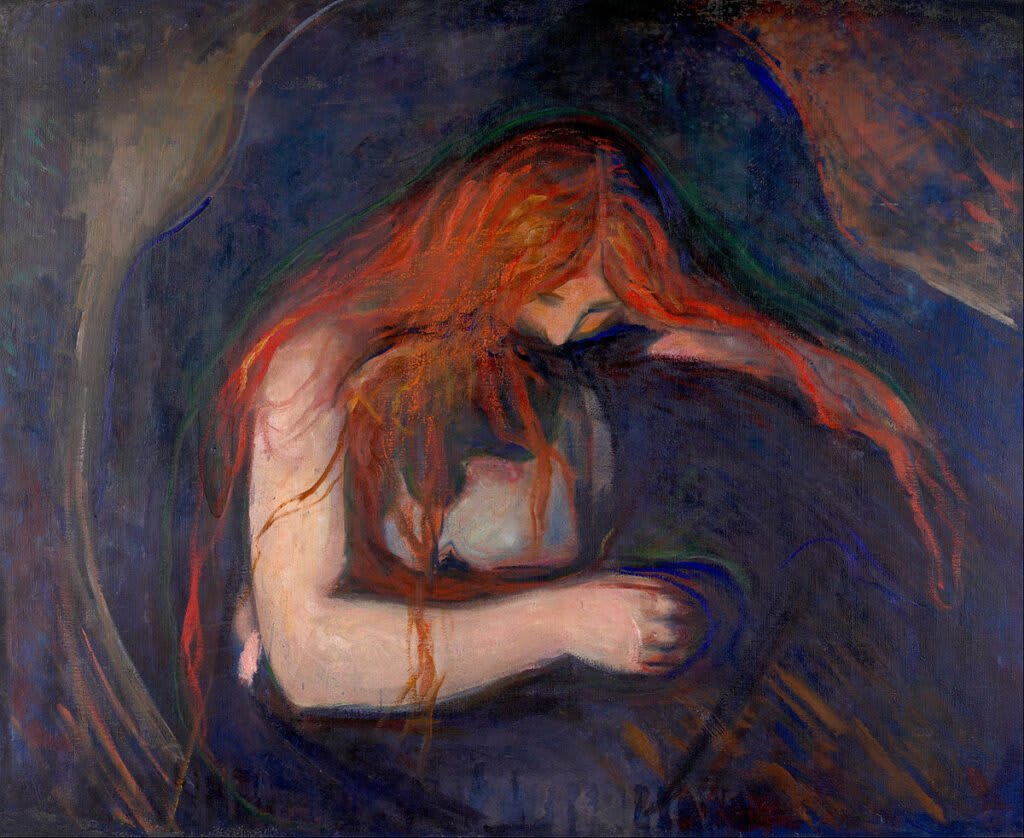
Love and Pain - The painting depicts a woman with long, fiery red hair kissing a man on the neck.
Many people identify the character as a vampire, yet the artist always maintained that it represented nothing more than "just a woman kissing a man on the neck."
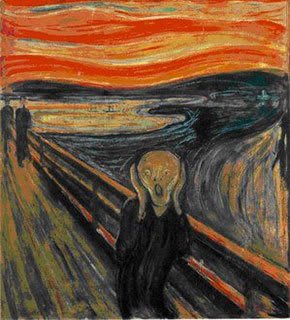
The Scream - Click here to learn more about the famous painting, considered Munch's masterpiece.
To understand the rest of this story, continue to our next article: Edvard Munch: Biography and Works – Essential Masterpieces and Final Legacy.


