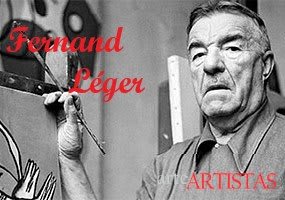
Fernand Léger
Fernand Léger was a French artist, painter, sculptor, and filmmaker. He was a key figure in the development of Cubism and Futurism, and his work had a significant influence on the development of modern art.
Fernand Léger was a French artist, painter, sculptor, and filmmaker. He was a key figure in the development of Cubism and Futurism, and his work had a significant influence on the development of modern art.
BIOGRAPHY
Joseph Fernand Henri Léger was born on February 4, 1881, in Argentan, a small town in the Normandy region of France. His father was a cattle merchant, and Léger was raised to follow in his footsteps. However, Léger showed a talent for drawing, and his parents sent him to study architecture in Caen.
In 1903, Léger completed his military service and moved to Paris to study at the École des Arts Décoratifs and the Académie Julien. During his studies, he earned a living by drawing architectural designs and retouching photographs. His early paintings were influenced by Impressionism, but after seeing an exhibition of Paul Cézanne's work in 1907, he shifted his style towards Cubism.
In 1909, Léger moved to Montparnasse, where he began to develop his own unique style of Cubism, which he called Tubism. He was influenced by the works of Georges Braque, Pablo Picasso, and Henri Rousseau. His friends included the writers Guillaume Apollinaire and Blaise Cendrars.
In 1911, Léger exhibited his paintings at the Salon des Indépendants, where he was recognized as a leading figure in the Cubist movement. He continued to exhibit his work until he was called up for military service in 1914. After the war, he returned to Paris and began to develop a new style that combined elements of Cubism and Futurism.
Léger's experience in the war had a profound impact on his art, and he began to focus on the human figure. He said, "I forgot about abstraction around 1912. Because of the cruelty, variety, humor, and absolute perfection of certain men around me, their precise sense of utilitarian reality and their application in the midst of life or death drama... I wanted to paint with all their color and mobility."
In 1920, Léger married Jeanne-Augustine Lohy, and he also met Le Corbusier, with whom he remained close friends. He became interested in the Futurist movement and began to incorporate elements of it into his art.
The 1920s were a productive period for Léger, and he began to experiment with new forms of art, including film and theater. In 1924, he made the film Ballet Mécanique, and he also founded a free school of modern art in Paris with Amédée Ozenfant.
In the 1930s, Léger became interested in social equality and began to create works that reflected this theme. He created a series of paintings called ciclos, which depicted different groups of people in action, such as workers, cyclists, and divers.
In 1931, Léger traveled to the United States for the first time and settled in New York City to escape the Second World War. He had a significant influence on the development of the New York School and also taught at Yale University.
In 1945, Léger returned to France and joined the French Communist Party. His wife died in 1950, and he married Nadia Khodossevitch in 1952. Léger continued to produce art until his death on August 17, 1955, in Gif-sur-Yvette, France.
GALLERY - COMMENTED ART
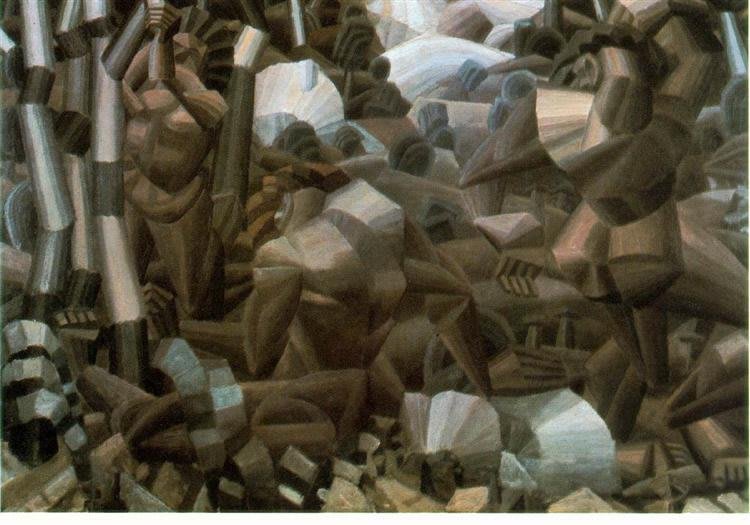
Nus na Floresta - This painting was a huge success at the Salon des Indépendants in 1911. It represents his break with Impressionism and his alliance with Cubism, particularly in its monochromatic palette and geometric forms.
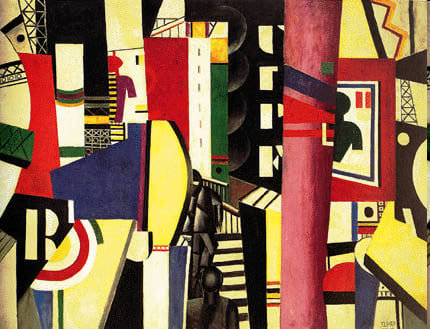
A Cidade - The colors play a key role in this painting, which represents the chaos of the city. They clash as volumes and flat forms recede and advance in space, appearing to overlap like pieces of a collage, giving the viewer the impression of being in a busy and noisy corner.
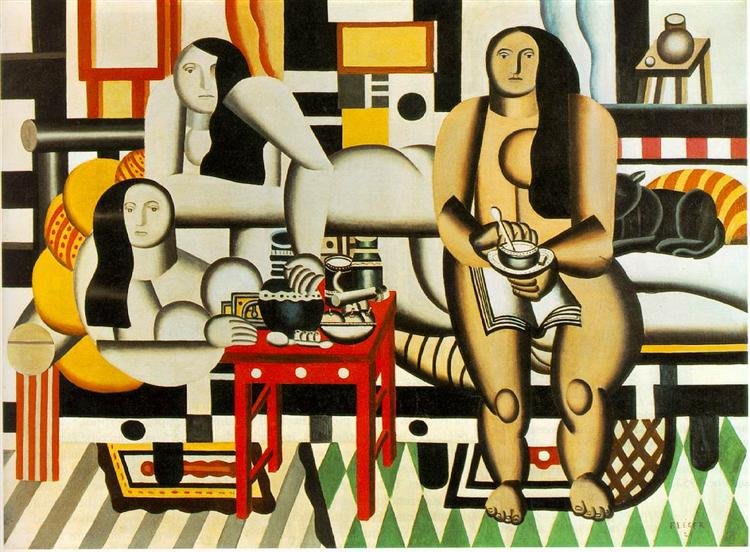
Três Mulheres - This painting is often seen as a classic example of the return to order that was typical of many artists in the early 1920s, when they retreated from some of their more experimental work before the First World War, presenting in its composition, form, space, and subject. Although the theme is not contemporary, Léger is not abandoning his interest in common people, but responding to an interest in art.
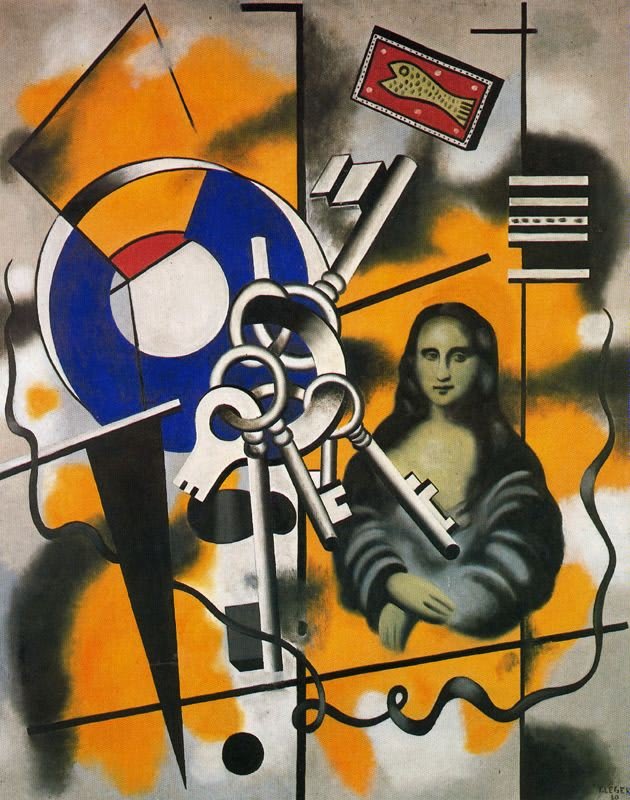
A Mona Lisa nas Chaves - We observe in this painting an influence of Surrealism. The objects depicted do not have support, but simply float in space like in the works of Joan Miró. Léger had made numerous paintings that included keys at the end of the 1920s, thus explaining the artist about this painting: "One day, after drawing a bunch of keys, I asked myself which element was farthest from the bunch of keys and said to myself: 'It's the human face. I went out into the street and saw in a shop window the portrait of Mona Lisa... No contrast has ever been more striking than between this bunch of keys and Mona Lisa." He considered this "risky image" a success and kept it for himself.