
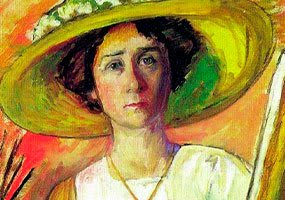
Gabriele Münter
Gabriele Münter was a prominent German modernist artist after 1900.
Gabriele Münter was one of the great modernist artists in Germany after 1900. Many associate the genius Wassily Kandinsky with her name, under whose shadow she lived for almost fifteen years - due to a lack of self-confidence and understanding of the role of women at the time.
In addition to her artistic career, the painter entered history for having hidden a large collection of paintings by different artists who were part of the artistic movement known as Blaue Reiter during the Second World War. Thanks to this, the expressionism in Germany, persecuted by the Nazis for being considered a degenerate art, was able to survive the war.
BIOGRAPHY
Gabriele Münter was born on February 19, 1877, in the city of Berlin, Germany. She was the youngest of five children, of Carl Friedrich Münter and Wilhelmine Scheuber. Her parents met and got married in America. Her father, who was a dentist, moved to the United States in 1848 to avoid imprisonment for promoting liberal and revolutionary ideas. After the outbreak of the American Civil War in 1864, the family returned to Germany. Gabriele's childhood was peaceful, she grew up in the comfort and protection of a prosperous middle-class German home.
Münter began her artistic training in Düsseldorf shortly before her mother's death in 1897. She had private lessons with the painter Ernst Bosch and enrolled in the Feminine School of the Academy of Arts of Düsseldorf.
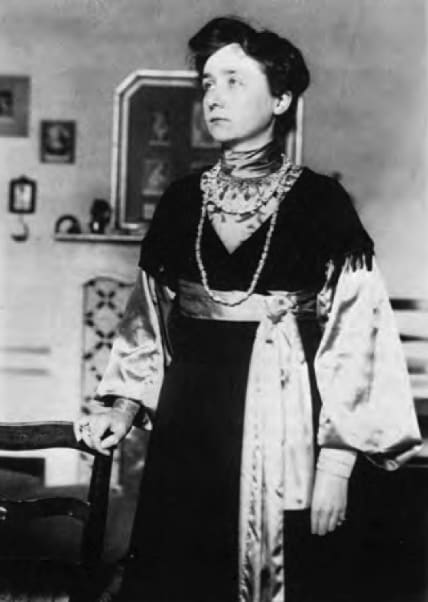
Between 1900 and 1902, she studied with various artists, including sculpture, drawing, and painting. In Munich, she trained with artists at the Escola Falange, where she met and studied with Wassily Kandinsky, Münter thought he, unlike her previous teachers, took her artistic ambitions seriously.
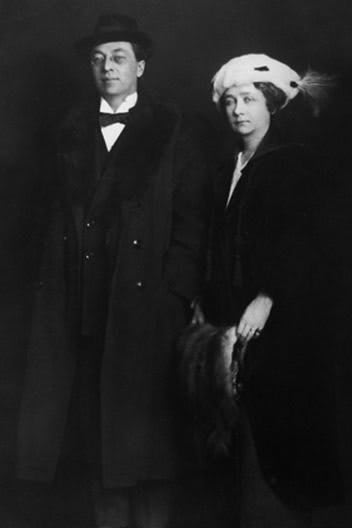
In 1903, Münter and Kandinsky began a secret romantic relationship and planned to get married after he obtained a divorce from his first wife. Although he officially divorced in 1911, to Münter's disappointment, the couple never married.
Between 1904 and 1907, Münter and Kandinsky traveled together throughout Europe and North Africa. Their itinerant years resulted in new aesthetic advances, with Münter's painting now composed of thick, post-impressionist post-impressionist paint strokes and naturalistic landscapes. In 1907, she began working in Paris and managed to exhibit her paintings at the Salon of the Independents.

In 1908, the artist exhibited eighty paintings in her first solo exhibition at the Salon of Art Lenoble, in Cologne. The collaborative relationship and artistic influence between the couple of artists, defined the mature period of Münter. In the same year, they moved to Munich, a period that also marked a trip to Murnau, at the foot of the Bavarian Alps, holidays that initiated a vital connection between Münter and Murnau.
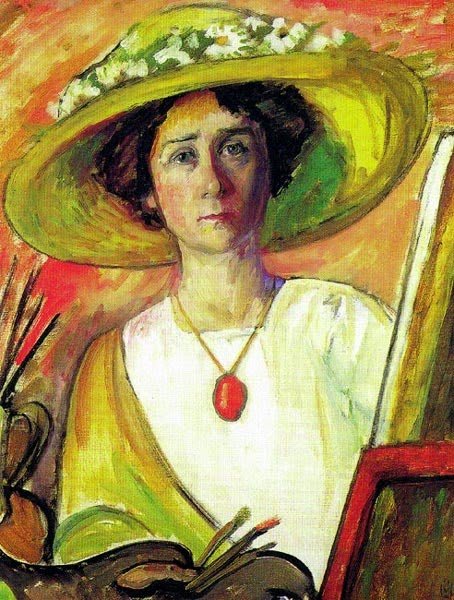
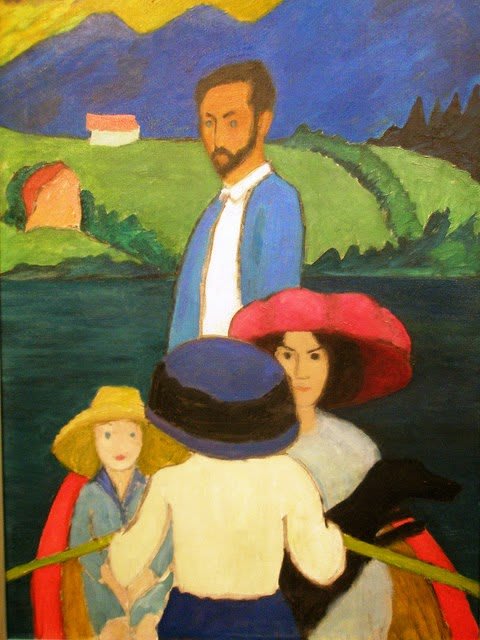
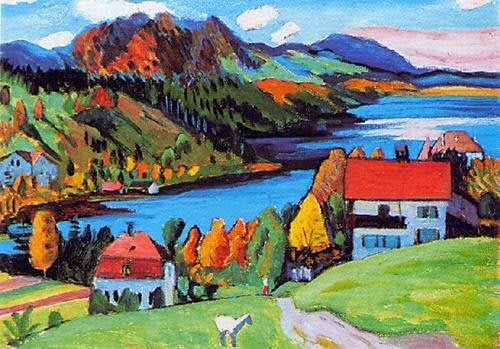
In 1909, Münter bought a house in the area, known locally as the "House of the Russians", which she hoped would serve as a museum to house her art. In Murnau, Münter and Kandinsky received avant-garde artists such as Franz Marc, August Macke, Alexej von Jawlensky and Arnold Schoenberg. It was within the new and expanded artistic circle, of the two, that Kandinsky initiated his investigations on abstract painting, and Münter had her artistic evolution. Inspired by her surroundings and influenced by her colleagues, she painted with a new fervor and created up to five oil studies a day, all defined by formal simplicity, strong color blocks, and flat perspective. In the same year, Münter and Kandinsky, founded the Association of New Artists of Munich, the NKVM, which promoted and exhibited international avant-garde art, it served as an intermediate station on the way to what would become the most notable avant-garde collective of her career.

When the First World War began in 1914, Münter and Kandinsky fled to Switzerland. However, the War provided a natural break for the two artists who lived apart for most of the duration of the conflict.
In September 1916, Kandinsky, now in Russia, initiated a relationship with Nina Andrejewska, seventeen years old, the following year he would become his second wife, although Münter only knew of his marriage in 1920. Münter and Kandinsky never met again, although she repeatedly tried to contact him to recover works that were still under his custody. As part of the restoration of her property, Münter forced Kandinsky to admit that between the two there had been a "marriage of conscience" if not in legal status, and in 1925, she initiated a text titled Confession and Accusation, which criticized Kandinsky for mistreatment.
Münter's aesthetic remained solidly aligned with the German expressionist style throughout this period and she continued to exhibit with distinction - especially in Scandinavia and Germany.
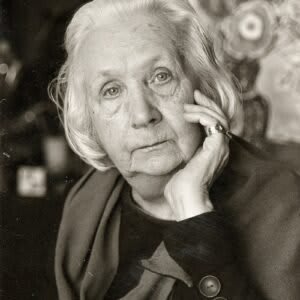
In 1917, the artist exhibited in Stockholm and connected with the Swedish avant-garde, held her largest exhibition to date in Copenhagen in 1918 and exhibited in 1919 at the Galeria Der Sturm in Berlin.
BIOGRAPHY
In 1928, with her reputation now established, Münter began a relationship with the art historian Johannes Eichner, which would last for the rest of her life.
During the period of 1931-33, she settled in Murnau with Eichner and mounted a retrospective exhibition that traveled for two years throughout Germany. However, her progressive art did not match the preferred aesthetic of Adolf Hitler. Eichner encouraged the artist to change her style for greater market viability, so she created still lifes and portraits to generate money or barter for food. Whatever her political beliefs, she generated works for national-socialist exhibitions.
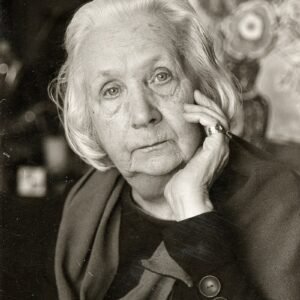
In 1936, Münter presented works for a Nazi project of the 1936 Berlin Olympics, where she exhibited two paintings in the itinerant exhibition Adolf Hitler's Streets in Art and sent works to the Great German Art Exhibition of 1937, but her work for this exhibition was rejected. However, despite these attempts, Münter was never fully accepted by the Nazi artistic program and her art was condemned by Nazi officials. Münter subsequently took the care to hide her Blaue Reiter collection in her basement for fear of confiscation.
Throughout the 1950s, she exhibited uninterruptedly, with at least one exhibition per year, in museums and art galleries in Germany. In 1956, the artist received the Culture Painting Prize and the following year, she received the Golden Medal of Honor of the City of Munich. In that year, she also donated a large part of her Blaue Reiter collection to the Städtische Galerie of Munich.
In 1958, Johannes Eichner died leaving Münter to live the rest of her days alone in Murnau, supported by the sustained attention of art historians and critics.
GALLERY
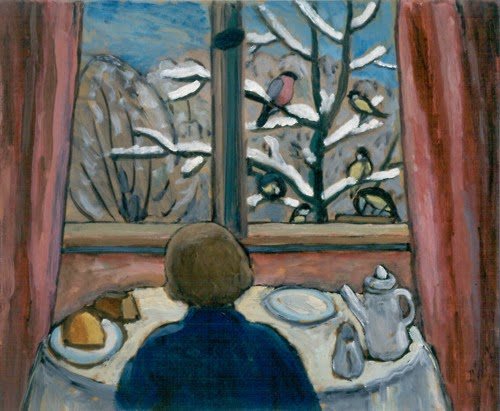
ARTWORK READING : Meditation
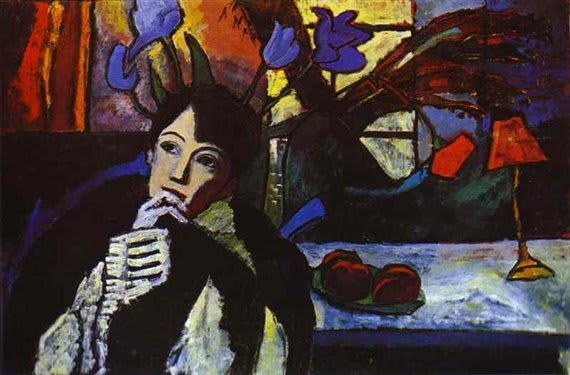
Münter composed many portraits of solitary women, in states of psychological waiting, hope, thought, or suffering. In this portrait, she represents her friend, Gertrude Holtz, applying to the composition aspects of her three preferred artistic genres - portrait, still life, and landscape. Her favorite model Holtz is seated, with her finger on her lips, her eyebrows raised, and her gaze outside the image plane to illustrate the external significant of intense contemplation, with her gloved white hand on a bright point against a body united by contour, hair, eyes, and dress by blocks of black and dark color. These same colors echo in the darkness of the interior and the white, blue, and black of the table. A deep violet shadow outlining the eyes, connects the model to the edge of the table and the touches of color in the dark background.
In her preference for the evocative potential of the color planes outlined, this work denounces the influence of the Swedish avant-garde, especially of two former students of Henri Matisse and founders of the expressionist movement in Sweden, Sigrid Hjertén and Isaac Grünewald.


