
Georges Seurat: Biography and Pointillism: Life and Early Career
Discover the life and early career of Georges Seurat, the mastermind behind the revolutionary pointillist movement.
Georges Seurat, the genius behind the revolutionary pointillist movement, transformed art with his scientific approach to color and light.
Born in 1859, in Paris, Seurat created masterpieces that captivate with their meticulous precision and dazzling visual effect.
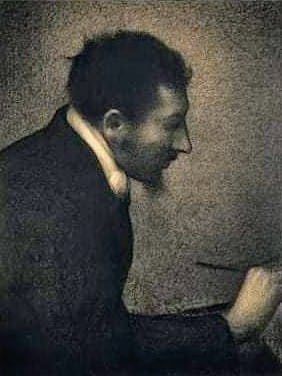 Georges Seurat: Biography and Pointillism - Self-Portrait" class="wp-image-12144"/>
His innovative technique, using thousands of small dots to compose vibrant and detailed images, not only challenged the artistic conventions of the time but also profoundly influenced the course of modern art.
Georges Seurat was a French painter born during the Industrial Revolution.
He was the founder of the French neo-impressionist school of the 19th century.
Georges-Pierre Seurat was born in Paris on December 2, 1859, France.He was the son of Antoine-Chrisostôme Seurat, originally from Champagne, and Ernestine Faivre, a Parisian.His father, a singular personality who was a justice official, spent most of his time in Le Raincy, where he had a cottage with a garden.The young Seurat lived mainly in Paris with his mother, his sisters Émile and Marie-Berthe.During the Paris Commune, in 1871, when Paris rebelled against the French state and established its own government, the family prudently withdrew temporarily to Fontainebleau.
While attending regular school, Georges began drawing and, from 1875, took classes with a sculptor, Justin Lequien.He officially entered the École des Beaux-Arts in 1878, in the class of Henri Lehmann, a disciple of Ingres, who painted conventional portraits and nudes.
In the school library, Seurat discovered a book that would inspire him for the rest of his life: The Essay on the Inconfundibles Signs of Art, published in 1827, byHumbert de Superville, a painter and engraver from Geneva whotreated the future course of aesthetics and the relationship between lines and images.
Throughout his brief career, Seurat showed an uncommonly strong interest in the intellectual and scientific bases of art.
In November 1879, at 20, Seurat went to Brest to perform military service.There he drew the sea, beaches, and boats.When he returned to Paris the following autumn, he shared a studio with another painter,Édmond-François Aman-Jean and they spent their afternoons at the Louvre, admiring the warm landscapes of Jean-Baptiste Millet. The two friends used to frequent dance halls and cabarets at night, and in the spring, they took a steamboat to the Island of La Grande Jatte, the setting for Seurat's future paintings.
Georges Seurat exhibited at the official Salon
for the first time in 1883, whose annual exhibition was sponsored by the state.
He exhibited portraits of his mother and his friend Aman-Jean, and in the same year, he began his studies, sketches, and panels for A Bath in Asnières.When the image was rejected by the Salon jury in 1884, Seurat decided to participate in the founding of theGroup of Independent Artists, an association without a jury and without prizes, where he showed the same work in June.
During this period, he saw and was strongly influenced by the monumental symbolic paintings of the impressionist painter Puvis de Chavannes.He also met the 100-year-old chemistMichel-Eugène Chevreuland experimented with Chevreul's Theories on the chromatic circle of light and studied the effects that could be achieved with the three primary colors (yellow, red, and blue) and their complements.
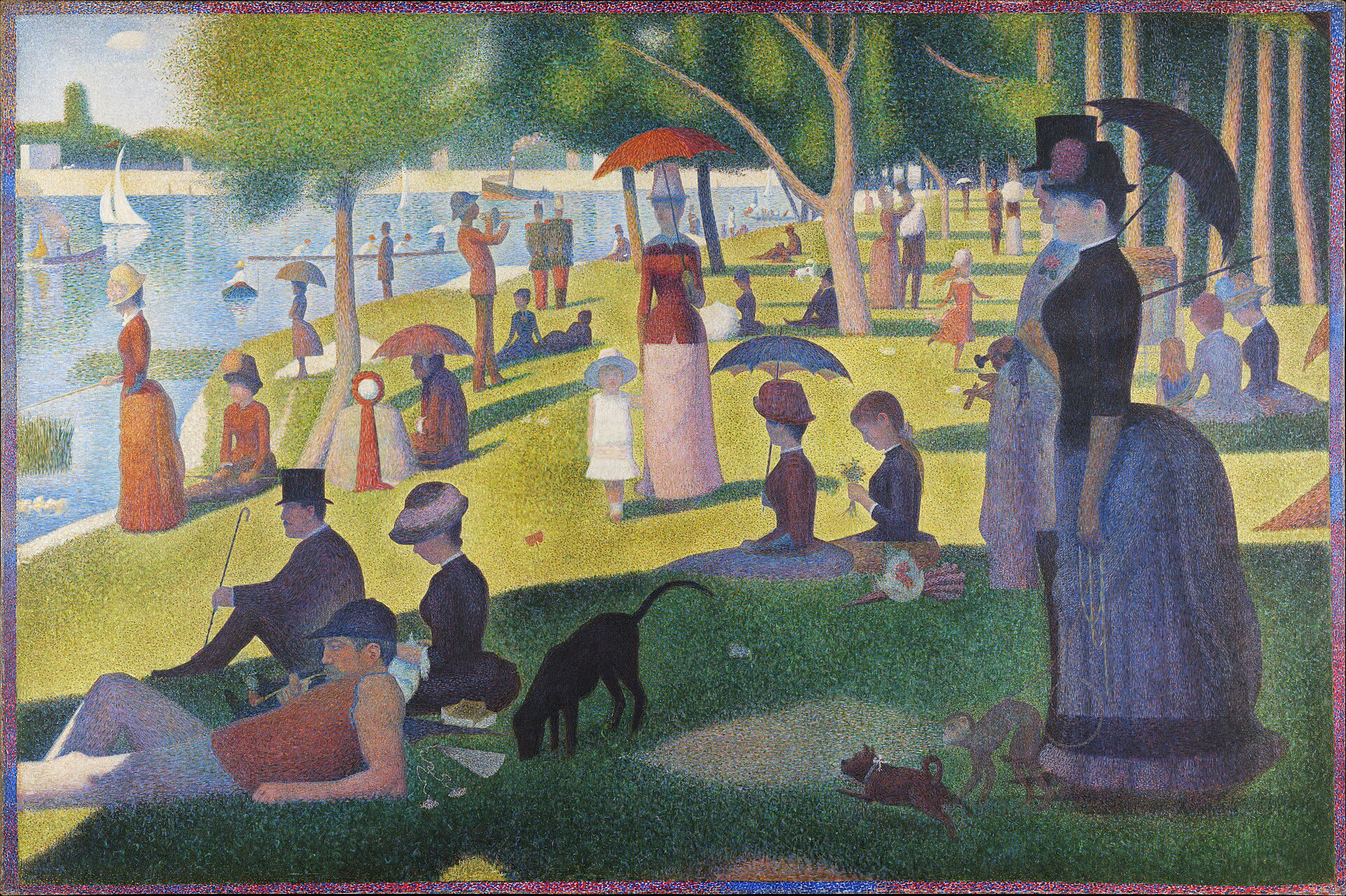
At the same time, Seurat met withPaul Signac, who would become his main disciple, and painted many sketches on small panels, preparing himself for his masterpiece,Sunday Afternoon on the Island of La Grande Jatte.In December 1884, he exhibited again the A Bath in Asnières, with the Society of Independent Artists, which had a huge influence on the development of modern art.
Seurat spent the winter of 1885 working on the Island of La Grande Jatte and in the summer in Grandcamp, in Normandy.The impressionist masterCamille Pissarro, who was temporarily converted to Pointillism, was introduced to Seurat by Signac during this period.
Seurat completed the paintingSunday Afternoon on the Island of La Grande Jatte
and exhibited it from May 15 to June 15, 1886, in an exhibition of the impressionist group.This demonstration of his technique sparked great interest.The main artistic associates of Seurat at this time were the painters also concerned with the effects of light on color, Signac and Pissarro.The unexpectedness of his art and the novelty of his conceptionanimated the Belgian poet Émile Verhaeren.The critic Félix Fénéon praised Seurat's method in a vanguard analysis.Seurat's work was exhibited by the renowned dealer Durand-Ruel in Paris and in the city of New York, in the United States.
In 1887, while living temporarily in a studio in Paris, Seurat began working on The Models.This painting would be his last major composition.The following year, he completed The Models
and also Circus Parade.
In February 1888, he went to Brussels with Signac for a private exhibition of the exhibition of the Twenty (Twenty - XX), a small group of independent artists, in which he showed seven canvases, including La Grande Jatte
In 1889, Seurat participated in the Salon of Independents, exhibiting landscapes.That same year, he painted the portrait of his friend Signac.His residence was in the district of Pigalle, where he lived with his 21-year-old mistress, Madeleine Knobloch.
In February 16, 1890, Madeleine presented him with a son, whom he officially recognized and registered in the birth register under the name of Pierre-Georges Seurat.The same year, Seurat completed the painting Le Chahut
, which he sent to the exhibition of the Twenty (XX) in Brussels.During this period, he also painted Young Woman, a portrait of his mistress, although he continued to hide his relationship with her even from his closest friends.He spent that summer in Gravelines, where he painted several landscapes and planned what would be his last painting, The Circus
To continue understanding this journey, read our next article: Georges Seurat: Biography and Pointillism: Death, Legacy, and the Essence of the Movement.


