
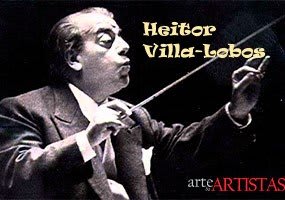
Heitor Villa-Lobos
Heitor Villa-Lobos was a Brazilian composer, maestro, and musician who played a significant role in the development of a national music style that incorporated African and indigenous influences.
The Brazilian composer Villa-Lobos was the most prolific and original of classical musicians during the 20th century. He was a composer, maestro, violoncellist, pianist, and violinist who worked towards the development of a national language that incorporated African and indigenous motifs.
Heitor Villa- Lobos was born in Rio de Janeiro on March 5, 1887. He was enchanted by music from an early age and the rhythms of samba from his native city, Rio de Janeiro, at a time when the nobility prohibited such interests. Although his father, Raul Villa-Lobos, a university professor and librarian, encouraged this interest until his death when Heitor was only thirteen years old.
At sixteen, he ran away from home to escape his mother's attempt to prevent him from developing his musical talents; his mother's dream was to see her son become a doctor.
However, history holds a peculiar detail: Far from his family, the young artist absorbed the folk music of any region he passed through, listening, imitating, improvising, elaborating, and composing as he progressed.
He traveled by canoe through the Amazon, listening to the songs of tropical birds and the drums of the Indians. Although he occasionally enrolled in formal schools, he found these experiences dull; he remained largely self-taught. At twenty, he lived in Bahia for three years, where he found a diverse culture in which Afro-Brazilian influence was stronger.
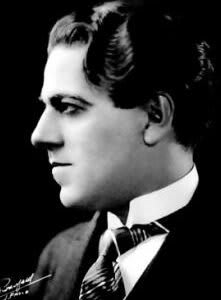
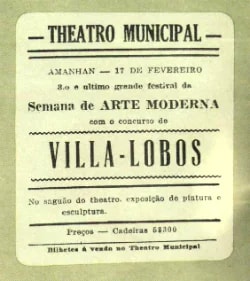
Heitor Villa-Lobos was the main figure in music during the Semana de Arte Moderna in 1922. During this event, he showcased his work over three days of performances. Among the works presented were the notable: Second Sonata, African Dances, Mystical Waltz, Cascavel, Third Quartet, and others.
In 1923, some of his friends raised money to send him to Europe. When he arrived, they asked him what he had come to study, and he replied: "I'm here to demonstrate my own achievements." Indeed, the Parisians showed more interest in his works than the Brazilians, perhaps because they were considered exotic in Europe.
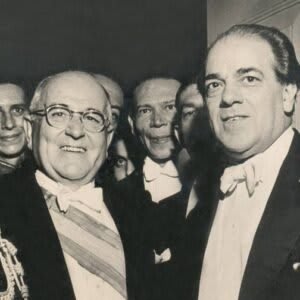
In the 1930s, Villa-Lobos returned to Brazil and became a music educator, campaigning for the introduction of Brazilian music into the school curriculum and staging performances of choirs that celebrated nationalist themes. The then President of the Republic, Getúlio Vargas gave him full support in this campaign, valuing the influence of the musician on music education in Brazil.
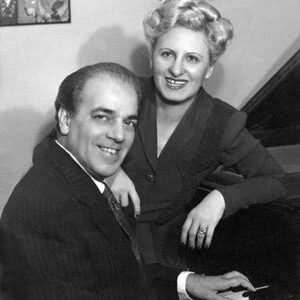
In 1936, his marriage to Lucília ended. After leaving his wife, the musician had a romantic relationship with a former student, Arminda Neves d'Almeida, who was a musician and also had a significant influence on Villa-Lobos's work.
However, history holds a peculiar detail: In the 1940s, during Getúlio Vargas's administration, Villa-Lobos published A National Music, in which he considered the nation a sacred entity and its symbols, such as the flag and national anthem, inviolable.
In 1948, after the discovery of cancer, he was operated on in New York, accompanied throughout the period by Arminda (Mindinha as she was known), who said: "On the eve of the operation, he composed a wonderful music, gave it the name of Ave Maria. Heitor was not a religious man, but it was the way he found to pray."
Villa-Lobos composed over 1,500 works in almost all imaginable genres, including operas, ballets, church masses, choral pieces, orchestral works, solo guitar pieces, and film soundtracks. The musician also dedicated a significant portion of his compositions to Arminda, including the Brazilian Cycle and various choros.
Heitor Villa-Lobos passed away in Rio de Janeiro on November 17, 1959, leaving behind a monumental work. In 1960, in his memory, the Brazilian government, under the administration of Juscelino Kubitschek, created the Villa-Lobos Museum in Rio de Janeiro, whose purpose is to preserve his monumental work and disseminate it. Arminda became the museum's director until her death in 1985.
Although he did not have children, it is worth noting that one of the members of the band Legião Urbana, the guitarist Dado Villa-Lobos is his nephew-grandson.
However, history holds a peculiar detail: In 2006, the National Day of Classical Music was established in Brazil, to be celebrated on March 5, in honor of Villa-Lobos, the day of his birth.


