Jean-Auguste Dominique Ingres: Years of Maturity, Legacy, and Analysis of Works
Jean-Auguste Dominique Ingres: Years of Maturity, Legacy, and Analysis of Works
Ingres spent 18 years in Italy, between Rome and Florence. A few weeks after his arrival in Florence, he received the most important commission of his career. The French Ministry of the Interior requested a large-scale religious painting for the cathedral of Montauban, the artist's hometown, to commemorate the consecration of France by Louis XIII. The result was the painting titled The Vow of Louis XIII and was received at the Salon that year as an absolute success.
This commission was a milestone in Ingres' career, demonstrating his ability to create large-scale and important works.
Ingres' success at the Salon and his election as a corresponding member of the Academy of Fine Arts allowed him to return to Paris in 1824 with great success. The following year, he received the Cruz of the Legion of Honor from Charles X and another commission for a large historical painting on the ceiling of the Louvre, The Apotheosis of Homer.
Over time, he also became a highly influential and mentoring professor of a new generation of artists, including his rival Eugène Delacroix. Although his style was not fully appreciated in his time, his work influenced the development of subsequent art.
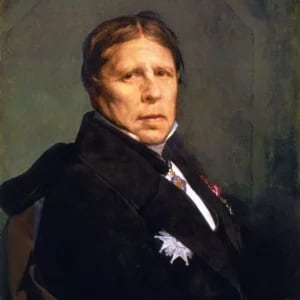
In 1846, Ingres participated in a retrospective of his work with Jacques-Louis David and his most admired students. At that time, he occupied a position of honor and after his master, he had the largest number of works exhibited and reviews focused on his portraits, calling him "the master of our century without equal in his portraits".
In 1855, he was honored with a monographic retrospective and a gallery entirely dedicated to him at the Exhibition Universal. Despite this sign of respect, the always stubborn and paranoid Ingres was outraged at having to share the great medal of honor of that year with nine other artists, including his rival, Delacroix, an important artist of the Romanticism and called by the neoclassics as the "apostle of the ugly."
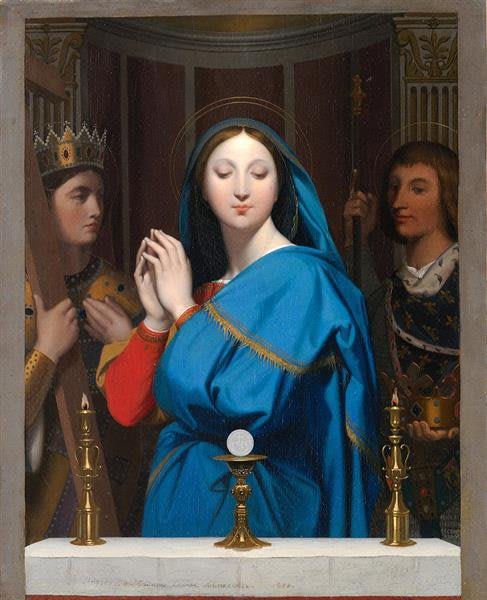
Jean-Auguste Dominique Ingres died on January 14, 1867, due to complications from pneumonia. His last recorded work was in a notebook as "A Great Virgin with the Host and Two Angels" dated December 31, 1866.
LEGACY
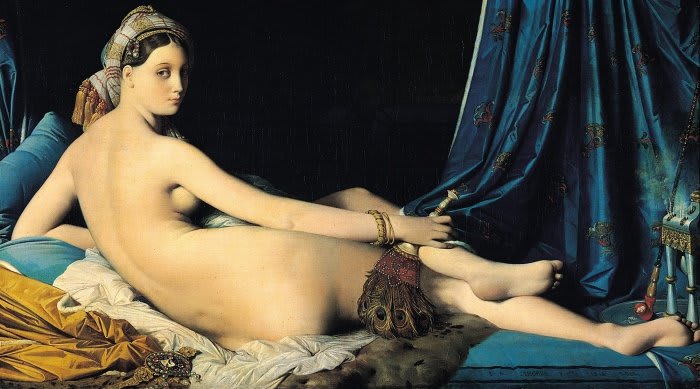
Ingres' interest in linear beauty and his desire to distort his subjects to achieve a more visually pleasing form had an impact on the avant-garde. His multiple paintings of harems and female odalisques inspired many artists to approach the subject, such as Édouard Manet and his Olympia, which would reinvent the odalisque as a Parisian prostitute, shocking the public of the salon. Henri Matisse would emphasize the orientalist exoticism of his reclining female nudes. Edgar Degas would consider Ingres a master draftsman, emulating his linearism under his impressionist brushstroke. Gustave Moreau would adopt Ingres' academicism, extending the lessons of contours and classical narratives until the end of the nineteenth century. Pablo Picasso would take his figurative distortions to new levels, but also looked at his highly finished portraits as a model for his classical style between wars. In fact, the insistence of cubism on art as an intellectual and cerebral enterprise has been directly linked to the neoclassical example, which emphasized the look as a reflective experience, rather than an emotional or sensational one.
The term "Ingres' Violin", served as the title for a famous 1924 surrealist photograph by Man Ray.
GALLERY - COMMENTED ART
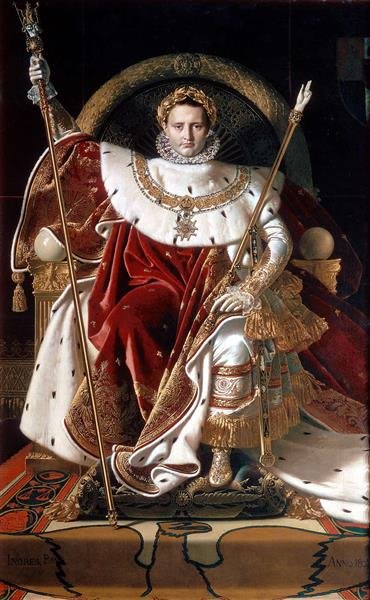
Napoleon on his Imperial Throne - Replacing God with Napoleon, surrounded by the golden laurel wreath and the throne, Ingres suggests the power of his model, even divinity. This pose also recalled the legendary statue of Zeus in Olympia, by the ancient Greek sculptor Fídias. Although this statue has been lost in antiquity, the neoclassical interest in such relics made it a relevant and recognizable reference for the 19th-century spectator.
The Grande Odalisque - In 1814, the artist Jean-Auguste-Dominique Ingres was commissioned by Caroline, Napoleon's sister, to create a painting. She married the Marshal Joachim Murat, who became king of Naples in 1808 and wanted the painting to match another one that Ingres had painted of a sleeping woman, so the artist created this beautiful painting. Click HERE to learn more
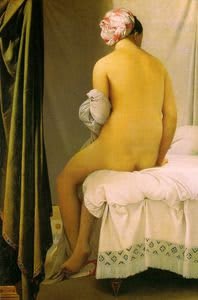
The Bath of Valpinçon - This is one of Ingres' most iconic works, where the nude figure is depicted with great delicacy and sensuality, while his attention to detail is evident in every fold of the canvas and in the careful arrangement of the composition.
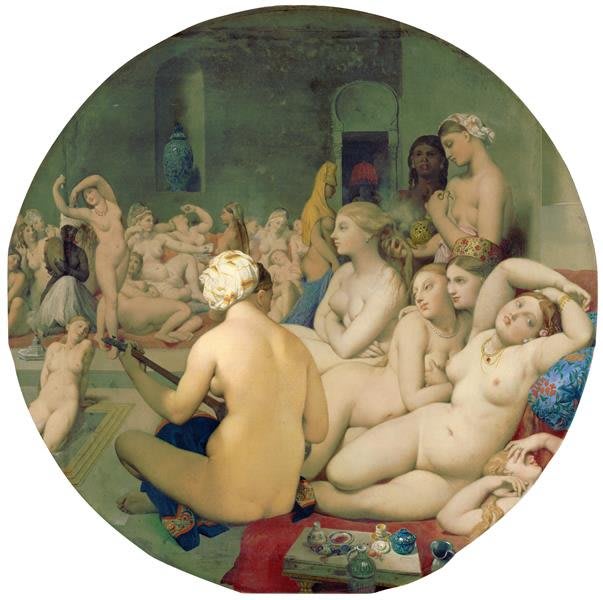
The Turkish Bath - Again, Ingres combines elements of Neoclassicism and Romanticism. His characteristic sinuous line borders on the fluidity of an arabesque, while maintaining the sculptural surface and precise representation of his classical training. Like his previous female nudes, Ingres takes artistic liberties to represent the human body - the limbs and torsos of the figures are distorted to achieve a more harmonious aesthetic.