
Mannerism
Mannerism
Mannerism is an artistic movement that emerged between the Renaissance and the Baroque periods. It took place during a highly imaginative era in art, following the peak of perfection that naturalistic painting had achieved in Renaissance Italy. New scientific discoveries distanced society from humanist ideals, and paintings no longer posited man as the center of the universe, but rather as isolated and peripheral participants in life's great mysteries.
Artists in Florence and Rome during the 16th century began to deviate from classical influences and move towards a more intellectual and expressive approach. This initiated a departure from authentic portrayals of figures and themes, a rejection of harmony, and the development of a new dramatic style unconfined by the pictorial plane, reality, or literal correctness. Radical asymmetry, artifice, and decorative elements also informed this movement.
Early Mannerism expressed an anti-traditional approach that lasted until 1535, followed by High Mannerism, where a more intricate and artificial style attracted more sophisticated patrons, becoming a kind of courtly style. Later, the use of the term Mannerism, to denote a specific period in art history, was initiated by Luigi Lanzi, a 17th-century art historian and archaeologist.
A key element of Mannerism was the use of figurative serpentinata, or "serpentine figure," whose representation of human bodies features snake-like forms, with extended limbs, elongated shapes, and an S-shaped fluid grace. These figures presented a supernatural quality that diverged from classical interpretations.
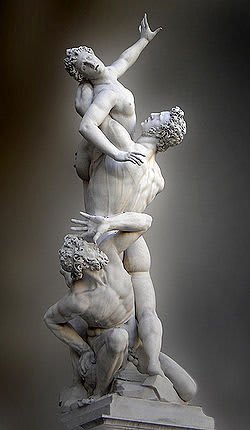
Many Mannerist works featured individuals or scenes in non-naturalistic settings, often without any contextual basis, inviting the viewer to a more philosophical experience rather than a literal reading of the work.
Mannerists repudiated the mere imitation of nature in art and, instead, sought to express the underlying psychological aspects of a work beyond its mythological or religious themes. These concepts informed a body of work that is deeply evocative of the Divine and universally known for manifesting the spirituality that lies behind all being.
KEY ARTISTS
Parmigianino (1503-1540) - An Italian artist, he was Palma's leading painter, considered an eccentric but technically competent virtuoso who also worked in Rome and Bologna.
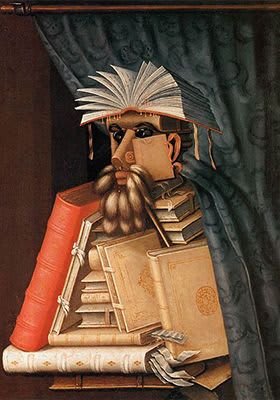
Giuseppe Arcimboldo (1527-1593) - Arcimboldo was an Italian painter known for his unusual human portraits, whose unique style incorporates a truly surreal wit, composed of fruits, vegetables, animals, books, and other objects.
Bronzino (1503-1572) - is considered a master portraitist whose painting embodied the gentle beliefs and ideals of the Medici dukes of 16th-century Italy. He developed his own meticulous linear style that owed as much to the influence of Michelangelo and Raphael . The artist produced a series of mythological paintings through which he flaunted his love for symbolism and mastery of coloring.
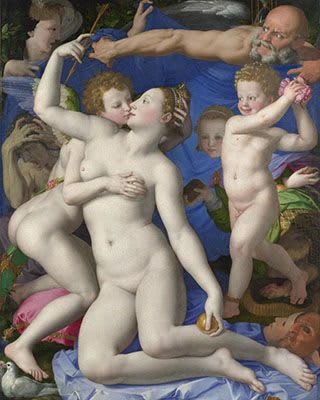
El Greco (1541-1614) - Doménikos Theotokópoulos, an artist born in Greece who lived a good part of his life in Spain, where he became known as El Greco (The Greek). His life and work were marked by a profound and underlying devotion to God. He mastered a long tradition of Byzantine icon art, but when he finally settled in Spain, his inspiration was largely drawn from the Italian and Spanish Renaissance.
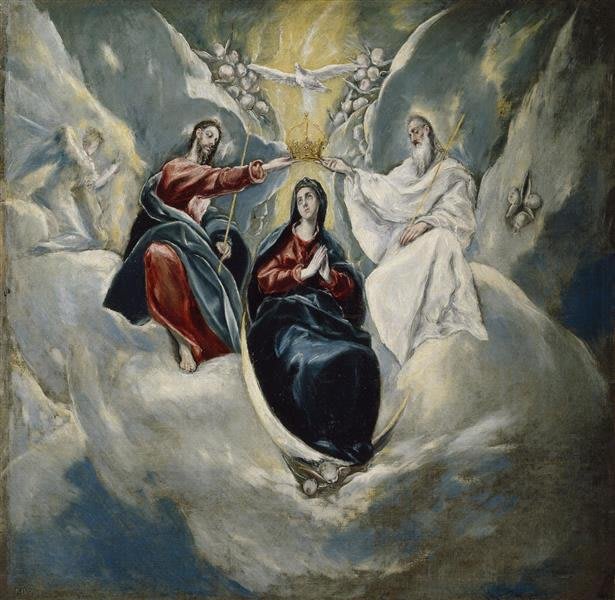
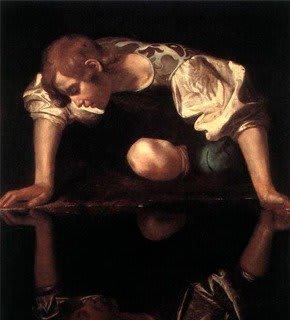
Caravaggio (1571-1610) - An important Italian painter, he created striking and innovative paintings, being a pioneer in the use of dramatic lighting and the representation of religious figures in modern clothes and attitudes. He had a profound influence on the painters around him and on later artistic movements, notably Baroque art and 19th-century realism.
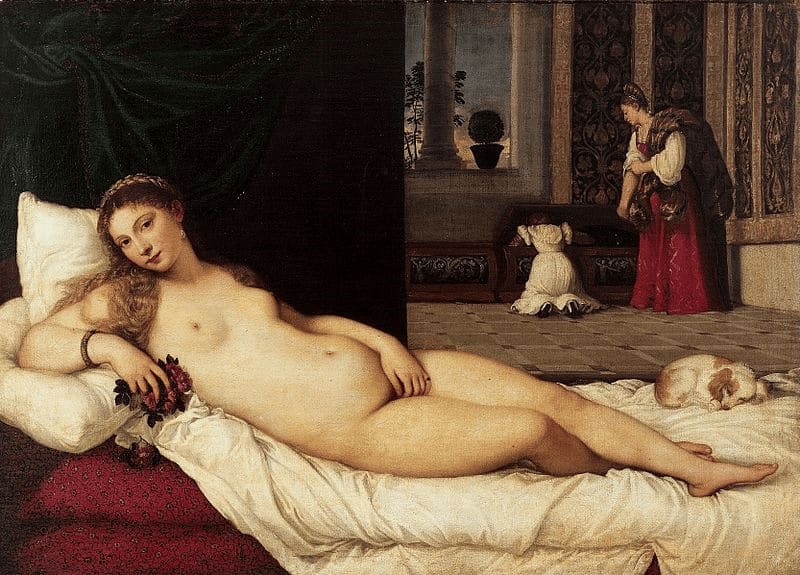
Titian (c.1488-1576) - Tiziano Vecellio was one of the greatest Renaissance painters of the Venetian School, combining High Renaissance and Mannerist ideas to develop a style that was well ahead of its time. He was one of the most famous portraitists of the era, and also painted a series of religious and mythological themes. He had an enormous impact on his contemporaries, and his canvases can be seen as precursors to the emotional drama of Baroque art, as well as influencing later innovators.
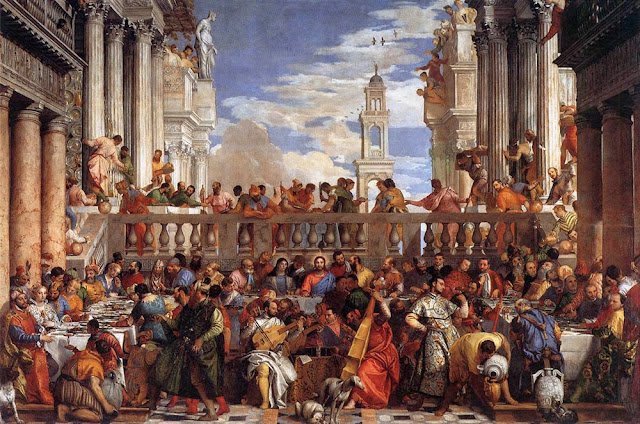
Paolo Veronese (1528-1588) - Paolo Caliari, the Italian born in Verona, thus became known as Veronese, is considered one of the most famous masters of the late Renaissance. The artist belonged to the Venetian School and distinguished himself as an excellent colorist and painter of the elegant and grandiose, of narratives that conveyed their meanings through rich and fluid color schemes.
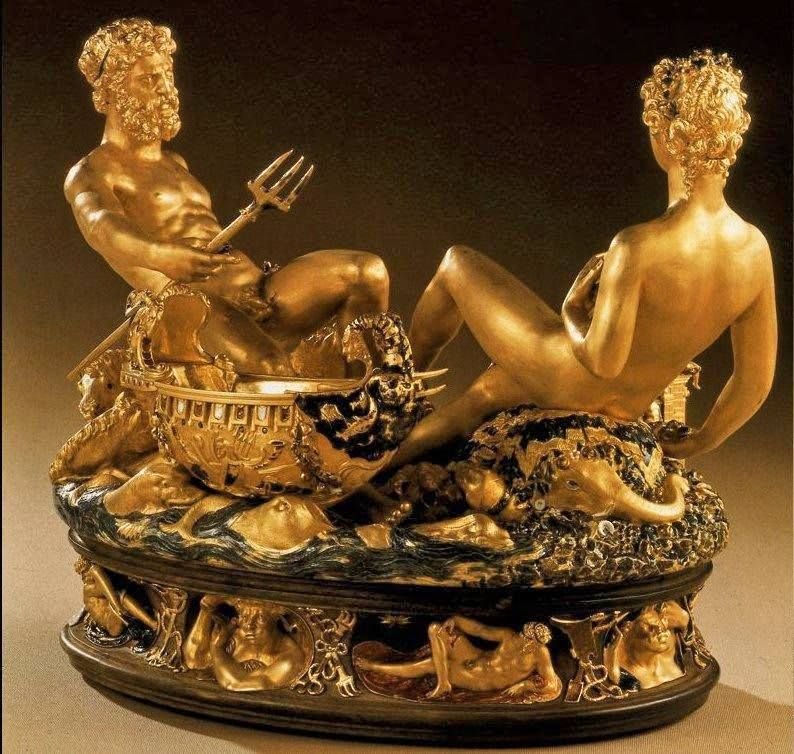
Benvenuto Cellini (1500-1571) - Cellini was an important Italian sculptor, considered the greatest goldsmith of his era. He was also the author of the celebrated "Autobiography." The work exemplified below, was called a “masterpiece of Mannerist sculpture,” but also exemplified the lavish decorative style of the French court.
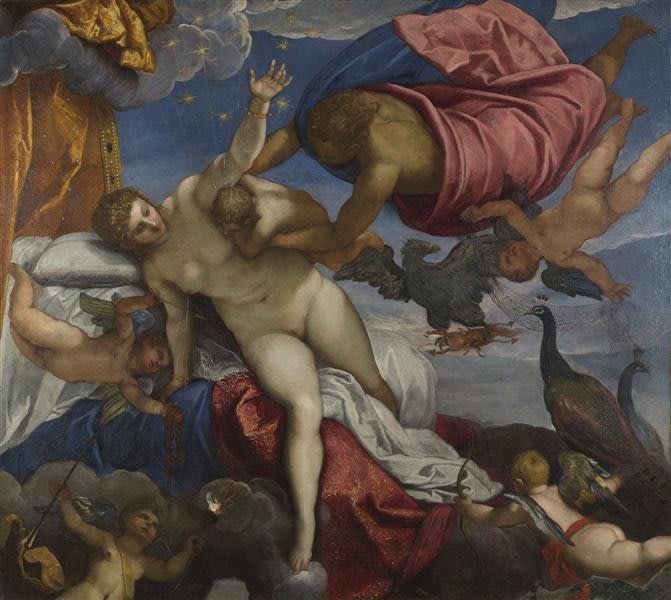
Tintoretto (1518-1594) - Jacopo Robusti became known as Tintoretto due to his father's profession as a dyer (tintore in Italian). His work is characterized by inventive boldness in both handling and composition. Most of his paintings are narratives, animated by dramatic lighting and gestures. He was profoundly influenced by Titian in his use of colors and by the energized forms of Michelangelo.
FEATURED WORK - ART COMMENTARY
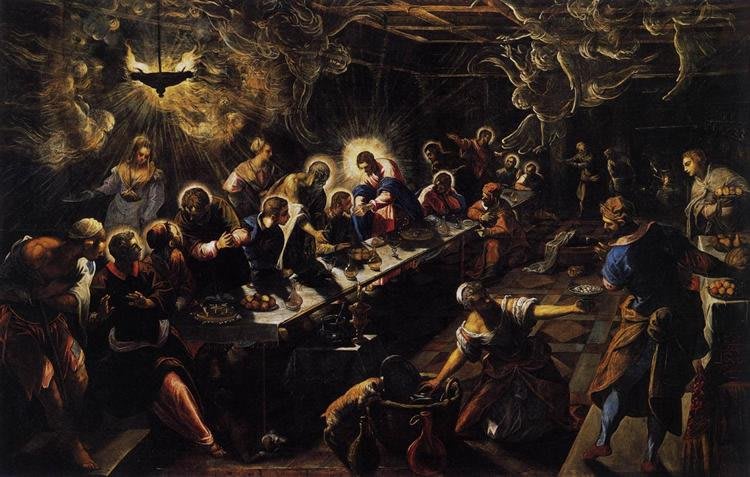
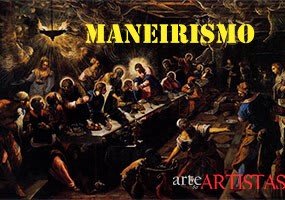
Tintoretto painted The Last Supper several times in his life. This version can be described as the feast of the poor, in which the figure of Christ blends with the crowd of apostles. However, a supernatural scene with winged figures appears by the light around his head. This gives the painting a visionary character that clearly differentiates it from paintings of the same theme made by earlier painters such as Leonardo da Vinci. The curious diagonal position of the table is explained by the painting's installation on the right wall of the presbytery of San Giorgio Maggiore.
The Last Supper has been a popular theme in art since the earliest days of Christianity. This was especially true during the Renaissance, which produced the most famous depiction of the subject in Da Vinci's mural for the convent of Santa Maria delle Grazie, which embodies the best of High Renaissance aesthetics.
Fifty years after Da Vinci completed his masterpiece, the great Venetian painter Tintoretto would find himself equally captivated by the theme. In his hands, the harmony of the Renaissance era dissolved into something more chaotic, dark, and mystical.


