Michelangelo Buonarroti: Biography and Works
Michelangelo Buonarroti: Biography and Works
We invite you to delve into the life and work of Michelangelo Buonarroti, one of the most renowned artists of the Renaissance.
Born in 1475 in Caprese, Italy, Michelangelo was a sculptor, painter, architect, and poet who left an unparalleled artistic legacy.
His masterpieces include sculptures such as 'David' and 'Pietà,' paintings like the frescoes of the Sistine Chapel, and architectural projects like the dome of St. Peter's Basilica in the Vatican.
Michelangelo was known for his exceptional technical skill and his ability to convey emotion and drama through his work.
Aside from his artistic genius, Michelangelo also played a significant role in politics and culture during his time, working for various popes and leaders.
His life and work continue to inspire and fascinate people around the world, serving as a testament to the grandeur of the human spirit and the power of art to transcend time and space.
Michelangelo Buonarroti is considered one of the greatest geniuses in the History of Art.
He lived during the era known as the Renaissance.
He was a sculptor par excellence, but also a painter, poet, and architect, a complete artist.
Michelangelo Buonarroti: BIOGRAPHY
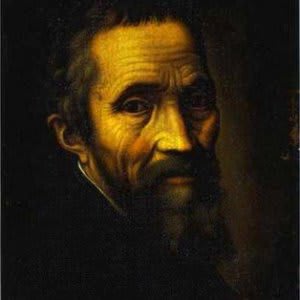
Michelangelo di Lodovico Buonarroti Simoni was born in Caprese, a small town north of Arezzo, in the region of Tuscany, Italy.
He was born on March 6, 1475. His family moved to Florence when he was just a month old.
Michelangelo was the second of five brothers born to Lodovico di Leonardo and Francesca Buonarroti.
His father was a member of the small nobility of the city and, in an attempt to chart a course for his son, enrolled him in a grammar school in Florence when he was seven years old.
Three years later, he became convinced that the effort had been in vain: the boy liked to draw and that was what he clung to.
And, since there were no other options, his father decided to occupy the boy - then 13 years old - and took him to the workshop of Domenico Ghirlandaio, considered one of the great masters of the time.
The training was rapid, and he even received a teacher's salary.
The fact is that, later, out of pride or arrogance, the artist would say that he never had a teacher, although the influence of the techniques taught by Ghirlandaio to Michelangelo was evident in his early sketches.
It took only two years of production in the workshop for the artist's work to catch the attention of Lorenzo de' Medici, the Magnificent, the most powerful man in Florence.
Michelangelo was invited to live in Lorenzo's house and stayed there until the Magnificent's death in 1492.
It was during this time that the artist returned to his father's house and, for two years, concentrated on studying human anatomy - dissecting bodies in the Hospital of the Holy Spirit.
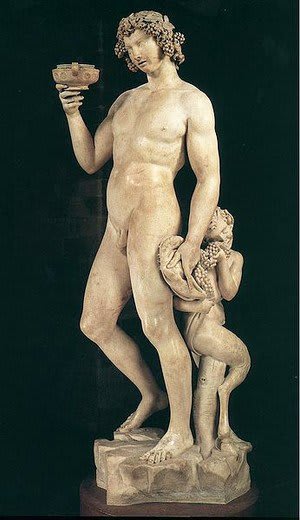
In June 1496, he created his first major work in Rome: Bacchus.
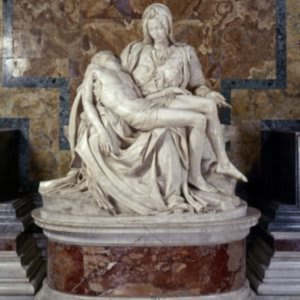
But what made him famous was the Pietà, carved in marble between 1498 and 1500.
The work, incidentally, is the only one that bears his signature, carved into a ribbon on the Virgin Mary's chest as she cradles the dead Christ.
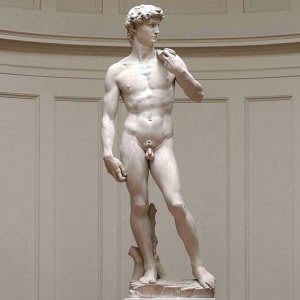
After completing the Pietà, the artist returned to Florence and began to sculpt David from a single block of marble.
It took him three years of work, and Michelangelo's fame grew in proportion.
While sculpting the piece, he began to receive various commissions, including the Sacred Family, the only painting he completed without being on a wall or ceiling.
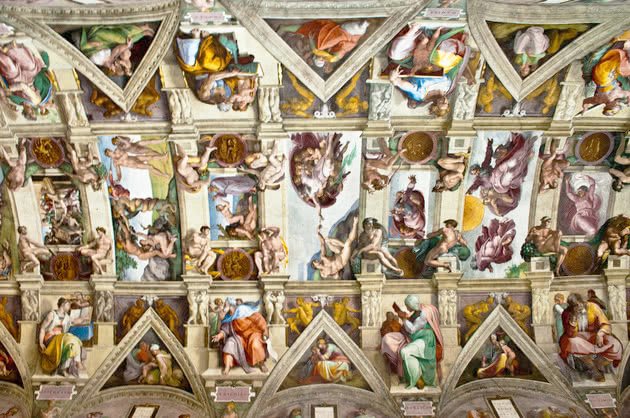
In 1508, he received the most important commission of his life: painting the ceiling of the Sistine Chapel in the Vatican, which took him four years to complete.
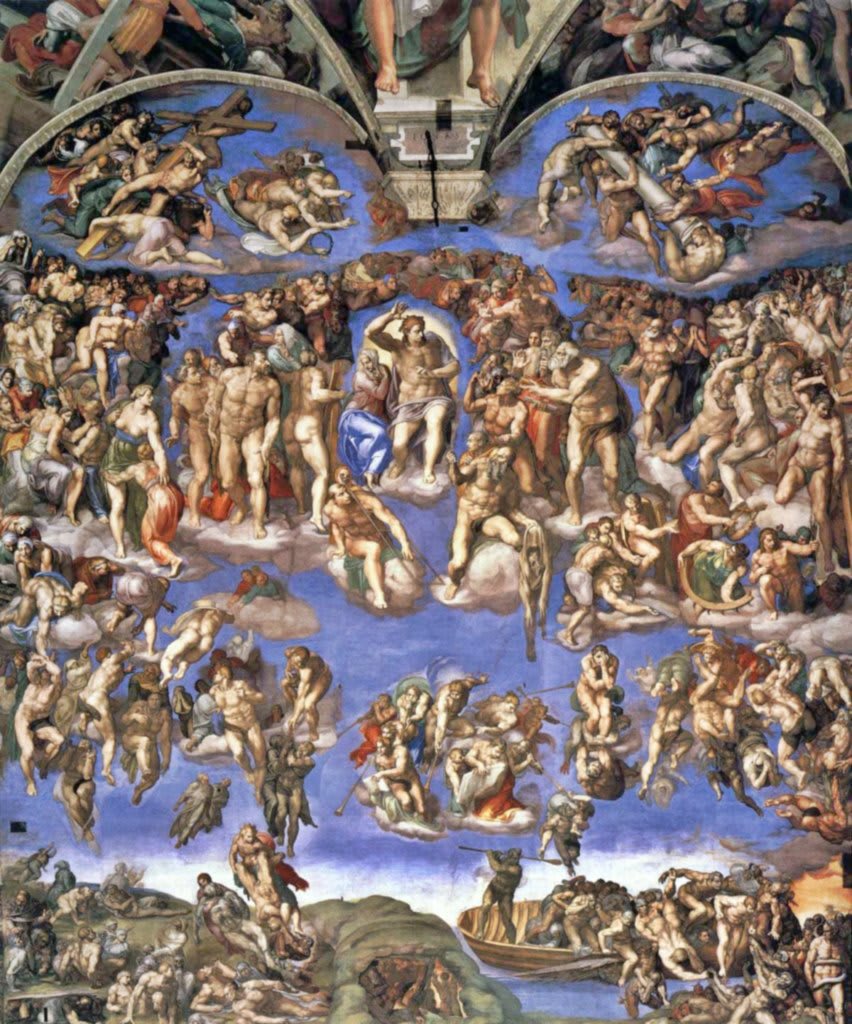
In 1533, 21 years later, the artist was again summoned to work in the Sistine Chapel.
This time, to paint the Final Judgment on the altar wall, which took him five years to complete.
From 1546 until his death, 17 years later, even though he was in great pain throughout his body, he worked on the St. Peter's Basilica as an architect.
Michelangelo Buonarroti died on February 18, 1564, in Rome, at the age of 88.
He always requested to be buried in Florence.
Initially, the artist was buried in the Roman Basilica of the Holy Apostles.
After three weeks, his nephew Leonardo, with the permission of the Pope, and at the order of Duke Cosimo de' Medici, secretly transferred his remains to the Basilica of Santa Croce in Florence, as the artist had wished.
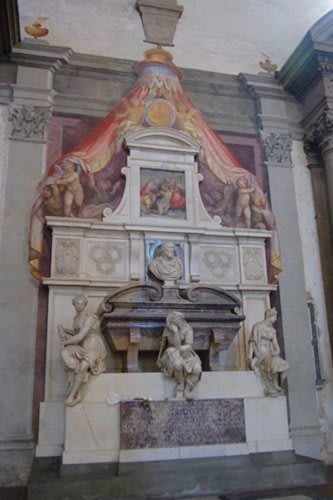
His tomb is a tribute to the artist, featuring references to sculpture, painting, and architecture, the art forms he developed.
It is a monument composed of two equilateral triangles placed on a classical Roman facade, decorated with beautiful frescoes filled with angels who guard the artist's soul and recall the frescoes of the Sistine Chapel, painted by Michelangelo.
It was designed by his friend, architect, and biographer Giorgio Vasari, who was responsible for the entire project, entrusting the execution of the paintings and sculptures to the artist's followers.
THE DOMINANCE OF THE MALE
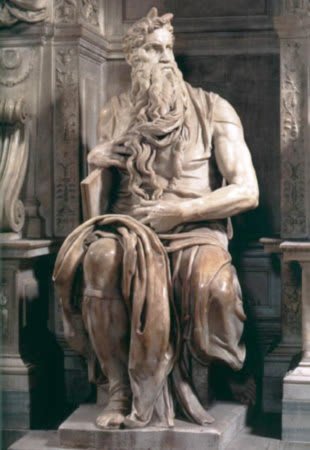
One of the greatest connoisseurs of human anatomy and movement in his time, Michelangelo explored the male body exhaustively, from his first major work, Bacchus, to Moises, when the artist was over 50 years old.
The harmonious and perfect description of the male body is attributed by several historians and biographers to Michelangelo's homosexuality, which he never tried to hide.
Michelangelo's poetry was almost entirely marked by his personal relationships, and his works contain many references to his passion for young men.
About the artist's preference for the male sex, a historian said: "If he had not been homosexual, he would not have been Michelangelo."
In one of his poems, he wrote:
"My eyes, seeking beautiful things,
and my soul, seeking salvation
have no other power to ascend to heaven
except by contemplating all that is beautiful"
See also our analysis of the work "The Creation of Adam"
HUMANISM
Ambition. This is the exact word to define Michelangelo's work. The strong features, stemming from the artist's turbulent nature, reflected his own personal conflicts.
Not surprisingly, his paintings were extremely worked, often carrying a certain tone of cruelty and pessimism.
The figures he conceived embodied a broad sense of tragedy, a characteristic that was distinctly his.
Humanism dominated Michelangelo's work.
Even if they served as a background for another idea, themes like rocks, trees, and flowers were despised by him.
The result was the incredible sense of reality in his figures.
Upon observing some of his works for a few minutes, one gets the impression that they are alive, full of emotion.
Michelangelo Buonarroti: WORKS CITED