
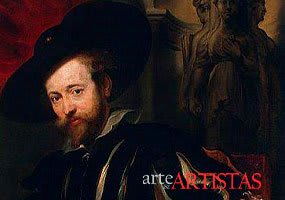
Peter Paul Rubens
Peter Paul Rubens was one of the leading Flemish painters of the 17th century.
Article Index
Peter Paul Rubens was one of the leading Flemish painters of the 17th century.
He is considered one of the most influential artists of the Baroque style and one of the most important painters in the history of art.
Rubens was born on June 28, 1577, in Siegen, in the region of Westphalia, northern Germany, but grew up and developed his career mainly in Antwerp, Belgium.
He came from a wealthy family and had a humanist education.
From his childhood, he showed a talent for art and received a rigorous artistic training.
In 1598, he traveled to Italy, where he studied the works of the great masters of the Renaissance, such as Michelangelo, Raphael Sanzio, and Titian.
This period in Italy was fundamental to his artistic development and allowed him to acquire a broad knowledge of techniques and styles.
In 1600, Rubens returned to Antwerp and established himself as a painter.
He soon became one of the most sought-after artists in the city and set up his own studio, where he worked alongside numerous assistants and apprentices.
His style was characterized by a virtuosic technique, the use of color, and the representation of historical, mythological, and religious themes.
In 1609, a year after returning from Italy, Rubens married Isabella Brant, the couple depicted by the artist.
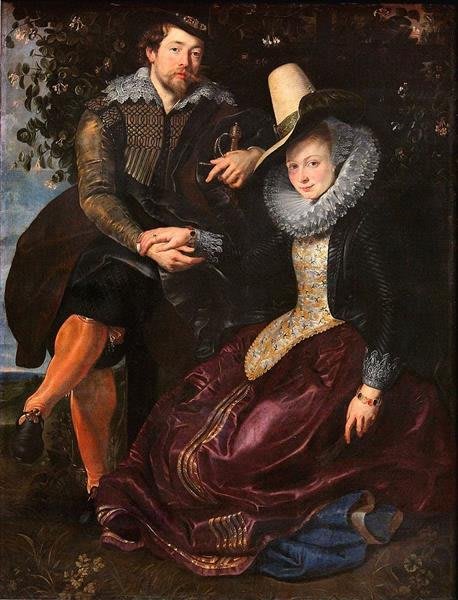
The marriage of Rubens with Isabella lasted from 1609 to 1626.
From this union, two children were born, Albert Rubens and Clara Serena Rubens.
Four years after Isabella's death, Rubens married Helena Fourment and had two more children.
Rubens was a prolific painter and produced a large number of works throughout his career.
His paintings are characterized by exuberance, energy, and dynamism.
His compositions are full of figures in motion, with detailed representation of muscles and facial expressions.
In addition to painting, he was also a skilled draftsman.
In addition to his successful artistic career, Rubens also played an important role as a diplomat.
He was sent on several missions by the rulers of the Netherlands and acted as an intermediary in political and diplomatic negotiations.
His numerous skills and knowledge of art and culture made him a influential figure in the society of his time.
Peter Paul Rubens died on May 30, 1640, in Antwerp, leaving a lasting artistic legacy.
His works continue to be admired for their technical mastery, use of color, and ability to capture emotion and drama.
His influence spread throughout Europe and left a definitive mark on the history of art.
GALLERY - COMMENTED ART
Rubens' paintings are characterized by exuberance, energy, and dynamism.
His compositions are full of figures in motion, with detailed representation of muscles and facial expressions, existing in the Baroque style that is peculiar to him.
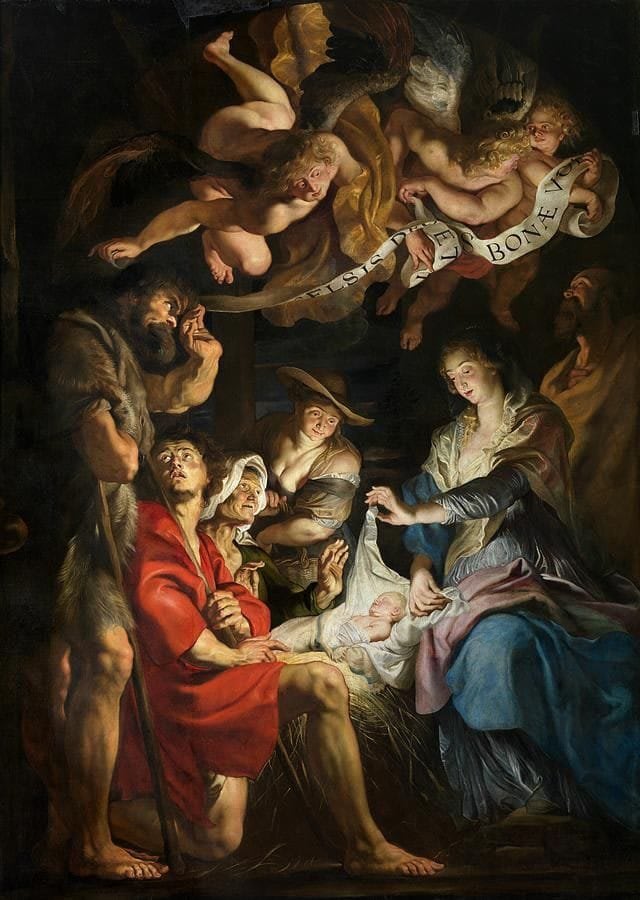
Rubens combined the mastery of Flemish realism with the traditions of Italian Renaissance to produce a powerful and exuberant style that synthesized the immensely popular Baroque movement, promoted by the Counter-Reformation in efforts to restore the greatness of the Catholic Church.
This style emphasized movement, color, drama, and sensuality and revitalized painting with a new desire for life after a relatively conservative period for art.
The characteristic style of Rubens in portraying the female figure was coined as 'Rubenesque', a term that remains widely recognized today to describe voluptuous nudes.
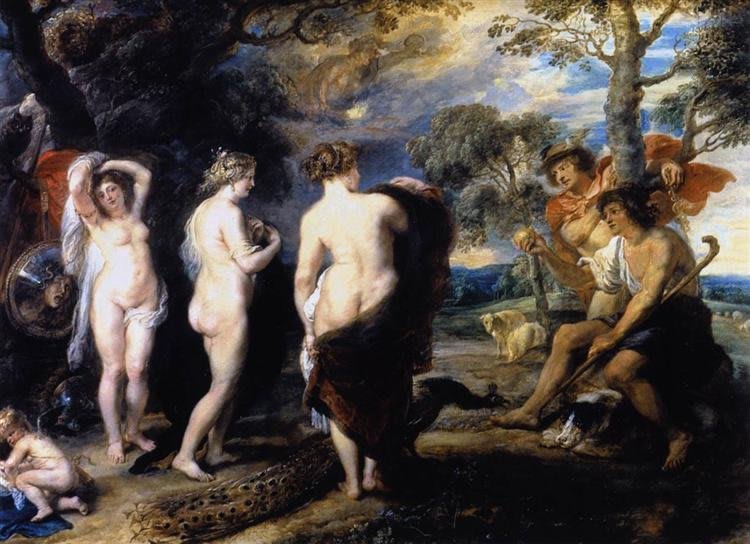
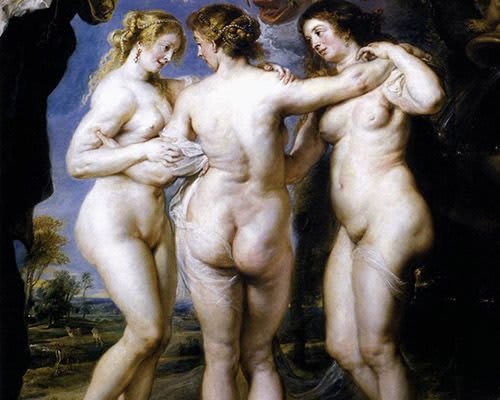
Rubens painted this trio several times since 1620, but here he employs the classical techniques of ancient Greece.
Most likely, his second wife, Helena Fourment, posed for him to highlight her sensual beauty, but the poses were based on classical Greek sculpture.
Rubens' mastery in painting skin tones is also evident in this trio.
He used the three primary colors yellow, red, and blue, which make up the appearance of everything in the world.
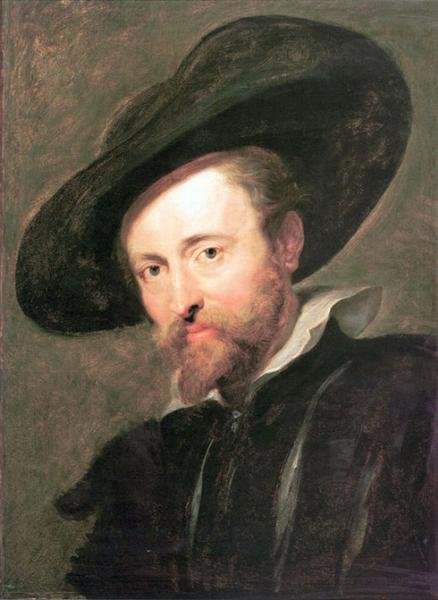
In this self-portrait, Rubens looks at the viewer amicably, directing his gaze directly at him.
In this case, with a thoughtful, inquiring, and at the same time gentle look.
For the attire, he chose a black doublet with slits where the light-colored shirt is visible.
The wide-brimmed hat is his only accessory.
The unfinished view in the background contributes to the quality of the informal painting.
Compared to his contemporary Rembrandt, Rubens made few self-portraits (only four, while Rembrandt about forty).
Rubens always poses with dignity and self-confidence, like a gentleman.
His self-portraits are essential to understanding his personality, after all, with this, the painter shows how he saw himself and how he also wanted to be seen by the viewer.
They served as business cards and were the definitive form of his self-promotion.
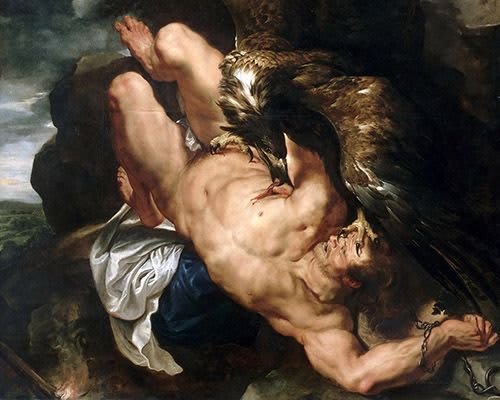
Rubens considered this work one of his most important.
They represent the absolute peak of the artist when he achieved total technical mastery in the execution of his work.
This is a classical mythological painting in which he represents the semi-god Prometheus who is being punished by Zeus for having given the secret of fire to man.
He is permanently chained to a rock on Mount Caucasus while the fierce eagle of Jupiter, a symbol of Zeus, feeds on his liver every day.


