
Pietà - Michelangelo
Pietà - Michelangelo
Article Index
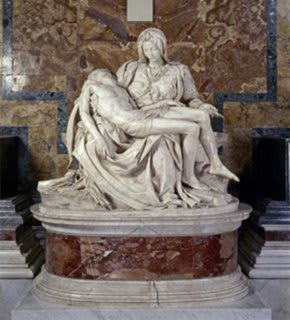
This is the first version of the Pietà created by Michelangelo Buonarroti, known as the Pietà Vaticana for being located inside St. Peter's Basilica in the Vatican.
Documents show that on November 19, 1497, Jean Bilheres de Lagraulas, a French cardinal, arranged for Michelangelo to receive a block of marble from the quarries of Carrara to commission a Pietà for his tomb. It was one of the first Pietàs to be carved. The theme - Christ dead in the lap of his mother - was commonly represented in paintings in Italy, but as a sculpture, it was more commonly found in Germany and France.
Michelangelo completed the sculpture in just one year, but the cardinal died in August 1499. It was intended for the Chapel of St. Petronilla, where the cardinal was buried. After about twenty years, the sculpture was transferred to St. Peter's Basilica and remained there for a while, then moved to its current location, located in the first chapel to the right of the Basilica. It is protected in a bulletproof glass case since it was attacked in 1972 (marble sculpture - 174 x 195)
READING THE WORK:
Probably, the idea originated in Germany in the 14th century, as a parallel to the Madonna holding the baby Jesus in her lap. One of the great problems of this composition is that the image of Christ must be at least the same size as the Virgin, if the proportions are realistic. This causes difficulties in representing convincingly the Virgin supporting Christ.
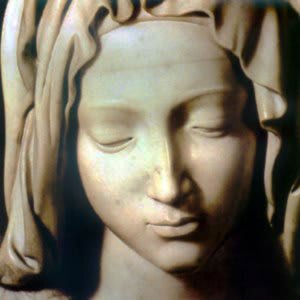
Michelangelo's genius allows him to create a realistic composition, without the observer being startled by the proportion between the size of the Virgin's figure and that of Christ. In fact, Michelangelo skillfully disguised the shape of the Virgin in voluminous clothing that conceals the fact that her lap is too wide and she would be much taller than her son if she were standing. None of this matters. The observer is immediately drawn into the pain evoked by the work. The Virgin's bent head, partially covered by a mantle, and her extended arm with her palm open become incredibly expressive as she holds her dead son in her lap.
Some critics pointed out that the Virgin's face was carved in a way that makes her too young to be Christ's mother. Michelangelo argued that the Virgin was so pure that she did not age. Like all of Michelangelo's works, and following a trend of the High Renaissance, this sculpture personified the idealized human form.
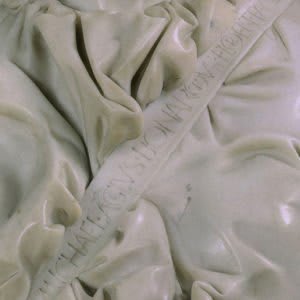
This is the only signed work by him. On the strip that passes through the Virgin's mantle, it is possible to read: MICHEA[N]GELVS BONAROTVS FLORENT[INVS] FACIEBAT, which means: the Florentine Michelangelo Buonarroti who made it. It is said that the signature was made in haste by Michelangelo, because he heard two men attribute his work to another artist. For this reason, the sculptor left his signature, which justifies the error in writing due to his anger and fury in leaving his mark.
The sculpture forms a pyramidal composition, accentuated by the Virgin Mary's clothing: a vertical line represented by her height and a curve made by Christ's body. The Pietà, even with the dead son, does not seem desperate, with the left hand open to the observer, as if to say that there is nothing she can do.
PIETÀ RONDANINI
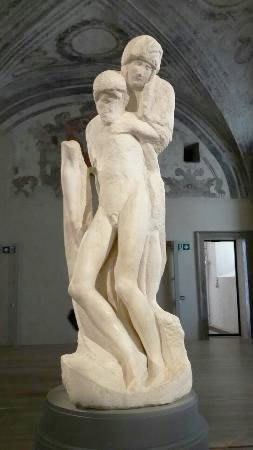
The Pietà Rondanini was Michelangelo's last work, one of the most emotional works created by the sculptor, at the time over 80 years old.
The work is a reworking of an idea that began in 1552: the outline of Jesus' legs, the right arm removed from the body, and the outline of a face of another person. In 1555, Michelangelo radically modified the project: the figures assumed a long, curved shape, joining in a touching way.
The first mention of the work was made by one of Michelangelo's students in 1564, the year of the artist's death, in two letters, one addressed to Giorgio Vasari and the other to his nephew, Leonardo Buonarroti: initiated with a Christ and another figure on top, joined, sketched, and not finished.
In the sculpture, Michelangelo renounces the perfection of the body and the heroic beauty, transforming the dead Christ into an emblem of suffering. The position of Mary and Jesus' bodies at different heights seems to suggest the entanglement of various events in Christ's life: the deposition of the cross, the burial, and the resurrection, dissolved in a maternal embrace. The Pietà, meditation on death and salvation of the soul, is a testament to the last years of the Renaissance genius.


