
The School of Athens, Raphael: Diogenes, Euclid and Hidden Portraits of the Masters (Part 3)
A School of Athens, Raphael: Diogenes, Euclid and Hidden Portraits of the Masters (Part 3)
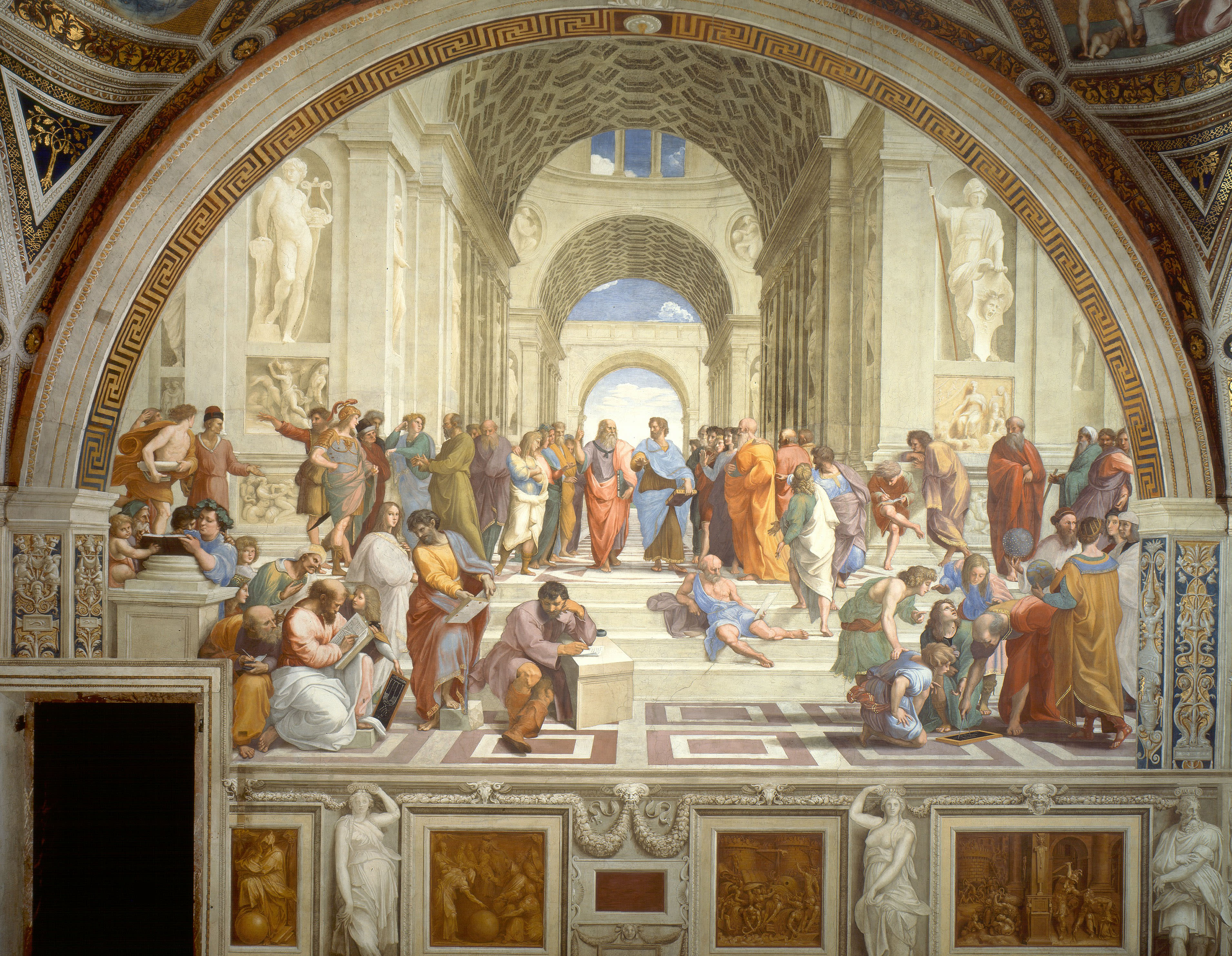
In the center, more to the right, we find Diogenes sitting on the stairs Diogenes, who is solitary and thoughtful. Raphael portrayed him with few clothes, to remind that he had as a philosophy of life, the poverty that was his greatest virtue. In Athens, he lived like a poor beggar, he was self-sufficient even so. He wanted a life that did not depend on the luxuries of the civilized world of ancient Greece.
On the right, we find the disciples of Aristotle. Below him, the mathematician Euclid, explaining the laws of geometry to a group of disciples with a compass drawing on a chalkboard placed on the floor. Next to him, the astronomer Zoroaster and the geographer Ptolemy who lead a discussion, both holding a globe, showing respectively the Earth and the sky. Leaning, next to the pillar dressed in white, possibly be Protogenes, a painter of ancient Greece. Rafael did not fail to highlight, in the same plane of Aristotle, Plotinus, who is represented in red; he is an old man isolated who observes silently the entire school. He is considered one of the oldest thinkers of ancient Greece.
The School of Athens continues to conduct discussions and analyses among historians and art scholars. There is insufficient information to validate whether Raphael received specific instructions from Pope Julius II on the components of the fresco, how much philosophical knowledge he had or how much he may have been influenced by his contemporaries. Regardless of the context or direction brought in this work, The School of Athens shows the depth of Raphael's artistic talent, including the ability to integrate four different frescoes into a related theme. If the fresco is considered an artistic representation of philosophy or a deeper meaning, it is associated with the various gestures and details, The School of Athens continues to provide a beautiful view of the art of the Renaissance.
CURIOSITIES
Self-portrait
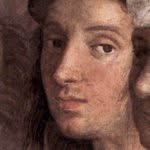
In homage to the great masters of his time, Raphael personified some figures. He also self-portrayed in the midst of this crowd of historical figures so important. He is on the right edge of the fresco in the middle of a discussion between Zoroaster and Ptolemy, looking out of the painting towards the observer, next to the painter Protógenes.
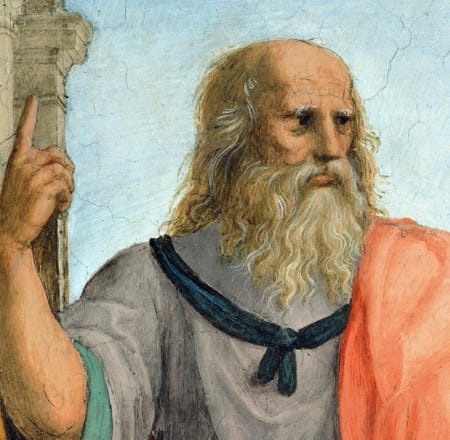
Several figures are based on contemporaries of Raphael. The dignified figure with white hair in the center, who represents the Greek philosopher Plato, was a tribute to Leonardo da Vinci, whom Raphael had a deep admiration for.
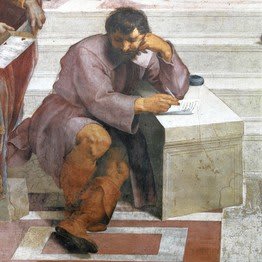
Heracleitus, the thoughtful man in the foreground, is based on Michelangelo. The first part of the ceiling of the Sistine Chapel was completed when Raphael worked on The School of Athens and Raphael paid tribute to his creator.
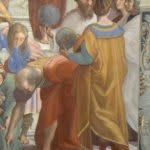
We have Bramante the great architect of the Vatican personified in the figure of Euclid, a figure represented in red. Euclid is considered the Father of geometry and the first to present notions of perspective and other mathematical concepts discussed at the time.


