Egon Schiele: Maturity, Conflicts, and Lasting Expressionist Legacy
Explore the intense life and work of Egon Schiele, from personal challenges and artistic maturity to his impact on expressionism and tragic early death.
Article Index
From 1912 onwards, Schiele lived through the most pivotal moments, both personally and artistically.
In addition to participating in various group exhibitions, he was invited by the Hans Goltz Gallery in Munich to showcase his work alongside members of the expressionist group Der Blaue Reiter (The Blue Rider), which included Wassily Kandinsky, Francis Marc, and Alexej von Jawlensky.
During this period, while residing in Neulengbach, Schiele was arrested in his studio and imprisoned for 24 days, accused of kidnapping and molesting a 12-year-old girl, just as he had in Krumau, his studio had become a gathering point for many local children, prompting outrage from the residents.
These charges were eventually dropped, and he was convicted of exposing children to erotic images.
Most of his works were confiscated by the local police as 'degenerate' and, in a symbolic gesture, the judge burned one of his drawings in court.
But the story has a bizarre twist:
The incident had a profound impact on the artist, and he soon ceased using children as models, although the morbidity and explicitness of his work, particularly in his drawings, increased after his release from prison.
As the First World War approached, his career flourished when he returned to Vienna.
In 1913, he held his first solo exhibition in Munich, and in 1914, another in Paris.
His personal life also took a turn, when in 1915, he wrote to a friend: 'I intend to marry, with advantage,' and proposed to Edith Harms, a young woman of good social standing.
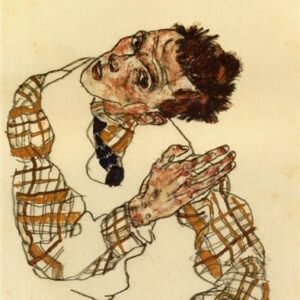
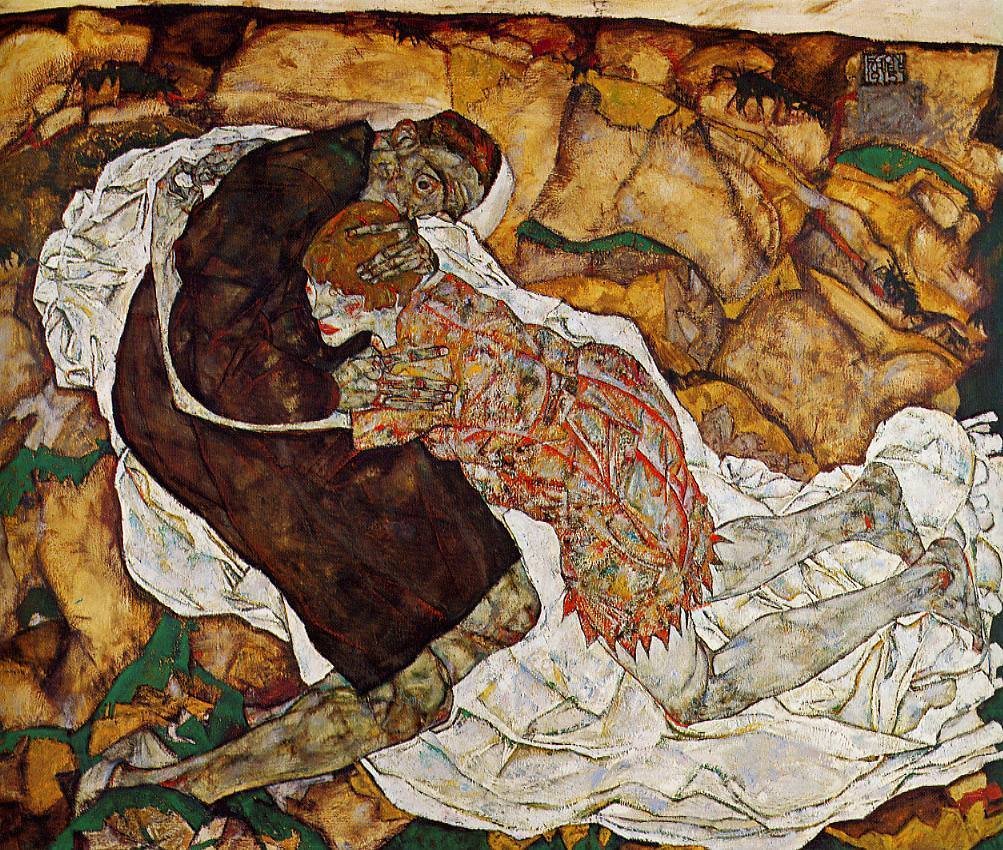
Although he expected to continue his relationship with Wally Neuzil, she left him after hearing the news of his engagement, a loss powerfully expressed in Death and the Lady, of 1915
After spending four days following his wedding, Schiele was conscripted into the military.
However, he never saw any real combat during the war and, instead, was allowed to continue producing and exhibiting.
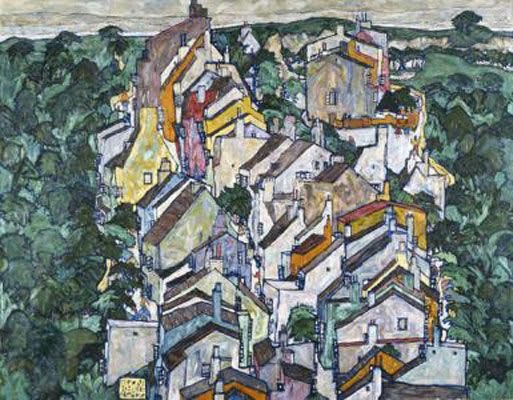
Inspired by his wartime travels, Schiele produced a series of landscapes and urban scenes from this period, devoid of the exaggerated contours typical of the artist.
In 1917, Schiele was back in Vienna and working tirelessly.
That same year, he and Klimt founded a new exhibition space designed to encourage Austrian artists to remain in their homeland.
During 1918, several tragedies occurred.
In February, a stroke and pneumonia took the life of his mentor and friend, Gustav Klimt.
In October, his wife, Edith, six months pregnant, died of the Spanish flu, which had swept through much of Europe at the time.
Supported by a text from Wassily Kandinsky, Schiele was convicted of producing 'degenerate' works. Der Blaue Reiter was an artistic movement that greatly influenced Schiele's work.
After three days of his wife's death, Schiele died at the age of 28 on October 31, 1918, with the same illness that had taken his wife's life.
LEGACY
Schiele's style influenced his contemporaries, such as Oskar Kokoschka, as well as the neo-expressionists Francis Bacon, Julian Schnabel and Jean-Michel Basquiat.
Despite his short life, the artist produced an impressive number of works, featuring numerous self-portraits, suggesting a preoccupation with the self.
He was instrumental in shaping the character of early 20th-century expressionism.
Paintings cited - Art commentary
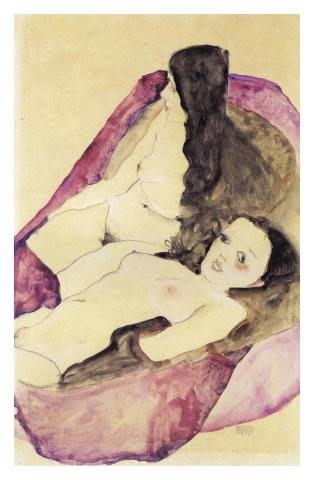
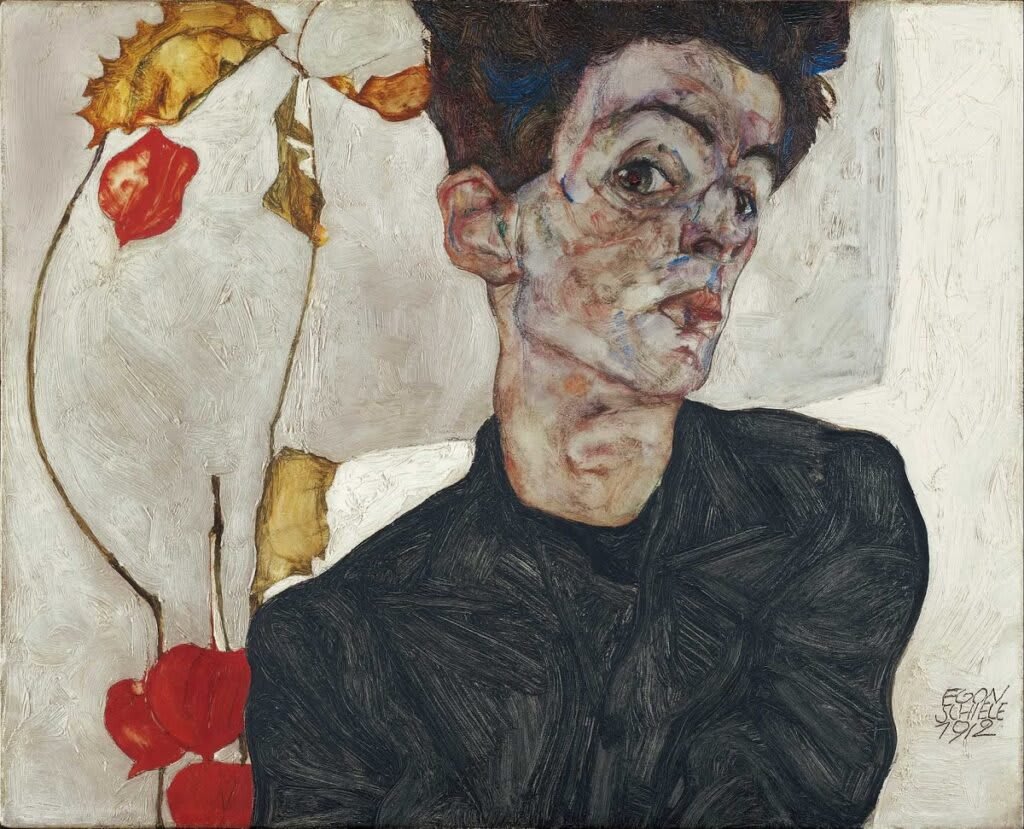
Self-Portrait with Chinese Lantern - his most famous self-portrait, part of a study where he represents himself with a face full of lines, scars, and subtle deformities.
Created during a period when he participated in numerous exhibitions, the artist looks directly at the viewer, his expression suggesting confidence in his artistic abilities.
Death and the Lady - a painting created during the time the artist separated from his long-time lover, Wally Neuzil, a few months before marrying Edith Harms.
The painting marks the end of a relationship, conveying a separation as the death of true love.
Interestingly, the way Schiele's figures are almost consumed by their clothes and abstract environments suggests the influence of Klimt.
The Old City III - A painting likely inspired by his mother's hometown, Krumau, where he briefly lived in 1911.
Schiele's few landscapes are seemingly devoid of people, presenting a wide range of colors, unlike his portraits and self-portraits.
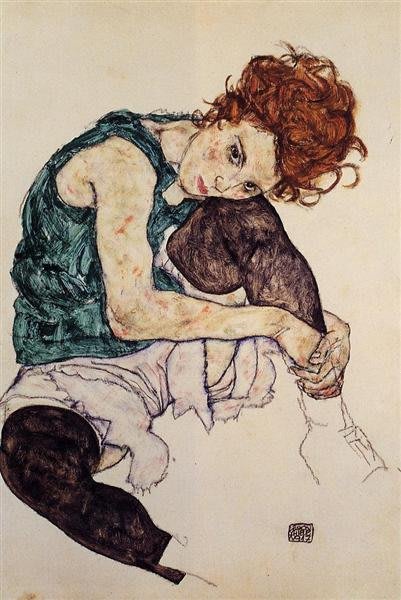
This is one of his last paintings...