
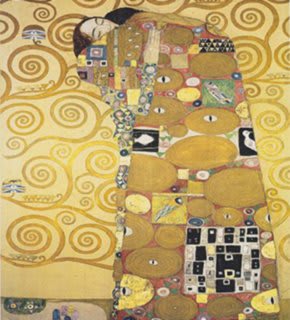
The Stoclet Frieze - The Embrace, by Gustav Klimt
Explore the Stoclet Frieze, a series of frescoes created by Gustav Klimt for the residence of industrialist Adolphe Stoclet in Brussels.
I invite you to contemplate the Stoclet Frieze, a series of frescoes created by Gustav Klimt for the residence of industrialist Adolphe Stoclet in Brussels.
One of the most well-known parts of this frieze is "The Embrace," which depicts a couple embracing in a golden and ornate background, characteristic of Klimt's style.
Created between 1905 and 1911, this work is considered one of the masterpieces of symbolism and Viennese modernism, standing out for its complex symbolism and aesthetic beauty.
Upon observing "The Embrace" and the Stoclet Frieze as a whole, you will be taken on a journey through the world of symbols, colors, and forms, in a unique visual and emotional experience provided by Klimt's art.
The Stoclet Frieze - 1904-1909 - Mixed technique (197 x 91cm) - Österreichische Museum für Angewandte Kunst, Vienna (Austria)
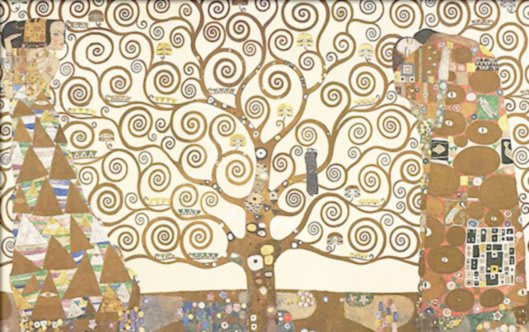
Without any trace of decorativism, this panel is a unique piece in Klimt's work.
Conceived with a strictly decorative purpose, it was, however, a source of inspiration for the abstract art of painter Theo van Doesburg (1883-1931).
In 1904, architect Josef Hoffmann received a commission from Adolphe Stoclet, a young Belgian magnate, to build a massive villa in the style of art nouveau in Brussels.
Hoffmann entrusted Klimt with the decoration of the dining room with large mosaics, which received the name of The Stoclet Frieze.
The two main panels repeat the same background: the representation of the tree of life, which, taking Japanese prints as a model, branches out into numerous spirals.
Two figures establish the differences. In the left panel, known as The Expectation, Klimt painted a dancer; in the right one, The Embrace, a man and a woman embracing appear.
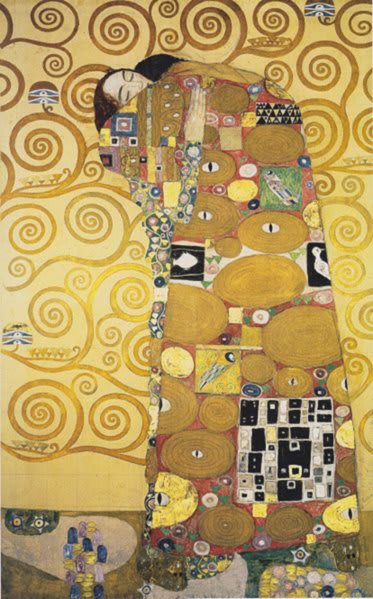
At the far right of the panel, above the dense and geometric spiral ramification of the Tree of Life, Klimt disposed in the form of a triangle, this couple that fuses in a tight embrace.
In The Embrace, we find a man with his back to us, dressed in a long robe that covers him from the back of his head to his feet.
Like the Japanese kimonos that the painter collected, the red and white tunic, decorated with concentric ellipses - some in the shape of a cat's eye - squares and rectangles of different sizes, inverted triangles, arabesques, and various colorful bird and fish motifs.
At the bottom, Klimt reproduced a large square filled with other black, gray, and gold rectangles - a homage to the sumptuous style of Hoffmann, who designed the interior of the Stoclet Palace, with white marble, black granite, and gold details.
Although the woman is almost engulfed by the representation of the man who leans on her shoulder, her figure guarantees the only figurative elements of the project: the face and the hands that envelop the man.
To distinguish the characters, Klimt drew a sinuous contour of the woman's dress against the straight profile of the man's clothing.
The Embrace addresses a recurring theme in Klimt's production: the embrace between man and woman: The motif appeared for the first time in Love (1895) and was repeated in Philosophy (1899-1907) and The Beethoven Frieze (1904).
The peak occurred in The Kiss (1907-08).


